
Traveling to the UK with your dog requires careful planning and strict adherence to documentation requirements.
The good news: if you follow the rules precisely, there’s no mandatory quarantine. The reality: one missing signature or a microchip implanted after vaccination can send your dog to a quarantine facility costing thousands of pounds.
Most dog owners need a minimum four-month timeline from start to travel, and costs typically range from £500 to £2,000 ($650-$2,600 USD) depending on your origin country. This guide covers exactly what border control checks, what triggers quarantine, and the real costs beyond government fees.
UK Dog Import: Key Facts
£500-£2,000 ($650-$2,600 USD)
Minimum 4 months from start to travel
Moderate (Complex for non-listed countries)
No (if fully compliant)
UK Dog Import Requirements: The Non-Negotiables
The UK operates under the Pet Travel Scheme (PETS), administered by the Animal and Plant Health Agency (APHA), part of the Department for Environment, Food & Rural Affairs (Defra).

Unlike some countries that require import permits for all pets, the UK doesn’t require a permit if your dog meets all PETS criteria. However, fail any single requirement and your dog faces quarantine at your expense or immediate return to the origin country.
Core UK Dog Import Requirements
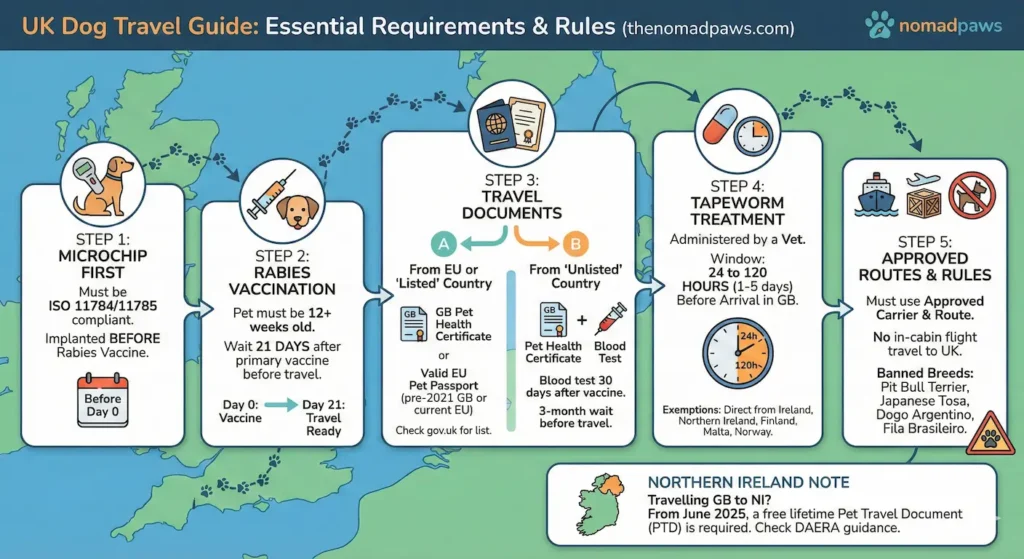
- ISO-compliant microchip (11784/11785 standard) implanted before or on the same day as rabies vaccination
- Valid rabies vaccination administered at least 21 days before travel (dog must be minimum 12 weeks old for vaccination)
- Appropriate travel document: EU pet passport (if issued before Brexit and dog never left EU) or official health certificate from an approved veterinarian
- Tapeworm treatment (praziquantel) administered by a vet 24-120 hours before arrival (not required from Finland, Northern Ireland, Ireland, or Malta)
- Entry through an approved route and Border Control Post
- Declaration that the move is non-commercial (typically fewer than 5 pets)
The APHA doesn’t charge for processing compliant pets, but you’ll pay substantial fees for veterinary certificates, treatments, and airline transport. Contact APHA through their online form at gov.uk/contact-apha or helpline 03000 200 301 if you have specific questions about your situation.
Pet Passport vs Health Certificate: Which You Need
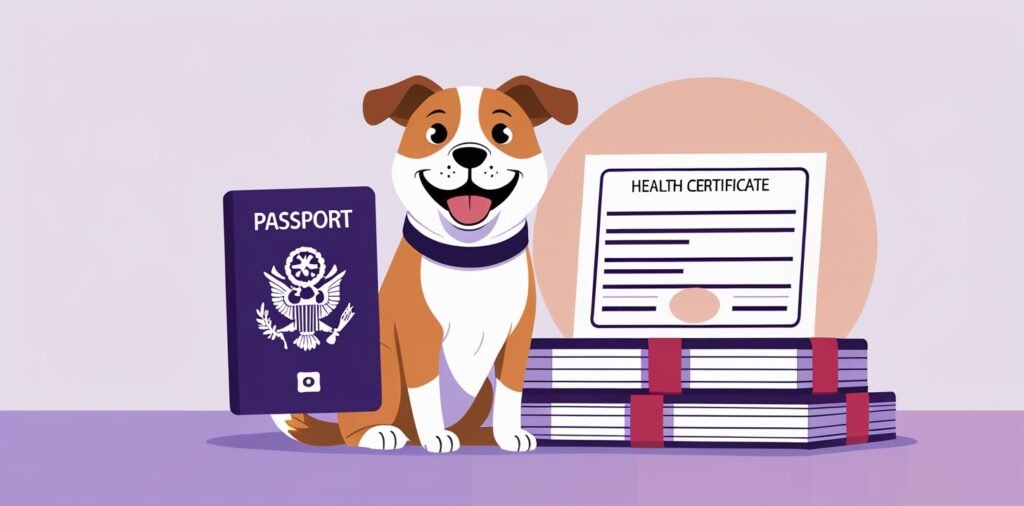
Post-Brexit confusion causes the most problems here. If your dog has an EU pet passport issued before the UK left the EU and has remained within EU countries, that passport remains valid for UK entry.
If you’re traveling from outside the EU, or if your dog’s EU passport was issued after Brexit, you need an official health certificate instead.
For dogs coming from non-EU countries (including the United States, Canada, Australia, and most of Asia), you must obtain a Great Britain Pet Health Certificate or Animal Health Certificate (AHC) from an Official Veterinarian (OV) in your origin country.
This certificate must be completed within 10 days of travel for some countries, though timing varies by origin. The OV will scan your dog’s microchip, verify vaccination records match the chip number, and complete the official documentation.
The certificate isn’t just a formality. UK border officials will scan your dog’s microchip and cross-reference every detail. If the microchip number on the certificate doesn’t match the chip in your dog, or if vaccination dates don’t align properly, your dog goes to quarantine immediately. There’s no grace period for “close enough.”
Dogs from non-listed (high-risk rabies) countries face additional requirements, including a rabies neutralizing antibody titer test (RNATT) performed at least 30 days after vaccination and at least three months before travel. Check the official gov.uk list to determine if your origin country is considered listed or non-listed.
Vaccination Timeline: Why 21 Days Matters

The rabies vaccination timing is where most people underestimate the planning required. Your dog must be at least 12 weeks old to receive the rabies vaccine.
After vaccination, you must wait a minimum of 21 days before travel. This means the absolute earliest a puppy can enter the UK is approximately 15 weeks old (12 weeks for vaccination plus 21-day wait).
Here’s the critical detail that trips people up: the microchip must be implanted before or on the same day as the rabies vaccination. If your dog was vaccinated against rabies before being microchipped, that vaccination doesn’t count. You’ll need to re-vaccinate after microchipping and wait another 21 days.
For rabies boosters, the rules are more forgiving. If your dog’s booster is administered before the previous vaccination expires (according to the vaccine manufacturer’s specifications, typically 1-3 years), there’s no additional waiting period. Your dog can travel immediately after a timely booster. However, if the booster is late and the previous vaccination has expired, you’re back to the 21-day wait.
Beyond rabies, the UK doesn’t mandate other vaccinations for import, though core vaccines like DHPPi (distemper, hepatitis, parvovirus, parainfluenza, leptospirosis) are strongly recommended. Many UK boarding facilities, doggy daycares, and some rental properties require proof of these vaccines.
The Real Cost of UK Dog Travel
Budget guides often cite government fees and miss the substantial costs that actually drain your wallet. The UK doesn’t charge an import permit fee for compliant pets, but that £0 government charge is misleading.
| Item | Cost (GBP) | Cost (USD) |
|---|---|---|
| Veterinary Preparation (Origin Country) | ||
| Microchip implantation | £10-£30 | $13-$39 |
| Rabies vaccination | £40-£70 | $52-$91 |
| Official health certificate (AHC) and OV examination | £100-£350 | $130-$455 |
| Tapeworm treatment | £20 | $26 |
| Government endorsement of health certificate (if required) | £30-£100 | $39-$130 |
| Additional vet visits for health checks | £50-£100 | $65-$130 |
| Transport Costs | ||
| Airline pet fee (cargo) | £200-£800 | $260-$1,040 |
| IATA-compliant travel crate | £80-£300 | $104-$390 |
| Pet taxi to/from airport (each way) | £50-£150 | $65-$195 |
| UK Arrival Costs | ||
| Border Control Post inspection (if applicable) | £20-£100 | $26-$130 |
| First 24 hours at Animal Reception Centre | Free | Free |
| Daily rate after first 24 hours | £52/day | $68/day |
| Potential Quarantine Costs (If Non-Compliant) | ||
| Quarantine facility booking deposit | £1,000+ | $1,300+ |
| Full 4-month quarantine (total) | £6,000-£10,000+ | $7,800-$13,000+ |
Government Fees vs Hidden Costs
The APHA doesn’t charge processing fees for pets entering under PETS, which sounds great until you realize where the real money goes.
The single biggest variable cost is the Official Veterinarian certificate. In the United States, for example, USDA-accredited veterinarians charge anywhere from $150 to $400 for completing the health certificate, depending on location and complexity. This isn’t price gouging; it’s a specialized service requiring specific training and liability.
The OV must verify every detail, and any mistake can result in your dog being quarantined at UK arrival.
Travel crate costs catch many people off guard. Airlines require IATA-compliant crates with specific ventilation, door mechanisms, and size requirements. You can’t just use any pet carrier.
A crate for a medium-sized dog (like a Border Collie) costs £150-£250 ($195-$325 USD), while large breed crates (Great Dane, German Shepherd) run £250-£400 ($325-$520 USD). Some airlines rent crates, but availability is limited and rental fees add up.
Pet travel insurance is optional but worth considering. Policies covering trip cancellation, emergency veterinary care during travel, and quarantine costs run £50-£200 ($65-$260 USD) depending on coverage limits and dog value.
Given that a single documentation error can trigger £6,000+ in quarantine fees, insurance provides meaningful protection.
UK Quarantine Rules: When It Happens and Why

The UK abolished routine quarantine for compliant pets decades ago, but quarantine absolutely still happens. It’s not a relic of the past; it’s an active enforcement mechanism for non-compliance.
What Triggers Quarantine
- Microchip doesn’t meet ISO 11784/11785 standards and you don’t have a compatible reader
- Microchip number on health certificate doesn’t match the chip implanted in your dog
- Rabies vaccination was administered before microchip implantation
- Fewer than 21 days have passed since rabies vaccination (or re-vaccination after lapsed booster)
- Health certificate is incomplete, expired, or not properly endorsed
- Tapeworm treatment wasn’t administered within the 24-120 hour window (or documentation is missing)
- You arrive at a non-approved port or through a non-approved carrier
- Your dog shows signs of illness or rabies symptoms
- You’re traveling from a non-listed country without the required blood titer test
- You’re bringing more than 5 pets without proper commercial documentation
Quarantine isn’t negotiable. If border officials identify non-compliance, your dog is immediately transported to an approved quarantine facility. You have two options: pay for quarantine (up to 4 months at £52/day plus initial fees) or return your dog to the origin country on the next available flight at your expense.
The primary quarantine facility for Heathrow arrivals is the Heathrow Animal Reception Centre (HARC), operated by the City of London Corporation at Heathrow Airport. Other approved facilities include Airpets (near Heathrow) and Pets on Jets (Manchester area). These aren’t shelters; they’re specialized veterinary quarantine facilities with strict biosecurity protocols.
Quarantine duration depends on the issue. Minor documentation problems might be resolved in days if you can obtain corrected paperwork.
Dogs from non-listed countries without proper titer tests face the full 4-month quarantine. During quarantine, you cannot visit your dog except in rare circumstances approved by APHA.
Approved Routes and Carriers
You cannot bring your dog to the UK through just any airport or on any airline. The UK maintains a specific list of approved routes and Border Control Posts for pet entry.
Approved Airports with Animal Reception Centres
- London Heathrow (HARC facility, most common entry point)
- London Gatwick (Animal Aircare Centre)
- Manchester Airport (Pets on Jets facility)
- Edinburgh Airport
- Glasgow Airport
- Newcastle Airport (ARC facility)
The full list of approved air, sea, rail, and charter routes is published on gov.uk and updated regularly. Using a non-approved route automatically triggers quarantine, even if all other documentation is perfect.
For sea travel, approved routes include Dover, Portsmouth, and specific ferry services like Eurotunnel (formerly Channel Tunnel). If you’re driving from Europe, you must use Eurotunnel or an approved ferry.
Airline approval is separate from route approval. British Airways operates pet transport through Heathrow and Gatwick but only in cargo hold, not cabin.
Most major international carriers (Lufthansa, KLM, Air France) accept pets on UK routes, but you must notify them in advance and confirm they’re using an approved entry point. Budget airlines like Ryanair and EasyJet generally don’t accept pets except certified assistance dogs.
Charter pet transport services like Pet Air UK and Airpets International specialize in UK pet relocation and handle all documentation, transport, and customs clearance.
Costs run £800-£2,500 ($1,040-$3,250 USD) depending on origin and dog size, but they significantly reduce the risk of documentation errors. For high-value dogs or complex situations, the premium is often worth it.
Documentation Checklist: What Border Control Actually Checks
Understanding the actual border inspection process helps you prepare the right documents in the right format. When your dog arrives at a UK Border Control Post, here’s exactly what happens:
- Step 1: Initial presentation. You (or your pet transport service) present your dog and all documentation to border officials. For cargo pets, this happens at the Animal Reception Centre before you can collect your dog.
- Step 2: Microchip scan. Officials use an ISO-compliant scanner to read your dog’s microchip. They verify the number matches exactly what’s printed on your health certificate or pet passport. If the chip can’t be read or doesn’t match, the process stops immediately.
- Step 3: Document verification. Officials examine your health certificate or pet passport for completeness, validity dates, rabies vaccination date and confirmation of 21+ day waiting period, tapeworm treatment date and confirmation of 24-120 hour window, Official Veterinarian credentials and endorsements, and microchip implantation date relative to vaccination date.
- Step 4: Physical inspection. A veterinary officer conducts a brief health check, looking for signs of illness, injury, or symptoms of rabies or other diseases. This isn’t a comprehensive exam, but obvious health issues can trigger additional quarantine or veterinary holds.
- Step 5: Declaration verification. You must declare that this is a non-commercial movement (typically defined as fewer than 5 pets). If you’re bringing multiple dogs, be prepared to explain why and potentially provide additional documentation.
- Step 6: Release or quarantine decision. If everything checks out, your dog is released to you after the inspection, usually within a few hours. The first 24 hours at the Animal Reception Centre are free. If there are any issues, officials explain the quarantine requirement and next steps.
Required Documents at the Border
- Original health certificate or EU pet passport (photocopies not accepted)
- Proof of rabies vaccination (usually included in health certificate, but bring original vet records as backup)
- Proof of microchip implantation (again, usually in health certificate, but original vet records help if there’s any question)
- Proof of tapeworm treatment (vet-signed statement with exact date and time of administration)
- Your own photo ID matching the name on pet documents
- Flight/transport documentation showing approved route
Additional Documents for Non-Listed Countries
- Original rabies antibody titer test results from an EU-approved laboratory
- Any additional country-specific health certificates (e.g., Malaysia requires Nipah virus testing)
Common Application Mistakes That Cause Delays
After speaking with pet transport specialists and reviewing APHA enforcement data, certain documentation errors appear repeatedly:
Microchip timing error: The most common mistake is having rabies vaccination records that predate microchip implantation. This happens when dogs receive routine puppy vaccines (including rabies) before international travel was planned, then get microchipped later. The solution requires re-vaccination after microchipping and another 21-day wait. There are no exceptions to this rule.
Tapeworm treatment timing: The 24-120 hour window is strict. Treatment at 23 hours before arrival is too early. Treatment at 121 hours is too late. The treatment must be administered by a veterinarian (not owner-administered), and the vet must provide written documentation with the exact date and time. “Approximately 3 days before travel” doesn’t cut it; officials need “administered at 14:30 on [specific date].”
Health certificate expiration: Some countries’ health certificates are valid for only 10 days from issuance to UK entry. If your travel is delayed (flight cancellation, missed connection), your certificate can expire mid-journey. Always build in buffer time, and if delays happen, contact your origin vet and APHA immediately to discuss options.
Incomplete signatures: Health certificates require signatures from both the examining Official Veterinarian and often a government endorsing official. Missing either signature, or signatures without official stamps, renders the document invalid. Double-check every signature line before leaving your origin country.
Breed identification errors: If your dog is a mixed breed or resembles a banned breed (Pit Bull, Japanese Tosa, Dogo Argentino, Fila Brasileiro), documentation must clearly state the actual breed. Vague descriptions like “terrier mix” can trigger additional scrutiny if your dog looks like it might have Pit Bull characteristics. Be specific and honest about breed composition.
Commercial vs non-commercial confusion: If you’re adopting a dog from a rescue, breeding a litter, or bringing dogs for any commercial purpose (including eventual sale), you need a Balai declaration and different documentation. Trying to bring commercial dogs under personal pet rules is fraud and results in immediate quarantine and potential prosecution.
Breed-Specific Restrictions and Airline Policies

Beyond UK government regulations, you face breed-specific restrictions from airlines and, later, from UK housing and facilities. These restrictions can be more limiting than government rules.
If your dog resembles a banned breed, border officials can seize and potentially destroy the dog. This is why breed identification on your health certificate must be accurate and specific. If you have a Staffordshire Bull Terrier (legal) that could be mistaken for a Pit Bull (banned), bring breed registration papers, pedigree documentation, and clear photos showing distinguishing features.
Airline Breed and Size Restrictions
Airlines impose their own breed restrictions, typically targeting brachycephalic (flat-faced) breeds prone to respiratory distress during flight.
Commonly Restricted Breeds
- English Bulldogs, French Bulldogs
- Pugs
- Boston Terriers
- Boxers (some airlines)
- Shih Tzus, Pekingese
- Cavalier King Charles Spaniels (some airlines)
British Airways, for example, restricts snub-nosed breeds during summer months (June-September) and bans some breeds year-round in cargo. Lufthansa has similar restrictions. KLM allows small dogs (under 8kg including carrier) in cabin on some routes, which can work for small brachycephalic breeds, but UK-bound flights often don’t permit cabin pets.
Size restrictions vary by airline. Most classify dogs as cabin (under 8kg total including carrier, very limited on UK routes), cargo hold (8-45kg, most common), or freight (over 45kg or oversized crates, requires separate booking).
Large breed owners (Great Danes, Mastiffs, Irish Wolfhounds) often struggle to find airlines willing to transport dogs over 45kg. Specialized pet transport services become almost necessary for these sizes, as they have contracts with freight carriers equipped for oversized animals.
Temperature restrictions also apply. Most airlines won’t transport pets in cargo if ground temperatures at origin, transit, or destination exceed 29°C (85°F) or fall below -12°C (10°F). UK weather rarely hits these extremes, but summer travel from hot climates (Middle East, Southern US) can face embargoes.
Timeline: When to Start the Process

The minimum timeline from “I want to move to the UK with my dog” to actual travel is approximately 4 months for most countries, longer for non-listed countries.
- 4 months before travel: Research your origin country’s classification (listed vs non-listed). Verify your dog’s microchip is ISO-compliant. If microchip is non-compliant or missing, schedule implantation immediately. Review current rabies vaccination status; if expired or never vaccinated, schedule vaccination for at least 21 days before desired travel date. For non-listed countries, schedule rabies titer test for 30+ days after vaccination. Contact airlines to check pet space availability on your target travel dates. Budget for all costs and set aside funds.
- 3 months before travel: Confirm rabies vaccination is complete and 21-day wait period is satisfied (or will be by travel date). For non-listed countries, receive titer test results (must show 0.5 IU/ml or higher). Book airline tickets for yourself and reserve pet space (separate reservations). Purchase or order IATA-compliant travel crate sized appropriately for your dog. Locate an Official Veterinarian in your origin country who can complete UK health certificates. Schedule OV appointment for 1-10 days before travel (depending on certificate validity period).
- 2 months before travel: Confirm approved entry route (airport/port) matches your flight booking. Acclimate your dog to the travel crate (daily practice sessions). Arrange pet transport to/from airports (pet taxi services book up in advance). Research UK housing options if relocating; confirm pet policies and any breed restrictions. Consider pet travel insurance and apply if desired.
- 1 month before travel: Confirm OV appointment and ensure vet has all current vaccination records. Verify microchip is still readable (some chips migrate or fail; better to discover this now). Prepare copies of all documents for your records. If traveling from a country requiring government endorsement, confirm timeline (can take 3-7 business days).
- 1-2 weeks before travel: Attend OV appointment; vet completes health certificate. Submit health certificate for government endorsement if required. Receive endorsed health certificate back. Review certificate for any errors or missing information (fix immediately if found). Confirm flight times and pet check-in procedures with airline.
- 24-120 hours before travel: Take dog to vet for tapeworm treatment (praziquantel). Obtain written documentation of treatment with exact date and time. Withhold food 4-6 hours before flight (water available until 2 hours before). Attach health certificate and all documents to travel crate in waterproof pouch.
- Day of travel: Arrive at airport 3-4 hours before departure for pet check-in (earlier than passenger check-in). Bring all original documents plus copies. Confirm crate is properly labeled with your contact information and “Live Animal” stickers. Attach water bowl to crate door.
- UK arrival: Proceed to Animal Reception Centre or designated pet collection area. Present all documents to border officials. Wait for microchip scan and document verification. If approved, collect your dog (typically 2-4 hours after flight lands). If issues arise, cooperate with officials and contact APHA immediately.
Settling In: Life in the UK with Your Dog
Once you’ve successfully navigated UK entry, new considerations emerge. The UK is generally dog-friendly, but regional differences and practical matters require attention.
Climate adjustment: The UK’s temperate maritime climate is mild compared to many regions, but it’s also damp and unpredictable. Dogs from hot, dry climates (Middle East, California, Australia) often struggle with the constant moisture. Invest in a quality dog coat for winter walks, especially for short-haired breeds. Dogs from cold climates (Canada, Scandinavia) typically adapt easily.
Finding a UK veterinarian: Register with a local vet within the first week of arrival. Bring all your dog’s medical records, including the health certificate used for entry. UK vets are excellent but expensive compared to many countries. Routine checkups run £40-£80, vaccinations £50-£100, and emergency care can easily exceed £1,000. Pet insurance is common in the UK and worth considering. [INTERNAL LINK: dog travel insurance guide]
UK vaccination schedules: The UK follows slightly different vaccination protocols than some countries. Your vet will likely recommend annual boosters for leptospirosis (a significant risk in the UK due to rat populations and waterways) and triennial boosters for core vaccines. Kennel cough (Bordetella) vaccination is mandatory for most boarding facilities and recommended for dogs who’ll attend daycare or training classes.
Housing with dogs: UK rental properties vary widely in pet policies. Many landlords prohibit pets entirely, while others allow them with additional deposit (typically 1-2 months’ rent extra). Some landlords restrict breeds or sizes. Start your housing search early and be upfront about having a dog. Certain breeds (even legal ones like German Shepherds or Rottweilers) face more housing discrimination than others. Expect to provide references from previous landlords and possibly a pet CV showing training and behavior history.
Public transport: Dogs are generally allowed on UK trains, buses, and the London Underground, though policies vary by operator. Most require dogs to be on a lead and well-behaved. Large dogs may need to be muzzled on some services. Assistance dogs have full access rights. Check specific operator policies before travel.
Off-lead exercise: The UK has extensive public footpaths and bridleways where dogs can exercise off-lead, but rules vary by location. Some parks require leads year-round, others only during bird nesting season (March-August). Always check local signage. The Countryside Code requires dogs to be under control around livestock; failure to control a dog that injures sheep can result in the dog being shot by farmers (legally) and criminal charges against the owner.
Dog-friendly establishments: Many UK pubs welcome dogs, as do some cafes and shops. However, dogs are prohibited in most restaurants and all food preparation areas. Some hotels and holiday cottages are dog-friendly, but expect to pay additional fees (£10-£50 per night). Always call ahead to confirm pet policies rather than assuming.
Microchip registration: Once in the UK, update your dog’s microchip registration with your new UK address and contact information. Use a UK-based database like Petlog or the Microchip Central Database. This is legally required and critical if your dog goes missing.