
The Poodle is the breed that proves you can have it all: genius-level intelligence, Olympic-athlete stamina, and a hypoallergenic coat that won’t trigger your allergies.
Ranked #2 in canine intelligence by researcher Stanley Coren, these curly-coated water dogs come in three distinct sizes (Toy, Miniature, Standard) that share the same remarkable trainability and dignified personality.
Whether you’re considering a four-pound Toy or a seventy-pound Standard, you’re looking at a dog that will outsmart you, outlast you on a hike, and require a grooming budget that rivals your own salon expenses.
The Poodle’s reputation as a “fancy” show dog obscures its working heritage: these are German water retrievers bred to work all day in cold lakes, and that drive doesn’t disappear just because they now sleep on your couch.
Originally bred in 15th-century Germany as waterfowl retrievers (the name derives from “pudelin,” meaning to splash in water), Poodles evolved into France’s national breed, favored by nobility for their trainability and showmanship. Today they excel in everything from therapy work to dock diving to retriever hunt tests, proving their versatility extends far beyond the show ring’s elaborate clips.

| Characteristic | Details |
|---|---|
| Size Range | Toy: 4-6 lbs, Miniature: 10-15 lbs, Standard: 45-70 lbs |
| Weight Range | 4-70 pounds depending on variety |
| Lifespan | 12-15 years |
| Energy Level | Moderate to High |
| Shedding | Minimal (hypoallergenic coat) |
| Good with Kids | Yes, especially Standard and Miniature |
| Good with Dogs | Yes with proper socialization |
Poodle Breed Overview
The Poodle holds a unique position in the dog world: it’s the only breed recognized by the AKC with three distinct size varieties sharing a single breed standard.
Standard Poodles (over 15 inches at the shoulder) were the original water retrievers, while Miniatures (10-15 inches) and Toys (under 10 inches) were bred down from their larger cousins to serve as companions for French aristocracy in the 1600s. This wasn’t aesthetic breeding, it was functional: smaller Poodles could hunt truffles and fit in aristocratic laps during carriage rides.
The American Kennel Club classifies all Poodles under the Non-Sporting Group, though the United Kennel Club more accurately places Standards in the Gundog Group and Miniatures and Toys in the Companion Group (a division made in 2000).
The Fédération Cynologique Internationale categorizes them as Group 9, Companion and Toy Dogs. This classification confusion reflects the breed’s versatility: Standard Poodles remain eligible for AKC Retriever Hunting Tests, demonstrating their working heritage isn’t just historical.
Poodles consistently rank in the top seven most popular breeds in the United States, holding the #5 position in 2023 AKC registration data with 45,000+ annual registrations. This popularity has remained remarkably steady since the mid-1950s, unlike trendier breeds that surge and fade. Their intelligence, hypoallergenic coat, and adaptability across three sizes create broad appeal for different living situations.
The breed’s curly, weather-resistant coat originally protected them during waterfowl retrieves in cold German lakes. The elaborate show clips you see today (Continental, English Saddle, Puppy) evolved from functional hunting trims that kept joints and vital organs warm while reducing drag in water. The pompoms on legs and tail originally marked joints for hunters to see their dogs in water. Modern Poodles retain their swimming prowess and retrieving instincts, though most now retrieve tennis balls rather than ducks.
The Poodle’s reputation as a “fancy” show dog obscures its athletic heritage. These are water dogs with serious stamina and drive, bred to work all day in challenging conditions. A Standard Poodle can swim for hours and has the endurance to hike 10+ miles without complaint. That history doesn’t disappear just because they now sleep on your couch.
One significant controversy surrounds merle Poodles, which are not recognized by any major kennel club and result from crossbreeding with herding breeds like Australian Shepherds.
Breeders marketing merle Poodles often falsify pedigrees, and the merle gene carries serious health risks including blindness, deafness, and microphthalmia (abnormally small eyes). The Poodle Club of America explicitly states merle is not a naturally occurring Poodle color. Reputable Poodle breeders universally condemn this practice.
The rise of Doodle hybrids (Labradoodles, Goldendoodles, Bernedoodles) has created another ethical concern. These crosses are often marketed as “healthier” due to hybrid vigor, but without health testing on both parent breeds, they frequently inherit the worst genetic issues from both sides.
A well-bred purebred Poodle from health-tested parents offers more predictable outcomes than a designer hybrid from untested stock selling for $3,000-5,000.
Poodle Temperament and Personality
Poodles are velcro dogs that thrive on human companionship and prefer being involved in every aspect of family life. They’re not the breed that contentedly naps in another room while you work. They want to be where you are, doing what you’re doing, preferably touching you. This attachment makes them wonderful companions but also means they’re prone to separation anxiety if left alone for extended periods without proper conditioning.
The breed’s defining trait is intelligence. Ranked #2 across all breeds in Stanley Coren’s working and obedience intelligence assessment (only Border Collies rank higher), Poodles learn new commands in fewer than five repetitions and obey first commands 95% of the time or better. This makes training remarkably easy for novice owners, but it also means boredom sets in quickly. An understimulated Poodle will create their own entertainment: opening cabinets, unlatching gates, or systematically destroying your couch cushions to see what’s inside.
Poodles carry themselves with a proud, dignified air that the AKC breed standard specifically calls out as “an air of distinction and dignity peculiar to the Poodle alone.” They’re alert and aware of their surroundings, making them excellent watchdogs who will bark to alert you of visitors or unusual activity. However, they’re not aggressive guard dogs. Once they’ve announced the stranger, they typically become friendly and outgoing, especially after proper socialization.
With children, Poodles are generally excellent, though size variety matters significantly. Standard and Miniature Poodles are sturdy enough for active play with kids of all ages and have the patience for typical childhood antics like dress-up games and tea parties. Toy Poodles, at just four to six pounds, are fragile and better suited to families with older children (8+ years) who understand gentle handling. A toddler’s enthusiastic hug can fracture a Toy Poodle’s ribs or legs.
The breed’s sociability with other dogs is good when properly socialized from puppyhood, though many Poodles show a preference for human company over canine companionship. They can coexist peacefully with cats, particularly when raised together. Their hunting heritage gives them prey drive, but it’s moderate and manageable with training. They’re more likely to chase squirrels than to harm them, unlike terriers bred for killing prey.
Poodles have a sense of humor that surprises people expecting a prissy show dog. They’re playful and animated, often performing little tricks or antics specifically to get your attention and make you laugh. This clownish side coexists with their dignified bearing in a uniquely Poodle way. They’ll prance regally across the room, then immediately steal your sock and parade around with it.
Energy levels vary somewhat by size. Toy Poodles need 20-30 minutes of daily activity, Miniatures require 30-45 minutes of moderate exercise, and Standards demand 60-90+ minutes of vigorous exercise daily. All varieties need substantial mental stimulation regardless of physical exercise. A tired body without a tired mind still results in problem behaviors: barking, destructive chewing, or obsessive behaviors.
The breed’s sensitivity is both an asset and a challenge. Poodles respond beautifully to positive reinforcement training and can be crushed by harsh corrections. They read human emotions remarkably well, making them excellent therapy dogs (they’re among the top breeds for therapy work) but also meaning they’ll absorb household stress. A chaotic, high-conflict home environment will produce an anxious Poodle.
Behavioral tendencies are generally manageable. Poodles aren’t excessive barkers beyond their watchdog alerts, they don’t have strong digging instincts, and destructive chewing is typically limited to puppyhood or boredom-related stress. They don’t have herding nip tendencies or guarding extremes that create management challenges. The primary behavioral concern is separation anxiety stemming from their velcro nature, which affects an estimated 20-30% of Poodles according to veterinary behaviorists.
Physical Characteristics and Size Varieties
The AKC breed standard defines Poodles by height at the shoulder, with strict disqualifications for dogs outside the specified ranges. Standard Poodles must exceed 15 inches, with the ideal range being 22-27 inches for males and 21-25 inches for females. Miniature Poodles fall between 10 and 15 inches exactly. Toy Poodles measure 10 inches or under. A Miniature measuring 15.5 inches would be disqualified from conformation showing and technically classified as a Standard.
Weight correlates with height but isn’t specified in the breed standard, as Poodles should be square-proportioned and athletic rather than stocky. Standard Poodles typically weigh 45-70 pounds, with males at the higher end (60-70 pounds) and females lighter (45-55 pounds). Miniature Poodles average 10-15 pounds. Toy Poodles weigh just 4-6 pounds, making them one of the smallest recognized breeds alongside Chihuahuas and Yorkshire Terriers.
All varieties share the same body structure: square proportions where the length from breastbone to rump approximates the height at the shoulders. They have a deep chest (reaching to the elbow), short muscular loin, and level topline with a slight hollow behind the shoulders. The build conveys elegant athleticism rather than bulk. These are endurance athletes built for swimming and sustained work, not powerlifters.
The head is moderately rounded with a slight but definite stop where the muzzle meets the skull. The muzzle is fine, straight, and approximately equal in length to the skull, with a definite chin. Cheeks are flat, and the dark, almond-shaped eyes convey intelligence and alertness. Drop ears hang close to the head, set at or slightly below eye level, and are heavily feathered with long, dense hair that extends the ear length.
The Poodle coat is the breed’s signature feature: dense, curly, and harsh in texture with a naturally occurring single layer (no undercoat). The curls are tight and even, creating the breed’s characteristic appearance. A corded coat is permitted under the breed standard, where the hair forms long, tight cords similar to dreadlocks, though this is rarely seen in modern show rings and requires specialized maintenance.
Recognized colors include all solid shades: black, blue, gray, silver, white, cream, brown, apricot, and red. Parti-colors (two or more colors in distinct patches) exist but are disqualified from AKC conformation showing, though they’re perfectly healthy and eligible for performance events like agility and obedience. Merle is not a naturally occurring Poodle color and indicates crossbreeding with another breed, typically accompanied by falsified pedigrees.
The tail is docked in the United States (though natural tails are increasingly common in Europe where docking is banned) and carried gaily upward at a 45-degree angle, never curled over the back. The feet are small and oval with arched toes and thick pads, built for swimming efficiency. Overall, the Poodle should convey balance, elegance, and the ability to move effortlessly for extended periods.
The elaborate show clips aren’t just for aesthetics. The Continental and English Saddle clips evolved from functional hunting trims: hair left on joints and vital organs for warmth, shaved elsewhere to reduce drag in water. The pompoms on legs and tail originally marked joints for hunters to see their dogs in water. Modern pet clips like the Sporting or Puppy clip are simpler but still require professional grooming every 4-8 weeks.
Within the breed, you’ll find subtle variations between show and working lines. Show-bred Poodles tend toward more refined, elegant builds with more pronounced curves and angulation. Working-line Standards (yes, they still exist, particularly in Europe) are straighter in build, more athletic, and less flashy in movement. There’s no formal “American” versus “European” type distinction as exists in some breeds, though European Poodles may appear slightly different due to different grooming traditions and natural tail preferences.
Poodle Health Issues and Lifespan
Poodles typically live 12-15 years, with smaller varieties often reaching the upper end of that range and Standards averaging 12-13 years. Some Toy and Miniature Poodles reach 16-18 years with excellent care and genetics. This longevity is above average for dogs, particularly for Standard Poodles given their size (large breeds typically live 8-10 years).
Hip dysplasia affects Standard Poodles at a rate of 11.9% according to the Orthopedic Foundation for Animals (OFA) database based on 23,000+ evaluations. This hereditary condition involves malformation of the hip joint where the ball and socket don’t fit properly, causing grinding, pain, and eventual arthritis. Symptoms typically appear between one and two years of age: limping after exercise, difficulty rising from a lying position, reluctance to jump or climb stairs, bunny-hopping gait, and decreased activity level.
Screening involves OFA or PennHIP radiographs, ideally performed at 24 months when growth plates have closed. OFA grades hips as Excellent, Good, Fair (all passing), or Borderline, Mild, Moderate, Severe dysplasia (failing). Treatment ranges from weight management and joint supplements (glucosamine, chondroitin, omega-3s) for mild cases to total hip replacement surgery costing $3,000-6,000 per hip for severe dysplasia. Prognosis with appropriate management is good, though affected dogs may have reduced activity tolerance and chronic pain requiring lifelong medication.
Progressive retinal atrophy (PRA) is a group of genetic diseases causing gradual retinal degeneration and eventual blindness. The OFA reports approximately 1% clinical prevalence in Poodles based on eye exam data, with 8-10% carrier rates for the PRCD form. The most common form in Poodles is progressive rod-cone degeneration (PRCD), which typically manifests as night blindness beginning around 3-5 years of age, progressing to complete blindness by 7-9 years.
A simple DNA test identifies PRCD status (clear, carrier, or affected), and responsible breeders test all breeding stock. No cure exists, though antioxidant supplementation (lutein, zeaxanthin, vitamins C and E) may slow progression. Affected dogs adapt remarkably well to blindness, particularly when it develops gradually. The key is avoiding breeding two carriers, which produces a 25% chance of affected puppies. Annual CAER eye exams by board-certified ophthalmologists screen for PRA and other eye conditions.
Epilepsy occurs in all Poodle varieties with genetic components, though triggers and inheritance patterns remain incompletely understood. Prevalence estimates range from 0.5-5% across the breed. Onset typically occurs between six months and three years of age. Seizures range from brief focal episodes (staring, facial twitching) to full grand mal convulsions with loss of consciousness. The Neuronal Ceroid Lipofuscinosis (NEwS) DNA test screens for one form of inherited epilepsy in Poodles.
Medication (phenobarbital, potassium bromide, or newer anticonvulsants like levetiracetam) controls seizures in 70-80% of cases, though finding the right drug and dosage can take months. Lifelong medication costs run $50-150 monthly, plus regular bloodwork ($150-300 every 6 months) to monitor liver function. Prognosis varies: some dogs achieve complete seizure control, while others require multiple medications and still experience breakthrough seizures every few months.
Gastric dilatation-volvulus (bloat) is a life-threatening emergency primarily affecting Standard Poodles due to their deep chest conformation. Estimated prevalence is 2-4% in Standard Poodles according to veterinary studies. The stomach fills with gas and twists on itself, cutting off blood supply. Onset is sudden, often occurring within 2-6 hours of eating or vigorous exercise. Symptoms include distended abdomen, unproductive retching, restlessness, rapid breathing, and rapid deterioration into shock.
Preventive gastropexy surgery (often performed during spay/neuter) tacks the stomach to the abdominal wall, preventing torsion. Cost is $400-800 when done during another surgery, $1,500-3,000 as a standalone procedure. Without emergency surgery (decompression and stomach repositioning costing $2,000-5,000), bloat has a 90% mortality rate. Even with treatment, mortality reaches 25-30%. Feeding smaller meals (2-3 daily instead of one large meal), avoiding exercise immediately after eating, and using slow-feeder bowls reduce risk but don’t eliminate it.
Sebaceous adenitis is an inflammatory skin condition affecting the sebaceous glands, causing flaky skin, hair loss (particularly on the head, neck, and back), and a musty odor. Prevalence in Standard Poodles is estimated at 2-4% based on OFA data. Onset typically occurs between one and five years of age. Diagnosis requires skin biopsy showing inflammation and destruction of sebaceous glands. Treatment involves medicated shampoos, oil soaks (mineral oil or humectant sprays), and omega fatty acid supplementation to manage symptoms. There’s no cure, and the condition is lifelong, though some dogs experience periods of remission.
| Health Test | Screens For | Recommended Timing | Testing Source |
|---|---|---|---|
| Hip Evaluation (OFA/PennHIP) | Hip dysplasia | 24 months (Standards) | OFA-certified radiologist |
| PRCD-PRA DNA Test | Progressive retinal atrophy | Before breeding (all sizes) | OFA/Paw Print Genetics |
| CAER Eye Exam | Multiple eye conditions | Annually (all sizes) | Board-certified ophthalmologist |
| Patellar Luxation | Kneecap displacement | 12 months (Toy/Miniature) | Veterinary orthopedic exam |
| NEwS DNA Test | Neuronal ceroid lipofuscinosis | Before breeding (all sizes) | DNA testing laboratory |
| vWD DNA Test | Von Willebrand’s disease | Before breeding (all sizes) | DNA testing laboratory |
| Thyroid Panel | Hypothyroidism | Elective, 2+ years | OFA thyroid registry |
| Cardiac Exam | Congenital heart defects | Elective, annually | Board-certified cardiologist |
The Poodle Club of America maintains a comprehensive health registry and recommends specific testing based on size variety. Standards require hip and eye clearances at minimum. Miniatures and Toys should have patella evaluations in addition to eyes and DNA tests. Responsible breeders perform all recommended tests and make results publicly available through the OFA database, where you can search by registered name or OFA number.
Delaying spay/neuter until 18-24 months may reduce joint disease and cancer risk in Standard Poodles, according to research from UC Davis School of Veterinary Medicine. This allows growth plates to close naturally and hormones to support proper development, though it requires managing intact dogs responsibly during sexual maturity (preventing unwanted breeding, managing marking behaviors).
Annual veterinary costs for routine care (exams, vaccinations, parasite prevention) average $400-800 for healthy Poodles. This increases substantially for dogs with chronic conditions: epilepsy medication and monitoring adds $1,200-2,000 annually, hip dysplasia management costs $800-1,500 yearly, and sebaceous adenitis treatment runs $500-1,000 annually. Pet insurance becomes valuable given the breed’s predisposition to expensive conditions, with premiums ranging $35-60 monthly ($420-720 annually) depending on coverage level and deductible.
Poodle Nutrition and Feeding Guidelines
Caloric needs vary dramatically across Poodle sizes. Toy Poodles require just 150-300 calories daily (roughly 1/2 to 3/4 cup of dry food), Miniature Poodles need 350-600 calories (1 to 1.5 cups), and Standard Poodles consume 1,000-1,600 calories (2.5 to 4 cups) depending on activity level. Adjust these baselines up or down by 20% based on individual metabolism, exercise intensity, and body condition. An active Standard competing in agility may need 1,800+ calories, while a sedentary senior Toy might maintain weight on 180 calories.
Protein should comprise 25-30% of the diet on a dry matter basis to support lean muscle mass and coat health. High-quality animal proteins (chicken, beef, fish, lamb, turkey) provide complete amino acid profiles. The Poodle’s dense, continuously growing coat demands adequate protein. Deficiencies manifest as brittle, slow-growing hair, poor coat texture, and increased shedding of the minimal hair they do lose.
Fat content of 12-16% provides concentrated energy and supports skin and coat health. Omega-3 and omega-6 fatty acids are particularly crucial for Poodles prone to sebaceous adenitis and skin allergies. Look for foods containing fish oil (salmon, menhaden), flaxseed, or chicken fat as fat sources. The ratio of omega-6 to omega-3 should ideally be 5:1 or lower to minimize inflammation. Too little fat (under 10%) results in dry, brittle coats and flaky skin.
Fiber at 3-5% supports digestive health without adding excessive bulk. Poodles don’t require unusually high fiber, but adequate levels from vegetables (sweet potatoes, peas, carrots), pumpkin, and whole grains help maintain consistent stool quality and gut health. Too much fiber (over 7%) can interfere with nutrient absorption in smaller varieties with faster metabolisms and may cause loose stools.
For Standard Poodles, choose large-breed formulas during puppyhood (up to 18-24 months) that contain controlled calcium (1.0-1.5% dry matter basis) and phosphorus (0.8-1.2%) levels to support slow, steady growth. Rapid growth in large breeds increases hip dysplasia risk. Avoid puppy foods with excessive calcium (over 1.8%) or calorie density (over 400 kcal/cup) that promotes fast weight gain exceeding 4-5 pounds monthly.
Toy and Miniature Poodle puppies have different concerns: their small size and high metabolic rate make them prone to hypoglycemia (low blood sugar) if meals are spaced too far apart. Feed puppies three to four small meals daily until six months, then transition to twice-daily feeding. Keep food available during the day for Toy puppies under four months to prevent dangerous blood sugar drops that can cause seizures, weakness, or collapse.
Omega fatty acid supplementation isn’t optional for Poodles, it’s essential coat maintenance. The breed’s dense, curly coat requires significant essential fatty acids to maintain proper texture, prevent dryness, and minimize skin conditions like sebaceous adenitis. If the food doesn’t contain fish oil or flaxseed in the first five ingredients, add a supplement providing 50-100mg combined EPA/DHA per 10 pounds of body weight daily.
Common food sensitivities in Poodles include chicken (the most common protein allergen in dogs) and grain allergies, though true food allergies are less common than environmental allergies. Symptoms include itchy skin (particularly paws, ears, and belly), chronic ear infections, and gastrointestinal upset (vomiting, diarrhea). Limited-ingredient diets featuring novel proteins (duck, venison, salmon, kangaroo) can help identify triggers through elimination trials lasting 8-12 weeks.
Ingredients to prioritize include named animal proteins as the first ingredient (chicken, beef, salmon, not “meat meal” or “by-products”), whole food sources like sweet potatoes and vegetables, and added glucosamine/chondroitin (400-800mg per cup for Standards) for joint support. Probiotics (Lactobacillus, Bifidobacterium strains) support digestive health, particularly in dogs with sensitive stomachs. Look for foods with at least 80 million CFU per cup.
Ingredients to avoid include artificial colors (Blue 2, Red 40, Yellow 5 and 6) and preservatives (BHA, BHT, ethoxyquin), excessive grain fillers (corn, wheat, soy as primary ingredients providing cheap calories without nutrition), and generic meat sources (“meat meal” or “animal by-products” without species identification). While grain-free diets became trendy, the FDA investigated links to dilated cardiomyopathy in some breeds. For Poodles without grain allergies, whole grains like brown rice, oats, and barley are safe, nutritious carbohydrate sources.
Feeding schedules should be consistent. Adult Poodles do well on twice-daily feeding (morning and evening), which helps prevent bloat in Standards by avoiding single large meals that distend the stomach. Senior Poodles (8+ years) may benefit from two to three smaller meals to ease digestion and maintain stable blood sugar. Always measure portions using a standard measuring cup rather than free-feeding to prevent obesity, which affects an estimated 25-30% of pet dogs.
Weight management is crucial across all sizes. Obesity increases joint stress in Standards already prone to hip dysplasia and reduces lifespan in all varieties by an estimated 1-2 years. You should be able to feel ribs easily under a thin layer of fat, and dogs should have a visible waist when viewed from above and a tucked abdomen when viewed from the side. Toy Poodles are particularly prone to becoming overweight because owners underestimate how few calories they actually need (a 6-pound Toy needs just 200-250 calories daily).
Senior Poodles (8+ years) benefit from reduced-calorie formulas (20% fewer calories than adult maintenance) with increased fiber (5-7%) to promote satiety without excess weight gain. Joint-supporting ingredients like glucosamine (500-1,000mg daily for Standards), chondroitin (400-800mg), and MSM become more important. DHA (an omega-3 fatty acid) supports cognitive function in aging dogs. Higher fiber helps seniors prone to constipation due to decreased activity and slower digestion.
Supplements worth considering include omega-3 fatty acids (if not adequately provided in food, aim for 50-100mg combined EPA/DHA per 10 pounds body weight), glucosamine and chondroitin for Standards over five years (1,000-1,500mg glucosamine, 800-1,200mg chondroitin daily), and probiotics for digestive health (1-5 billion CFU daily). Avoid over-supplementation, particularly calcium in large-breed puppies, which can worsen skeletal development problems. Work with your veterinarian before adding supplements to a balanced commercial diet.
Exercise and Activity Requirements
Toy Poodles need 20-30 minutes of daily exercise, which can be split into two or three shorter sessions. A couple of brisk 10-minute walks around the block plus 10 minutes of indoor play (fetch, tug, hide-and-seek) typically suffices. Don’t mistake their small size for laziness. They’re athletic and energetic, just with tiny legs that cover less ground. A Toy Poodle can walk a mile, but it takes them three times as long as a Standard.
Miniature Poodles require 30-60 minutes of moderate daily exercise. This might include a 30-minute walk plus a 15-minute game of fetch or a training session. They have more stamina than Toys and enjoy activities that engage both body and mind: hiking on easy trails, swimming in shallow water, or playing with other dogs at the park.
Standard Poodles demand 60-90+ minutes of vigorous daily exercise. A 20-minute neighborhood walk won’t cut it for an adult Standard. They need sustained cardiovascular activity: long hikes (5+ miles), jogging (3-5 miles), swimming (20-30 minutes), or vigorous fetch sessions. Standards bred from working lines may need even more. Insufficient exercise in Standards leads to destructive behavior (chewing furniture, digging), excessive barking, and anxiety.
All varieties need substantial mental stimulation regardless of physical exercise. A physically tired Poodle with a bored mind will still find trouble. Puzzle toys (Kong Wobbler, Nina Ottosson games), nosework (hiding treats for them to find), obedience training (15 minutes daily), and interactive games should be daily activities. Poodles excel at learning tricks and new commands. Use that intelligence productively or they’ll use it to outsmart your containment efforts (opening cabinets, unlatching gates, figuring out how to get on counters).
Swimming is the Poodle’s ancestral activity, and most take to water naturally. It provides excellent low-impact exercise, particularly for seniors or dogs with joint issues. Standard Poodles are powerful swimmers with endurance for extended water retrieves (30+ minutes). Even Toy Poodles can swim, though they tire more quickly (10-15 minutes) and need closer supervision due to their small size and rapid heat loss in cold water.
If your Poodle is destroying furniture, barking excessively, or developing separation anxiety, look first at exercise and mental stimulation. An understimulated Poodle is a problem Poodle. These are working dogs in companion bodies. They need jobs, whether that’s learning tricks, playing nosework games, or competing in dog sports.
Dog sports perfectly suit the Poodle temperament. Agility showcases their athleticism and trainability (Poodles regularly compete at national levels). Dock diving leverages their swimming ability (Standards can jump 20+ feet). Nosework engages their hunting heritage and scenting ability. Rally obedience and competitive obedience play to their strengths (Poodles dominate obedience trials). Standard Poodles can even participate in herding instinct tests, though it’s not their primary heritage.
Off-leash reliability is achievable with proper training, though individual prey drive varies. Poodles generally have good recall when trained with positive reinforcement, making them safer off-leash than many breeds (hounds, terriers, northern breeds). However, always assess the environment and your individual dog’s training level before removing the leash in unfenced areas. Start off-leash work in enclosed spaces, then progress to long lines (20-30 feet) before full freedom.
Exercise needs change across life stages. Puppies should avoid sustained running or jumping until growth plates close (12-14 months for Toys/Miniatures, 16-18 months for Standards) to prevent joint damage. Short play sessions (10-15 minutes) multiple times daily work better than long walks. Adult Poodles hit peak exercise needs between one and seven years. Seniors need continued activity but at lower intensity: swimming and gentle walks (20-40 minutes) replace vigorous running.
Insufficient exercise manifests quickly in Poodles. Boredom behaviors include destructive chewing (furniture, shoes, walls), excessive barking (alert barking that doesn’t stop), digging (even indoors at carpet or furniture), hyperactivity (zooming around the house, inability to settle), and attention-seeking behaviors (pawing, whining, bringing toys repeatedly). Separation anxiety often worsens when dogs don’t receive adequate physical and mental outlets. A well-exercised Poodle is a well-behaved Poodle.
Poodle Grooming and Coat Care
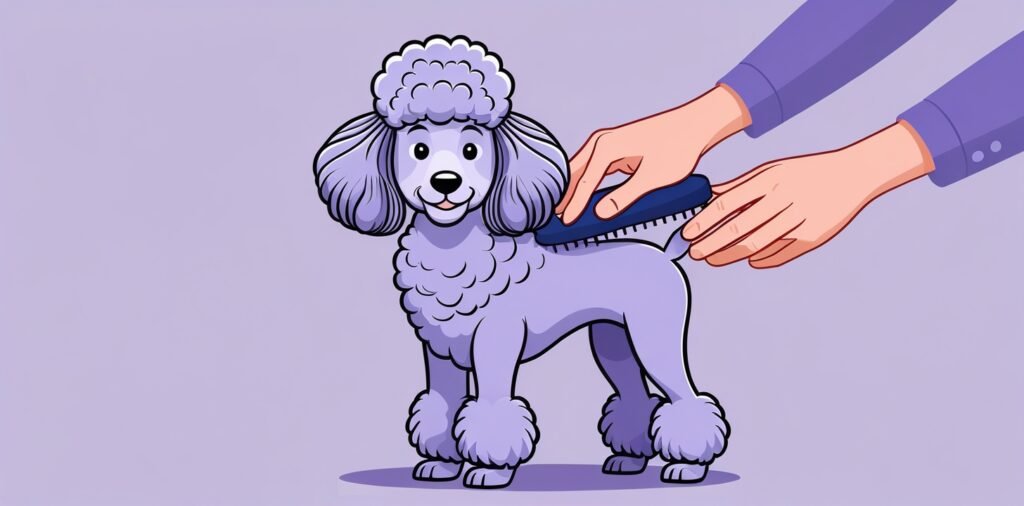
Professional grooming every 4-8 weeks is mandatory, not optional. The Poodle’s continuously growing coat mats severely if neglected, causing skin infections, restricted movement, and pain. This isn’t a breed you can skip grooming appointments for. The coat doesn’t shed out naturally like most breeds, so it must be clipped regularly. Budget $840-1,800 annually for professional grooming before getting a Poodle.
At-home brushing must occur daily for 10-15 minutes using a slicker brush and metal comb (Greyhound-style combs work well). Work through the entire coat systematically, paying particular attention to friction areas: behind ears, under legs (armpits), around the collar area, and the tail. Brush down to the skin, not just surface brushing. Surface brushing leaves mats underneath that tighten against the skin, pulling painfully and creating hot spots.
Shedding is minimal, which makes Poodles suitable for people with allergies. However, “hypoallergenic” doesn’t mean “non-allergenic.” Poodles produce dander (dead skin cells) and saliva proteins (Can f 1, Can f 2) that trigger allergies in some people. The curly coat traps shed hair rather than releasing it into the environment, but that trapped hair must be brushed out daily to prevent matting. Expect to find minimal hair on furniture compared to shedding breeds.
Bathing frequency depends on lifestyle and coat length. Most Poodles need baths every 3-6 weeks, or more frequently if they swim, roll in dirt, or have skin conditions. Use a moisturizing shampoo formulated for curly coats (Isle of Dogs, Chris Christensen, or Plush Puppy brands work well). The harsh texture benefits from added moisture. Oatmeal-based shampoos work well for Poodles prone to skin sensitivity. Always brush thoroughly before bathing, as water sets mats permanently.
Professional grooming costs vary by size and location. Toy Poodles average $50-100 per session, Miniature Poodles run $70-120, and Standard Poodles cost $100-150 or more in urban areas (New York, San Francisco, Los Angeles). Annual grooming expenses reach $600-1,200 for Toys, $840-1,440 for Miniatures, and $1,200-1,800 for Standards. Severely matted coats incur additional fees ($20-50) or require shaving short and starting over.
Nail trimming should occur every 3-4 weeks. Poodles have dark nails that make the quick (blood vessel) difficult to see, so trim conservatively (small amounts frequently) or use a grinding tool (Dremel, Nail Grinder). Overgrown nails cause splayed feet and gait problems, particularly in smaller varieties where proper foot structure is crucial for sound movement. You should hear minimal clicking on hard floors.
Ear cleaning is critical weekly maintenance. Poodles’ drop ears with heavy feathering create a warm, moist environment perfect for bacterial and yeast infections (Malassezia). Pluck or trim hair from inside the ear canal (your groomer can demonstrate the technique), then clean with a veterinary ear cleaner (Epi-Otic, Zymox). Never use cotton swabs deep in the canal. Watch for head shaking, odor, or discharge indicating infection requiring veterinary treatment.
The single biggest grooming mistake Poodle owners make is waiting too long between professional appointments. An 8-week coat is manageable with daily brushing. A 12-week coat is a matted disaster requiring a shave-down. Set recurring appointments every 6 weeks and don’t skip them, even if the coat looks okay. Mats form at the skin level where you can’t see them.
Dental care requires daily brushing with dog-specific toothpaste (enzymatic formulas like Virbac C.E.T.). Toy and Miniature Poodles are particularly prone to dental disease due to crowded teeth in small mouths. An estimated 80% of dogs show signs of dental disease by age 3. Untreated dental disease leads to tooth loss, pain, and systemic infections affecting heart and kidneys. Professional cleanings under anesthesia may be needed annually or biannually for small varieties, costing $500-1,000 per cleaning.
Grooming challenges center on matting prevention. The curly coat tangles easily, and mats form quickly in high-friction areas. Once a mat forms, it tightens against the skin, pulling painfully and creating hot spots (moist dermatitis) underneath. Severe matting requires shaving the dog down to skin level and starting over, a process that can take 6-9 months to regrow a full coat. Prevention through daily brushing is far easier than dealing with mats.
Coat clips range from practical to elaborate. Pet owners typically choose a simple puppy clip (same length all over, 1-2 inches), lamb clip (short body, fuller legs and head), or sporting clip (short body and legs, fuller topknot). Show dogs require Continental or English Saddle clips with specific pompom placements and shaved areas defined by the breed standard. Discuss lifestyle and maintenance commitment with your groomer to choose an appropriate style.
Total weekly grooming time commitment is 1.5-2.5 hours at home (10-15 minutes daily brushing = 70-105 minutes weekly, plus 15 minutes weekly ear cleaning, 10 minutes nail maintenance, 15-20 minutes teeth brushing) plus professional appointments every 4-8 weeks (2-3 hours per appointment). This is significantly more than most breeds require. If you’re not prepared for this time and financial investment, choose a different breed. Poodles are high-maintenance in the grooming department, period.
Poodle Travel Considerations
Toy and Miniature Poodles can fly in airplane cabins on most major carriers, provided they meet weight restrictions and fit comfortably in an airline-approved soft-sided carrier that fits under the seat. Southwest Airlines allows pets up to the carrier dimensions of 18.5″ L x 8.5″ W x 13.5″ H. American Airlines permits carriers up to 19″ L x 13″ W x 9″ H. Delta and United have similar size restrictions for in-cabin pet travel. In-cabin pet fees range $95-150 each way.
The critical factor is combined weight: dog plus carrier must typically stay under 20 pounds for cabin travel. A 15-pound Miniature Poodle in a 3-pound carrier hits 18 pounds (acceptable). A 17-pound Miniature pushes limits and may be denied boarding. Toy Poodles at 4-6 pounds easily meet requirements with room to spare. Standard Poodles at 45-70 pounds cannot fly in cabin under any circumstances. They must travel as checked pets in cargo holds or not fly at all.
Cargo travel for Standard Poodles requires IATA-compliant hard-sided crates with proper ventilation (openings on at least three sides), secure latches (not simple snap closures), and absorbent bedding. Many airlines have suspended cargo pet programs or impose seasonal restrictions during extreme temperatures. United PetSafe paused small pet cargo but maintains programs for larger dogs with specific temperature windows (45-85°F). Delta Cargo suspended most pet transport except for service animals. American Airlines PetSafe operates year-round with temperature restrictions.
Before booking flights with your Standard Poodle, verify current cargo pet policies directly with the airline. Programs change frequently, and seasonal embargoes during summer heat (over 85°F) or winter cold (under 45°F) may prevent travel during your planned dates. Some owners drive 1,000+ miles rather than risk cargo travel stress and safety concerns.
Poodles are not brachycephalic breeds, so they don’t face the respiratory restrictions that ground Bulldogs, Pugs, and similar flat-faced breeds. Their normal muzzle length and open airways make them physiologically safer for air travel than brachycephalic dogs. However, this doesn’t eliminate travel stress. It just removes one specific risk factor (respiratory distress at altitude).
Travel temperament is generally excellent in well-socialized Poodles. Their intelligence and adaptability help them handle new environments and experiences. They’re less prone to travel anxiety than many breeds (hounds, herding dogs, guardian breeds), particularly when crate-trained from puppyhood. However, their velcro nature means separation from owners (as in cargo travel) can be stressful. Cabin travel where they remain with you is ideal.
Heat and cold tolerance is moderate. The dense, curly coat provides good insulation against cold (comfortable to 20-30°F with a coat), though Toy Poodles lose body heat quickly due to their small size and may need sweaters below 40°F. Poodles handle heat reasonably well but aren’t built for extreme temperatures. Avoid exercising in temperatures above 80°F, and provide shade and water. In cargo holds, temperature extremes pose serious risks: heat stroke above 85°F, hypothermia below 45°F.
Crate training ease is high. Poodles’ intelligence makes them quick to accept crates as safe spaces when introduced properly. Start crate training in puppyhood (8-12 weeks) with positive associations: feed meals in the crate, provide special toys only available inside (Kong stuffed with treats), and never use it for punishment. A properly crate-trained Poodle views their crate as a den, not a prison, and will voluntarily nap inside.
Recommended carrier sizes for air travel: Toy Poodles fit in carriers around 17″ L x 11″ W x 11″ H (Sherpa Original Deluxe, Sleepypod Air). Miniature Poodles need 18-19″ L x 12-13″ W x 12″ H (SturdiBag Large, Sherpa Delta). Ensure your dog can stand, turn around, and lie down comfortably. For cargo travel, Standard Poodles require crates sized to their height and length: typically 36-42″ L x 25-28″ W x 30-32″ H (Petmate Sky Kennel, MidWest Ultima Pro) for most Standards.
Travel preparation tips include acclimating your Poodle to their carrier weeks before travel. Feed meals inside it, take short car trips (10-15 minutes, gradually extending), and gradually extend time spent inside (start with 5 minutes, work up to 2+ hours). Exercise thoroughly before travel (60-90 minutes for Standards, 30-45 minutes for smaller varieties) to encourage rest during the journey. Avoid sedatives unless specifically prescribed by your veterinarian for medical reasons. Sedation can be dangerous at altitude and masks distress signals.
Required documentation includes current rabies vaccination certificates (required by all airlines, must be administered at least 30 days before travel), health certificates issued by a veterinarian within 10 days of travel for most domestic flights and specific requirements for international travel, and airline pet travel forms completed in advance. Microchipping is essential. If your Poodle escapes during travel, a microchip (registered with current contact information) is the best reunion tool.
International travel adds complexity: European Union countries require pet passports, rabies titers (blood tests showing antibody levels, costing $200-300), and specific entry protocols varying by country. Some countries (Australia, New Zealand, Hawaii) quarantine incoming pets for weeks or months. Research destination requirements months in advance. Some tests and waiting periods take 6+ months to complete. The USDA APHIS website provides country-specific requirements.
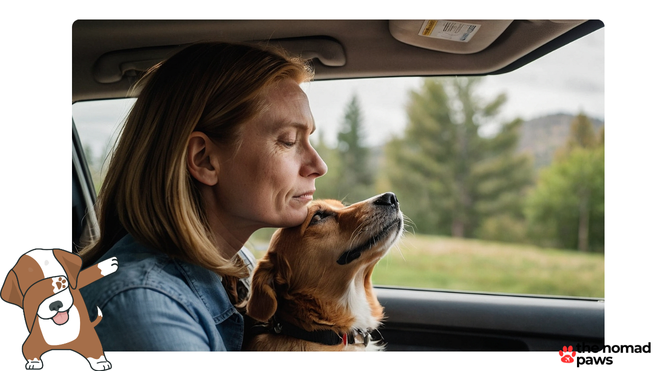
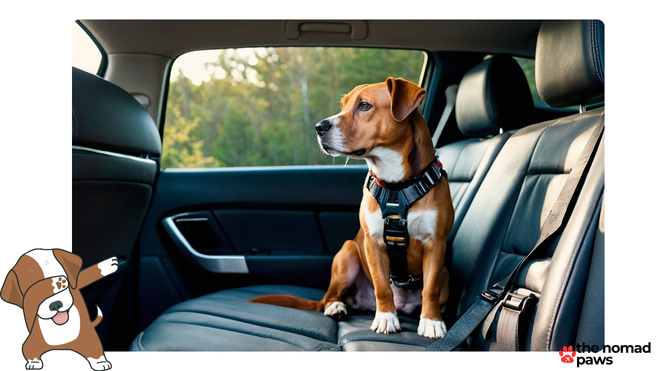
Road trip considerations: Poodles generally travel well in cars when secured in crates or with pet seatbelt harnesses (Sleepypod Clickit Sport, Kurgo Tru-Fit). Stop every 2-3 hours for bathroom breaks and brief walks (10-15 minutes). Never leave Poodles in parked cars. They overheat quickly (heat stroke can occur in 15 minutes at 70°F), and their high value makes them theft targets. Bring familiar bedding, toys, and food to maintain routine in hotels or rentals.
Training Your Poodle
Training a Poodle is easier than training most breeds, thanks to their #2 intelligence ranking (only Border Collies rank higher) and eagerness to please. They learn new commands in fewer than five repetitions and obey first commands 95% of the time or better in testing. This makes them excellent choices for first-time owners willing to invest in training, though their intelligence also means they’ll quickly learn behaviors you don’t want if you’re inconsistent (counter-surfing, door-dashing, demand barking).
Positive reinforcement training works best. Poodles are sensitive dogs that shut down under harsh corrections or punishment-based training (leash jerks, yelling, physical corrections). They respond beautifully to treats (small, high-value like chicken, cheese, or freeze-dried liver), praise (enthusiastic verbal rewards), and play rewards (tug, fetch). Clicker training is particularly effective. The precise marker (click sound) helps them understand exactly which behavior earned the reward.
Socialization must begin early and continue throughout life. Expose Poodle puppies to diverse people (men, women, children, people in wheelchairs, people wearing hats), dogs (various sizes and breeds), environments (urban streets, parks, pet stores), sounds (traffic, fireworks recordings, vacuum cleaners), and experiences between 8-16 weeks (the critical socialization window). Well-socialized Poodles are confident and friendly. Under-socialized Poodles can become anxious, reactive, or fearful.
Common training challenges include boredom with repetitive exercises. Poodles master commands quickly (sit, down, stay in 2-3 sessions), then lose interest if you drill the same behavior endlessly. Keep training varied and progressive. Once they know “sit,” move to “sit-stay,” then “sit-stay with distractions,” then “sit-stay while you leave the room.” Trick training keeps their minds engaged: Poodles excel at complex behavior chains like fetching specific items by name or navigating obstacle courses.
The Poodle’s intelligence is a double-edged sword. They learn what you teach them remarkably quickly, but they also learn what you don’t mean to teach. If you laugh when your puppy jumps on the counter, you’ve just trained counter-surfing. If you give attention when they bark for it, you’ve trained demand barking. Consistency isn’t optional with smart dogs.
Separation anxiety prevention requires deliberate training. Because Poodles bond intensely with their people, they’re prone to distress when left alone. Start alone-time training early (8-10 weeks): leave for brief periods (5 minutes) and gradually extend duration (add 5-10 minutes weekly). Provide puzzle toys (Kong stuffed with frozen peanut butter) and food-dispensing toys (Snuffle Mat, Bob-A-Lot) to create positive associations with your absence. Never make departures or arrivals dramatic. Keep them low-key (no excited greetings or long goodbyes).
House training is typically straightforward due to the breed’s intelligence and desire to please. Establish a consistent schedule: outside immediately after waking, after meals (15-30 minutes), after play sessions, and before bed. Toy Poodles may take longer (4-6 months vs. 3-4 months for larger varieties) due to small bladders (can only hold it 2-3 hours) and faster metabolisms. Crate training accelerates housebreaking by leveraging their denning instinct (dogs avoid soiling their sleeping area).
Leash training requires early attention, particularly for Standard Poodles who will have the strength to pull you around (50-70 pounds of pulling force). Start with loose-leash walking in puppyhood using the “be a tree” method: stop moving when the leash tightens, resume when it loosens. Poodles learn this quickly (1-2 weeks of consistent practice). Retractable leashes teach pulling and should be avoided during training. Use 4-6 foot standard leashes.
Recall training is essential for off-leash reliability. Poodles generally have good natural recall due to their desire to stay near their people, but it must be reinforced. Practice in low-distraction environments first (backyard, quiet park), gradually adding challenges (other dogs, squirrels, interesting smells). Always reward coming when called (high-value treats, enthusiastic praise). Never call your dog to you for something unpleasant like nail trimming or ending playtime. Go get them instead.
Advanced training and dog sports are where Poodles truly shine. They excel in competitive obedience (regularly earning perfect 200 scores), agility (competing at national championships), rally (earning titles quickly), nosework (using their scenting ability), dock diving (Standards jumping 20+ feet), and even retriever hunt tests (working certificate programs). Their versatility is remarkable. The same breed that wins Best in Show at Westminster also competes in field trials.
Barking management is usually manageable. Poodles bark to alert (doorbell, people passing the house) but aren’t typically nuisance barkers like Beagles or Shelties. Teach “quiet” command by rewarding silence after an alert bark (wait 3-5 seconds of quiet, then treat and praise). Address the underlying cause if barking becomes excessive: usually boredom (increase exercise and mental stimulation), insufficient exercise, or separation anxiety (work on alone-time training).
Cost of Poodle Ownership
Purchasing a Poodle puppy from a reputable breeder costs $1,500-4,500 depending on size variety, location, and breeder reputation. Toy Poodles typically command $2,000-4,000 due to breeding challenges with small dogs (smaller litters, higher C-section rates). Miniature Poodles range $2,500-4,500. Standard Poodles from health-tested parents average $1,500-3,500. Show-quality puppies or those from champion bloodlines cost more, sometimes exceeding $5,000.
Adoption from rescues or shelters costs $200-800, including spay/neuter, initial vaccinations, and microchipping. Poodle-specific rescues exist nationwide (Poodle Club of America Rescue Foundation, Carolina Poodle Rescue, NorCal Poodle Rescue) and often have dogs of all three sizes. Adult Poodles and senior dogs are frequently available, offering wonderful options for people who prefer skipping the puppy stage (house training, teething, high energy).
| Expense Category | First Year Cost | Annual Ongoing Cost |
|---|---|---|
| Food (varies by size) | $400-1,200 | $400-1,200 |
| Routine Veterinary Care | $800-1,200 | $400-800 |
| Professional Grooming | $840-1,800 | $840-1,800 |
| Training Classes | $300-500 | $0-200 |
| Supplies (crate, bowls, toys, etc.) | $400-600 | $100-200 |
| Pet Insurance | $300-600 | $300-600 |
| Preventive Medications | $200-400 | $200-400 |
| FIRST YEAR TOTAL | $3,240-6,300 | — |
| ANNUAL ONGOING TOTAL | — | $2,240-5,000 |
First-year costs run $3,200-6,300 beyond the purchase price, covering initial veterinary care (spay/neuter $300-800, vaccinations $150-300, health screening $200-400), supplies (crate $80-200, bedding $40-80, bowls $20-40, leash and collar $30-60, toys $50-100), training classes ($300-500 for puppy kindergarten and basic obedience), and establishing grooming routines. Toy Poodles fall toward the lower end of this range, Standards toward the higher end.
Annual ongoing costs average $2,500-5,000 for healthy adult Poodles. Grooming represents the single largest recurring expense at $840-1,800 annually depending on size (6-8 appointments yearly at $70-150 per appointment). Food costs $400-1,200 annually ($35-100 monthly). Routine veterinary care (annual exams $50-100, vaccinations $80-150, parasite prevention $200-400) runs $400-800. Pet insurance adds $300-600. Toys, treats, and replacement supplies contribute another $100-200.
Unexpected expenses can be substantial. Emergency veterinary care for bloat (Standard Poodles) costs $2,000-6,000 including surgery. Foreign body ingestion (swallowed toys, socks) requires surgery costing $2,000-4,000. Orthopedic surgery for hip dysplasia costs $3,000-6,000 per hip. Chronic condition management (epilepsy medication $50-150 monthly, ongoing eye treatments for PRA $30-80 monthly) adds $1,000-2,000+ annually. Dental cleanings under anesthesia cost $500-1,000 and may be needed annually for Toy and Miniature Poodles.
Grooming isn’t negotiable or optional, it’s a fixed cost of Poodle ownership. If $840-1,800 annually for professional grooming seems excessive, this isn’t your breed. The coat doesn’t maintain itself, and neglect causes suffering: painful mats, skin infections, and restricted movement. Budget for grooming before getting a Poodle.
Pet insurance becomes cost-effective for Poodles given their genetic health predispositions (hip dysplasia, PRA, epilepsy, bloat). Policies covering hereditary and congenital conditions provide financial protection against expensive treatments. Annual premiums of $300-600 ($25-50 monthly) are modest compared to potential $5,000+ surgery costs. Choose policies with high annual limits ($10,000-unlimited), reasonable deductibles ($250-500), and 80-90% reimbursement rates. Healthy Paws, Trupanion, and Embrace offer comprehensive coverage.
Lifetime cost of ownership over a 12-15 year lifespan ranges $32,000-78,000 including purchase price ($2,500 average), routine care ($2,500-5,000 annually x 13 years = $32,500-65,000), and average unexpected expenses ($5,000-10,000 over lifetime). Standards trend toward the higher end due to larger food portions and potential orthopedic surgeries. Toys and Miniatures may have lower food costs but higher dental expenses ($500-1,000 annually for cleanings). These estimates assume generally healthy dogs. Chronic conditions increase costs substantially.
Ways to reduce costs include learning basic grooming skills (bathing, nail trimming, sanitary trims between professional appointments can extend time between groomer visits from 6 to 8 weeks), buying quality food in bulk (20-30 pound bags vs. 5 pound bags saves 20-30%), maintaining preventive care to avoid expensive emergencies (annual exams catch problems early), and training your dog yourself rather than hiring trainers for basic obedience (YouTube tutorials, library books). However, professional grooming cannot be eliminated entirely. The coat requires expert clipping every 4-8 weeks.