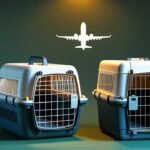

You need to ship your dog to another state, and you’re staring at conflicting advice about health certificates, airline fees, and crate sizes. Here’s what actually matters: start 8 weeks before travel, expect to spend $375 to $2,375 depending on your dog’s size and distance, and understand that brachycephalic breeds face year-round airline bans with limited alternatives.
This guide provides exact timelines, current airline fees from Delta, American, United, Southwest, and Alaska, and the breed-specific restrictions that derail most shipping plans.
Timeline: 8 Weeks to Departure
Interstate dog shipping requires coordination between veterinarians, airlines, and state regulations. Missing a single deadline can delay your trip by weeks.
8 Weeks Before Travel
Schedule your veterinary appointment with a USDA-accredited veterinarian. Find accredited vets through the USDA APHIS database. Expect to pay $150 to $300 for the exam.
Confirm rabies vaccination is current. Your dog must be vaccinated at least 21 to 30 days before travel. The vaccine costs $50 to $100 if needed, plus $30 to $50 for DHPP core vaccines.
Request microchip implantation if your dog isn’t already chipped. Most airlines require ISO 11784/11785 compliant microchips for checked pets. Implantation costs $25 to $50, registration adds $15 to $25. Register with AKC Reunite or HomeAgain and update the address to your destination.
Research your destination state’s requirements. Contact the state veterinary board directly. While the USDA APHIS confirms no federal health certificate endorsement is required for travel within the 48 contiguous states, individual states may have import permits or breed restrictions.
6 Weeks Before Travel
Book your airline reservation. Cargo space books 6 to 8 weeks in advance. Cabin pet reservations fill 2 to 4 weeks out. Compare policies now:
| Airline | Cabin Fee (One-Way) | Weight Limit | Carrier Dimensions | Cargo Available |
|---|---|---|---|---|
| Delta | $95 | 20 lbs (pet + carrier) | 18″ × 11″ × 11″ | Yes (Delta Cargo) |
| American | $125 | 20 lbs (pet + carrier) | 19″ × 13″ × 9″ | Military only (PetEmbark) |
| United | $125 | 18 lbs (pet + carrier) | 18″ × 11″ × 11″ | Yes (PetSafe) |
| Southwest | $95 | 20 lbs (pet + carrier) | 18.5″ × 13.5″ × 9.5″ | No |
| Alaska | $100 | 20 lbs (pet + carrier) | 17″ × 11″ × 9.5″ | No |
Verify fees during booking. Airlines adjust rates seasonally and by fuel costs.
Cargo costs range from $350 to $1,500+ depending on weight and distance. United PetSafe charges approximately $850 to $1,000 to ship a 50-pound dog from New York to Los Angeles. Delta Cargo ranges $300 to $950 for domestic routes. American Airlines restricts cargo connections to 10 hub cities: CLT, ORD, DFW, LAX, JFK, LGA, MIA, PHL, PHX, DCA.
4 Weeks Before Travel
Begin crate training immediately. Your dog needs a minimum 2 weeks to acclimate. Leave the crate accessible in your home. Reward your dog for entering voluntarily. Practice 15 to 30 minutes daily.
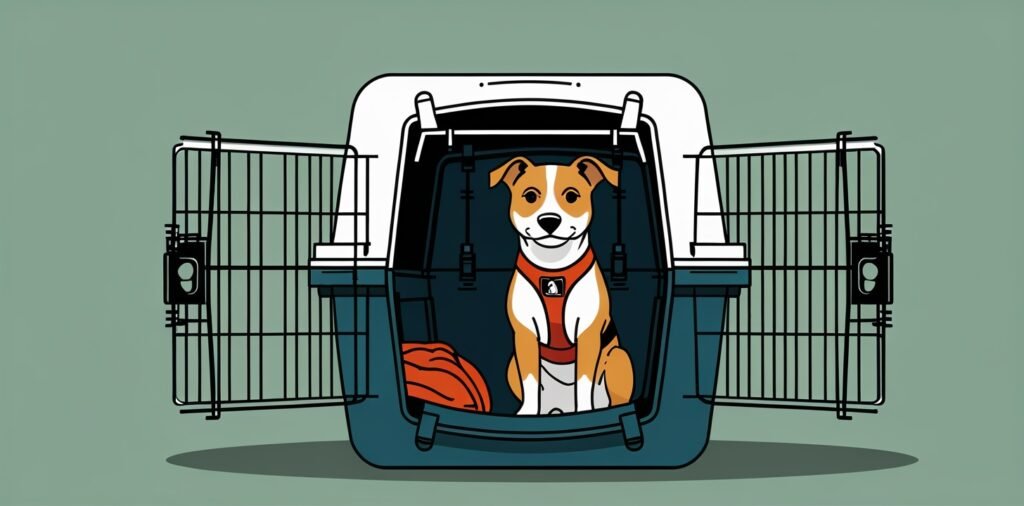
Purchase an IATA-compliant crate. Airlines require rigid construction with ventilation on at least 3 sides for domestic travel (4 sides for international). Calculate dimensions using this formula:
- Length: Nose-to-rump measurement + ½ head length
- Width: Widest body point × 2
- Height: Standing height + 2 to 3 inches for bedding
Common crate sizes and costs:
| Dog Weight | Crate Size | Dimensions | Cost |
|---|---|---|---|
| 15 to 20 lbs | Medium | 24″ × 18″ × 21″ | $150 to $250 |
| 30 to 50 lbs | Large | 32″ × 22″ × 26″ | $200 to $400 |
| 60 to 90 lbs | X-Large | 40″ × 27″ × 30″ | $300 to $500 |
Brachycephalic breeds require the next size larger than calculated dimensions. Snub-nosed dogs struggle with temperature regulation and need extra ventilation space.
3 Weeks Before Travel
Confirm health certificate details with your veterinarian. For domestic interstate travel to the 48 contiguous states, the USDA does not require federal endorsement. However, airlines require a health certificate issued by a licensed veterinarian within 10 days before travel. Some airlines extend validity to 30 days for cargo shipments.
Call your airline’s cargo or pet department to verify crate requirements. Confirm approved materials (metal versus plastic), ventilation specifications, and food/water bowl attachment requirements. Contact numbers:
- United PetSafe: (855) 748-3867
- Delta Cargo: (404) 715-1000
- American Airlines Cargo: General cargo booking line
2 Weeks Before Travel
Finalize your booking and confirm all reservation details. Verify your dog’s name, age, breed, weight, and microchip number appear correctly. Obtain your booking confirmation number. Complete this step 2 weeks out to catch errors before they become crises.
Prepare your documentation packet. Organize these items in a waterproof folder, make 2 copies, and keep the originals with whoever drops off your dog:
- Original health certificate (not photocopies)
- Vaccination records with veterinarian signature and date
- Microchip registration papers
- Airline-specific forms (American requires a written feeding certification)
- Proof of rabies vaccination
Schedule your final veterinary visit for 7 to 10 days before departure. The health certificate must be issued within this window. Expect to pay $150 to $300 for the exam and certificate.
1 Week Before Travel
Increase daily exercise by 30 to 45 minutes. Extra activity reduces travel anxiety. Continue through the day before departure.
Adjust your dog’s feeding schedule. Reduce meal size by 25% the day before travel. Feed your dog 4 to 6 hours before shipping. Stop water 2 hours before departure to minimize accidents.
Conduct a final crate inspection. Check for sharp edges, verify the door latch works, and confirm ventilation holes are clear. Add 1 to 2 inches of absorbent bedding. Attach food and water bowls securely inside. Some airlines require separate dishes.
Pack these items with the crate:
- Feeding instructions for a 24-hour period (typed, signed, dated, attached outside)
- Small bag of your dog’s regular food
- Absorbent pads or newspapers
- Copy of health certificate taped inside and outside the crate (laminate if possible)
- Collar, leash, and ID tag attached to crate handle
- Emergency contact information (typed, signed) attached to crate
Day Before Travel
Call the airline cargo department 24 hours before departure. Confirm your dog is still approved for the flight, verify no weather embargoes affect your route, and confirm check-in time and location.
Feed your dog a light meal 6 to 8 hours before drop-off. Provide water until 2 hours before you leave for the airport.
Day of Travel
Arrive at the cargo facility 2 to 4 hours before departure. American Airlines requires a minimum 2-hour, maximum 4-hour window. Cargo facilities operate separately from passenger terminals. Obtain the exact address and building number in advance.
Check-in process takes 30 to 45 minutes:
- Present health certificate and government ID
- Confirm dog’s name, microchip number, and weight
- Complete airline checklist or acknowledgment form
- Pay balance fees if not prepaid
- Receive tracking number and receipt
Document your dog’s condition in writing before handoff. Note any existing injuries, anxiety levels, or health concerns. This protects you if issues arise during transport.
After Arrival
Pick up your dog within 24 hours of arrival. Cargo holding fees apply after 24 hours, typically $50 to $75 per day. Bring government ID and your booking confirmation to the destination cargo facility.
Inspect the crate immediately for damage. Verify your dog is alert, responsive, and uninjured. Sign the release form only after inspection. Obtain a receipt.
Limit activity for the first 2 to 3 hours after pickup. Offer small amounts of water (¼ cup every 30 minutes, increase gradually). Skip the first meal. Offer light food 4 to 6 hours after arrival. Monitor for stress, diarrhea, or loss of appetite, which are normal for 24 to 48 hours. Contact a local veterinarian if distress persists beyond 48 hours.
Cost Breakdown: What You’ll Actually Pay
Shipping costs vary dramatically by dog size, travel distance, and whether your dog qualifies for cabin travel.
Scenario 1: Small Dog (15 lbs), Cabin Travel
| Expense | Cost |
|---|---|
| Airline cabin fee | $95 to $125 |
| Health exam + certificate | $200 to $300 |
| Soft-sided carrier | $50 to $100 |
| Accessories and supplies | $30 to $50 |
| Total | $375 to $575 |
Scenario 2: Medium Dog (40 lbs), Cargo Travel, One-Way
| Expense | Cost |
|---|---|
| Airline cargo fee | $500 to $750 |
| Health exam + certificate | $200 to $300 |
| IATA crate (Large) | $300 to $400 |
| Accessories and supplies | $40 to $60 |
| Total | $1,040 to $1,510 |
Scenario 3: Large Dog (70 lbs), Cross-Country Cargo
| Expense | Cost |
|---|---|
| Airline cargo fee (NY to LA) | $1,000 to $1,500 |
| Health exam + certificate | $200 to $300 |
| IATA crate (X-Large) | $400 to $500 |
| Accessories and supplies | $50 to $75 |
| Total | $1,650 to $2,375 |
Hidden Costs Most Guides Miss
- Cargo facility waiting fees: $50 to $75 per day if you don’t pick up within 24 hours
- Weather embargo rebooking fees: $50 to $100 (some airlines rebook free)
- Airport parking for drop-off and pickup: $15 to $30
- Veterinarian acclimation letter for cold weather: $75 to $150 if traveling when ground temperature drops below 45°F
- Pet transport service (alternative to airline cargo): $300 to $1,000+
- Post-travel veterinary exam at destination: $150 to $300 (recommended)
Brachycephalic Breed Restrictions: Year-Round Airline Bans

If you own a snub-nosed breed, airline shipping is likely impossible. United, American, Delta, Southwest, and Alaska ban brachycephalic breeds from both cabin and cargo due to respiratory risks.
Banned breeds include:
- Affenpinscher
- Boston Terrier
- Boxer
- Brussels Griffon
- Bulldog (English, French, American)
- Bullmastiff
- Cane Corso
- Chow Chow
- English Toy Spaniel
- Japanese Chin
- Lhasa Apso
- Mastiff (all types)
- Pekingese
- Pit Bull
- Pug (all types, including mixes)
- Shar Pei
- Shih Tzu
- Staffordshire Bull Terrier
- Tibetan Spaniel
Why airlines ban these breeds: Shortened nasal passages, soft palate abnormalities, and narrow larynxes make breathing difficult.
Pressurized cabins, stress, and temperature fluctuations create acute respiratory crisis risk. Industry data show brachycephalic breeds have 3 to 5 times higher incidence of acute distress during air travel.
Alternatives for Brachycephalic Breeds
Pet transport services specializing in high-risk breeds cost $1,000 to $3,000+. These services use ground transport or hybrid ground/air routes with climate-controlled vehicles and frequent breaks.
Drive cross-country yourself. A 2 to 5 day road trip allows you to control temperature and provide frequent breaks. This is the safest option for brachycephalic breeds.
Amerijet International accepts some brachycephalic breeds with documentation. Verify current policies before booking. Amerijet currently restricts English Bulldogs but accepts some French Bulldogs with proper health clearances.
British Airways Cargo accepts some snub-nosed breeds except Pugs, Bulldogs, and Pekingese. They offer larger kennel options. Verify breed eligibility before international booking.
Verify all brachycephalic breed policies directly with carriers before making travel plans. Policies change frequently.
Temperature Embargoes: When Airlines Won’t Fly Your Dog
Airlines enforce strict temperature restrictions to prevent heatstroke and hypothermia. These embargoes are non-negotiable.
Heat Embargoes (May 1 to September 30)
No pet travel when ground temperature exceeds 85°F (29.4°C) at any point in the journey. This includes origin, destination, and connection cities. American Airlines bans pet cargo entirely to Phoenix (PHX), Las Vegas (LAS), Tucson (TUS), and Palm Springs (PSP) from May 1 to September 30.
Workaround: Book early morning flights when temperatures are lowest, or travel in spring or fall.
Cold Weather Embargoes (December to February)
No pet travel when ground temperature drops below 45°F (7.2°C) without a veterinarian acclimation letter. The letter must state your dog is acclimated to cold temperatures and must be signed by a USDA-accredited veterinarian. Expect to pay $75 to $150 for this letter.
Extreme cold exception: No travel below 20°F (negative 6.6°C) even with an acclimation letter.
Check weather forecasts for all cities in your route 48 hours before travel. Airlines will cancel pet shipments if embargoes activate.
What Happens When Things Go Wrong
The DOT tracks animal incident reports for all U.S. airlines. Common problems include:
Health Certificate Rejected at Check-In
Cause: Certificate issued more than 10 days before travel, missing veterinarian signature, or lacking required vaccination dates.
Consequence: Pet denied boarding. You must reschedule and obtain a new health certificate.
Prevention: Schedule your final vet visit 7 to 10 days before departure. Verify the certificate includes all required fields before leaving the clinic.
Weather Embargo Activated Day of Travel
Cause: Temperature exceeds 85°F or drops below 45°F at origin, destination, or connection city.
Consequence: Flight canceled. Rebooking fees range from free to $100 depending on airline.
Prevention: Avoid travel during heat embargo season (May 1 to September 30) if possible. Book direct flights to eliminate connection city temperature risks.
Crate Doesn’t Meet IATA Standards
Cause: Crate too small, missing ventilation on required sides, or door latch doesn’t secure properly.
Consequence: Pet denied boarding. You must purchase a compliant crate at the airport (often 2 to 3 times retail cost) or reschedule.
Prevention: Call your airline’s cargo department 3 weeks before travel to confirm exact crate specifications. Conduct a dry run: place your dog in the crate for 30 minutes to verify fit and comfort.
Dog Not Picked Up Within 24 Hours
Cause: Flight delays, miscommunication about arrival time, or cargo facility closes before you arrive.
Consequence: Holding fees of $50 to $75 per day. Your dog may be held in an uncontrolled environment without adequate water or exercise.
Prevention: Obtain the destination cargo facility’s phone number, address, and operating hours before travel. Call 2 hours before scheduled arrival to confirm pickup window. Build a 4-hour buffer into your pickup schedule.
Dog Shows Signs of Distress After Travel
Symptoms: Excessive panting, refusal to eat or drink for more than 48 hours, lethargy, diarrhea lasting more than 2 days.
Action: Contact a local veterinarian immediately. Provide the vet with your dog’s health certificate and vaccination records. Mention the dog traveled by air cargo.
Prevention: Choose direct flights to minimize time in cargo. Avoid travel during extreme weather. Ensure your dog is fully crate-trained before departure.
Start preparation 8 weeks before travel. Expect to spend $375 to $2,375 depending on your dog’s size and distance. Brachycephalic breeds face year-round airline bans with limited alternatives. Book direct flights, verify all documentation 2 weeks out, and confirm weather conditions 48 hours before departure. Most shipping disasters stem from missed deadlines or vague preparation, not the shipping process itself.
Frequently Asked Questions
How much does it cost to ship a dog to another state?
Costs range from $375 to $2,375 depending on your dog’s size, travel distance, and whether your dog qualifies for cabin travel. Small dogs under 20 pounds traveling in-cabin cost $375 to $575 total (airline fee $95 to $125, health exam $200 to $300, carrier $50 to $100). Medium dogs traveling cargo cost $1,040 to $1,510 (cargo fee $500 to $750, health exam $200 to $300, IATA crate $300 to $400). Large dogs traveling cross-country cost $1,650 to $2,375 (cargo fee $1,000 to $1,500, health exam $200 to $300, crate $400 to $500).
Can I ship my dog in the cabin with me?
Small dogs under 18 to 20 pounds (combined pet and carrier weight) may fly in-cabin if the carrier fits under the seat. Delta allows 20 pounds in an 18″ × 11″ × 11″ carrier. United allows 18 pounds in an 18″ × 11″ × 11″ carrier. American allows 20 pounds in a 19″ × 13″ × 9″ carrier. Larger dogs must travel as cargo. Cabin fees range from $95 to $125 one-way.
What documents do I need to ship my dog?
You need a health certificate issued by a licensed veterinarian within 10 days before travel, current vaccination records including rabies (vaccinated at least 21 to 30 days before travel), microchip documentation (ISO 11784/11785 compliant), and airline-specific forms. American Airlines requires a written feeding certification. The USDA does not require federal endorsement for interstate travel within the 48 contiguous states, but airlines enforce their own documentation requirements.
Is it safe to ship a dog to another state?
Yes, when you follow proper procedures. Choose direct flights to minimize time in cargo (reduces delay risk by 50%). Use IATA-compliant crates sized correctly for your dog’s dimensions. Avoid extreme weather conditions: no travel when ground temperature exceeds 85°F or drops below 45°F without a veterinarian acclimation letter. The DOT tracks animal incident reports and requires airlines to report injuries, losses, and deaths. Brachycephalic breeds face 3 to 5 times higher risk of acute distress and are banned by most airlines.
How long can a dog safely stay in a crate during shipping?
Most airlines limit crate time to 12 hours maximum. For longer journeys, include water bowls attached inside the crate, absorbent bedding covering the floor 1 to 2 inches deep, and comfort items like a familiar blanket. The DOT prohibits sedation or tranquilization of pets in cargo due to respiratory risks at altitude. Feed your dog 4 to 6 hours before shipping and stop water 2 hours before departure to minimize accidents.
You’re Ready to Ship Your Dog Safely
You now have the exact timeline, itemized costs, and airline-specific requirements to ship your dog to another state without surprises. Start your preparation 8 weeks out, verify every deadline twice, and confirm weather conditions 48 hours before departure.
Your dog’s safety depends on specifics: the right crate dimensions, the correct health certificate timeline, and direct flights that avoid temperature embargoes. Follow this guide, and you’ll avoid the mistakes that derail most pet shipping plans.