
A Cocker Spaniel can make a dinner plate feel like a moral question, with those long ears, that soft face and a stare that suggests nobody has fed it in days.
It has usually been fed quite well, which is the problem. The American Kennel Club notes that groomers and vets often see overweight Cockers, and a UK study of English Cocker Spaniels found obesity among the most common diagnoses of the year.
Weight is only half the story, though. American Cockers carry a heart condition that’s been tied to taurine, the breed turns up more often than most in studies of pancreatitis and an underactive thyroid, and each of those changes what belongs in the bowl.
So this page puts six dry foods side by side on the numbers that matter for this breed: calories in a cup, fat, protein and the AAFCO statement, along with how much your Cocker actually needs.
The short answer. An adult Cocker needs roughly 510 to 795 kcal a day, and a cup of these foods holds 256 to 449. Royal Canin’s Cocker Spaniel Adult is the only one made for the breed, Royal Canin Medium Weight Care has the lightest scoop, and Purina Pro Plan Sensitive Skin & Stomach the richest.

Choose the food your vet is happy with, measure every meal, and check your dog’s ribs and waist every few weeks rather than trusting the cup.
At a glance
A medium dog, not a small one
The AKC breed standard puts males at 25 to 30 lb and females at 20 to 25 lb, about 14 to 15 inches at the shoulder, with a life expectancy of 10 to 14 years.
That makes a Cocker a medium dog in pet food terms, and Royal Canin’s medium range starts at 23 lb, so small-breed puppy and senior foods aren’t the natural fit that a lot of advice suggests.
In the US, “Cocker Spaniel” means the American breed. The English Cocker Spaniel is a separate breed, and UK vets recorded a median adult weight of about 15 kg (33 lb) for it, so check which one you have when you read a feeding chart.
How many calories a Cocker needs
The American Animal Hospital Association uses a simple formula: resting energy is 70 times body weight in kilograms to the power of 0.75, and a neutered adult needs about 1.4 to 1.6 times that.
It’s a starting point that your vet will adjust after checking body condition, and here’s what it gives for a Cocker.
| Dog | Weight | Resting kcal | Daily kcal (neutered) | Cups of the lightest food | Cups of the richest food |
|---|---|---|---|---|---|
| Small female | 20 lb | 366 | 512 to 585 | 2.1 | 1.2 |
| Typical Cocker | 25 lb | 433 | 606 to 692 | 2.5 | 1.4 |
| Large male | 30 lb | 496 | 694 to 794 | 2.9 | 1.7 |
The cup columns use the middle of the range, 1.5 times resting energy, with Royal Canin Medium Weight Care as the lightest food and Purina Pro Plan Sensitive Skin & Stomach as the richest.
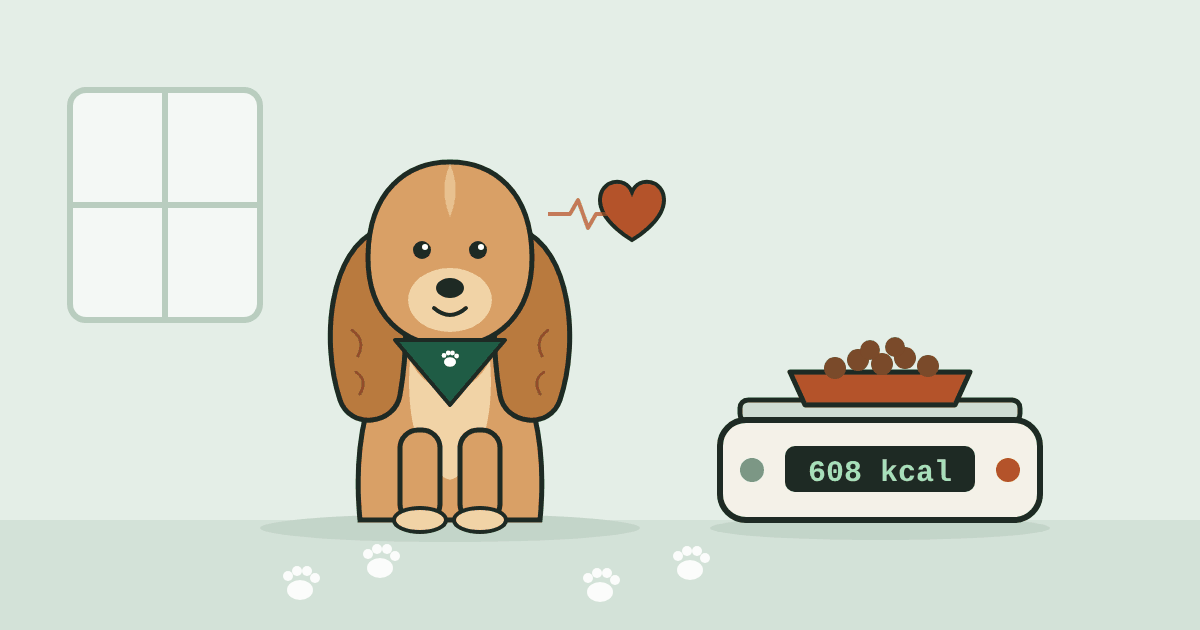
The labels land in the same place. Royal Canin’s Cocker chart gives a 24 lb dog of medium activity 2 cups a day, about 608 kcal, and Purina’s chart gives dogs of 21 to 35 lb 1 1/3 to 2 cups, about 600 to 900 kcal.
The cup is the trap
A cup of Pro Plan Sensitive Skin & Stomach holds 449 kcal and a cup of Medium Weight Care holds 256, so the richer food carries about 75% more energy in the same scoop.
For a typical 25 lb Cocker that’s the difference between about 1 1/2 cups and 2 1/2 cups a day, which is why switching foods without switching portions is such an easy way to add a pound or two.
Use the chart for the food you’re actually pouring, level the cup or weigh it, and count treats as part of the day. A common rule of thumb among vets is to keep treats to about a tenth of daily calories, which for a 25 lb Cocker is around 65 kcal.
The Cocker heart and taurine
American Cocker Spaniels are one of the few breeds where a heart disease, dilated cardiomyopathy (DCM), has been linked to low taurine, an amino acid most dogs make for themselves.
In the MUST study from 1997, every Cocker with DCM had low blood taurine, and when they were given taurine and carnitine their hearts worked better and they could come off their heart drugs, although most hearts didn’t return fully to normal.
It was a small study of 14 dogs, and it doesn’t mean every Cocker needs a supplement. What it does mean is that a heart murmur, tiring easily or a cough in a Cocker is worth a vet visit, and that your vet may want a taurine test before reaching for anything else.
Royal Canin’s Cocker formula is the only food on this page that guarantees a taurine level, 0.25%, and the brand notes that AAFCO doesn’t treat taurine as essential for dogs. Please don’t add supplements without your vet.
Pancreatitis and fat
In a UK post-mortem study, cocker spaniels had a higher risk of acute and chronic pancreatitis than other breeds, and a 2024 study found chronic pancreatitis common in English Cockers, especially parti-coloured dogs and blue roans.
Diet doesn’t cause every case, but a dog that has had pancreatitis is usually kept on a lower-fat food under a vet’s care. That’s why the fat row on each card below is worth a look, and our guide to food for dogs with pancreatitis goes further.
The thyroid link
In a VetCompass study of UK dogs, American Cocker Spaniels had 8.64 times the odds of hypothyroidism of crossbred dogs, and English Cockers about twice the odds.
An underactive thyroid slows the metabolism, so a Cocker that keeps gaining weight on a sensible portion, or seems unusually tired, should see a vet before you cut its food any further.
Ears, skin and food allergy
Those ears are famous for trouble. Ear infections were the second most common diagnosis in UK English Cockers, at about 1 dog in 10, just behind dental disease at about 1 in 5.
A food allergy can show up as ear and skin infections, but so can environmental allergies, and a 2019 review found no reliable evidence that any breed is more prone to food allergy than others.
The way to find out is an elimination trial run with your vet, on a diet built around a protein your dog hasn’t eaten before. Switching between pet store foods rarely gives a clear answer, and our guide to digestive health ingredients explains what helps a sensitive stomach.
The AKC also suggests learning from your vet how to clean your Cocker’s ears, especially after a bath, since moisture trapped under those long flaps is part of the problem.
Fat and protein per 1000 calories
Percentages on a bag depend on how much water and how many calories the food holds, so grams per 1000 kcal puts every food on the same footing, and it’s the fairest way to compare fat.
Hill’s prints dry-matter averages, so I calculated its figures by allowing 5 to 12% water. The others print minimums, so their real fat and protein are a little higher than shown.
The six foods in numbers
| Food | kcal per cup | g fat per 1000 kcal | g protein per 1000 kcal | AAFCO basis |
|---|---|---|---|---|
| Royal Canin Medium Weight Care | 256 | at least 28 | at least 78 | Formulated to meet |
| Hill’s Perfect Weight | 298 | about 32 (calculated) | about 83 (calculated) | Feeding tests |
| Royal Canin Cocker Spaniel Adult | 304 | at least 33 | at least 63 | Formulated to meet |
| Royal Canin Medium Adult 7+ | 315 | at least 33 | at least 63 | Formulated to meet |
| Royal Canin Medium Puppy | 410 | at least 48 | at least 78 | Formulated to meet, growth |
| Pro Plan Sensitive Skin & Stomach | 449 | at least 41 | at least 67 | Feeding tests |
I didn’t feed these to a dog, so there’s no taste test here. I read each brand’s own page or label, copied the numbers as printed, and marked anything I worked out myself as calculated.
The foods one by one
Each card shows what’s printed on the brand’s page or label. Hatched bars are my calculation, and solid bars on the fat and protein rows are label minimums.
Royal Canin Cocker Spaniel Adult
Dry kibble · breed formula
Made for the breed, moderate per cup and the only pick here with a guaranteed taurine level, but formulated to meet the AAFCO profile rather than feeding-tested.
Formulated to meet · 3661 kcal per kg
Full details
Royal Canin prints 23% protein minimum, 12% fat minimum, 3.3% fibre maximum and 10% moisture maximum, plus taurine 0.25%, EPA 0.17% and DHA 0.07% minimum. Its chart covers dogs from 22 to 35 lb and gives a 24 lb dog of medium activity 2 cups a day, about 608 kcal. Royal Canin also says the kibble is shaped for the Cocker’s jaw, which is the brand’s claim rather than something I could check. The 25 lb bag is linked here, and there’s a 6 lb bag if you want to try it first.
Royal Canin Medium Weight Care Adult
Dry kibble · weight management
The lightest scoop on this page at 256 kcal per cup, with the lowest fat minimum, for a Cocker that gains weight easily.
Formulated to meet · 3200 kcal per kg
Full details
Royal Canin prints 25% protein minimum, 9% fat minimum, 12.5% fibre maximum and 10% moisture maximum, with L-carnitine at 140 mg/kg minimum. It’s sized for adult dogs of 23 to 55 lb, which takes in most Cockers. The 17 lb bag is linked here, and it also comes in a 30 lb bag.
Hill’s Science Diet Adult Perfect Weight, Chicken & Brown Rice
Dry kibble · weight management
A light, high-fibre food backed by AAFCO feeding tests, with separate portions for weight loss and for keeping weight steady.
AAFCO feeding tests · 3189 kcal per kg
Full details
Hill’s US page prints dry-matter averages rather than a guaranteed analysis: 28.8% protein, 11.2% fat and 10.3% crude fibre, which I turned into per-1000-kcal figures by allowing 5 to 12% water, so treat them as calculated. Chicken, cracked pearled barley, brown rice and pea fiber come first. The chart gives a 20 lb dog 1 1/4 cups a day for weight loss and 1 3/4 cups to maintain, and a 30 lb dog 1 2/3 and 2 1/3 cups. Hill’s says its own research shows visible weight loss within 10 weeks, which is the brand’s claim.
Purina Pro Plan Sensitive Skin & Stomach, Salmon & Rice
Dry kibble · sensitive skin and stomach
Feeding-tested, salmon first and made for dogs with touchy skin or stools, but it packs 449 kcal into a cup, so portions need care on a Cocker.
AAFCO feeding tests · 3903 kcal per kg
Full details
Purina prints 26% protein minimum, 16% fat minimum, 4% fibre maximum and 12% moisture maximum, with no corn, wheat or soy. The chart gives dogs of 21 to 35 lb 1 1/3 to 2 cups a day, which works out at roughly 600 to 900 kcal. With the highest fat on this page, it isn’t the food to pick for a dog with a history of pancreatitis without your vet’s say. Purina’s page lists no probiotics for this recipe, and the ‘prebiotic fiber’ on the Amazon title is a different thing. The 30 lb bag is linked here, and the 40 lb Adult bag is the same formula.
Royal Canin Medium Puppy
Dry kibble · puppy growth
A puppy food with an AAFCO growth statement, sized for dogs that will be 23 to 55 lb as adults, which is where a Cocker lands.
Formulated to meet, growth · 3869 kcal per kg
Full details
Royal Canin prints 30% protein minimum, 18.4% fat minimum, 4% fibre maximum and 10% moisture maximum, with DHA at 0.1% minimum, and it’s meant for puppies up to 12 months. For a puppy heading for 24 lb, the chart starts at about 1 1/2 cups a day at 2 months and about 1 7/8 cups at 4 months, split into meals. The 17 lb bag is linked here, and there’s a 30 lb bag.
Royal Canin Medium Adult 7+
Dry kibble · senior
A moderate senior food for medium dogs over seven, at 315 kcal per cup.
Formulated to meet · 3658 kcal per kg
Full details
Royal Canin prints 23% protein minimum, 12% fat minimum, 3.7% fibre maximum and 10.5% moisture maximum. It’s sized for dogs of 23 to 55 lb over seven years old, so it suits an older Cocker better than the small-breed senior foods often suggested for the breed. The linked bag is 30 lb.
Feeding a Cocker puppy
A Cocker puppy needs a food with an AAFCO statement for growth, and since the breed grows into a 20 to 30 lb adult, a medium-breed or all-sizes puppy food fits better than a small-breed one.
Go by the chart on the bag for your puppy’s expected adult weight. For Royal Canin Medium Puppy and a puppy heading for 24 lb, that’s about 1 1/2 cups a day at two months and about 1 7/8 cups at four months, split into several meals.
Very young puppies are still with their mother or being weaned, so if your breeder sends a puppy home on a particular food, keep it for the first couple of weeks and then change slowly.
Changing food without an upset stomach
The usual advice is to switch over about 7 to 10 days, starting with a quarter of the new food mixed into the old and adding a little more every couple of days.
If your Cocker’s stools go soft, slow down rather than stopping, and call your vet if it doesn’t settle, sooner for a dog with a pancreatitis history.
What about grain-free?
The US FDA has investigated a possible link between some diets, many of them grain-free, and DCM. It hasn’t established a cause, and it said in December 2022 that it wouldn’t post further updates until there was meaningful new science.
The research has moved on since. A June 2026 update from Tufts says diet-associated DCM appears to be linked to diets high in pulses such as peas and lentils, grain-free or not, and not to a lack of grains or to low taurine, which makes it a different problem from the taurine-responsive DCM seen in Cockers.
Every food on this page contains grain. If you’re drawn to a grain-free or pulse-heavy food, talk to your vet first, and our guide to feeding Golden Retrievers covers the same question for another breed in the DCM spotlight.
Questions to take to your vet
- What is my Cocker’s ideal weight, and what is their body condition score today?
- How many calories a day should we aim for with the food we use?
- Should we check taurine or listen for a murmur, given the breed’s heart history?
- Is a thyroid test worth doing if my dog keeps gaining weight?
- Does my dog’s history of ear, skin or stomach trouble point to an elimination diet?
- If my dog has had pancreatitis, how much fat should its food have?
Frequently asked questions
What is the best food for a Cocker Spaniel?
There isn’t one best food. For a Cocker the useful questions are how many calories sit in a cup, how much fat the food carries, whether it has an AAFCO statement for your dog’s life stage, and if your vet is happy with it. Royal Canin’s Cocker Spaniel Adult is the only US food made for the breed, and lighter foods suit a Cocker that gains weight easily.
How much should a Cocker Spaniel eat a day?
Using the AAHA formula, a neutered adult Cocker of 20 to 30 lb needs roughly 510 to 795 kcal a day. Depending on the food, that’s somewhere between about 1 1/4 and just under 3 cups, so read the chart on your own bag and let your vet adjust it by body condition.
How much should a Cocker Spaniel weigh?
The American Kennel Club gives 25 to 30 lb for males and 20 to 25 lb for females.
Do Cocker Spaniels need taurine?
American Cocker Spaniels have a form of heart disease, dilated cardiomyopathy, that has been linked to low taurine and responded to taurine and carnitine in a small 1997 study. That doesn’t mean every Cocker needs a supplement, so ask your vet before adding one, and ask about a taurine test if your dog has a heart murmur or a family history.
Is grain-free food bad for Cocker Spaniels?
The US FDA has investigated a possible link between some diets, many of them grain-free, and dilated cardiomyopathy without establishing a cause. Tufts researchers now point to diets high in peas, lentils and other pulses, grain-free or not. Every food on this page contains grain, and it’s worth talking to your vet before choosing a pulse-heavy food.
What should I feed a Cocker Spaniel puppy?
A puppy food with an AAFCO statement for growth, sized for medium breeds, since Cockers grow into 20 to 30 lb adults. Follow the chart on the bag for your puppy’s expected adult weight, split into several meals, and adjust with your vet as the puppy grows.
Why is my Cocker Spaniel gaining weight?
Usually too many calories, since vets and groomers often see overweight Cockers. But American Cocker Spaniels had more than eight times the odds of hypothyroidism of crossbred dogs in one large UK study, so unexplained weight gain is worth a vet check.
References
American Kennel Club. Cocker Spaniel breed information (weight, height, nutrition and grooming).
American Animal Hospital Association. 2021 Nutrition and Weight Management Guidelines, energy requirement formulas.
Kittleson MD, et al. (1997). Results of the multicenter spaniel trial (MUST): taurine- and carnitine-responsive dilated cardiomyopathy in American cocker spaniels with decreased plasma taurine concentration. Journal of Veterinary Internal Medicine.
Freeman LM, et al. (2025). Dogs with diet-associated dilated cardiomyopathy have higher urine di-docosahexaenoyl (22:6)-bis(monoacylglycerol)phosphate, a biomarker of phospholipidosis. American Journal of Veterinary Research. See also Tufts Petfoodology, Update on diet-associated dilated cardiomyopathy, June 2026.
U.S. Food and Drug Administration. FDA investigation into potential link between certain diets and canine dilated cardiomyopathy.
Watson PJ, et al. (2007). Prevalence and breed distribution of chronic pancreatitis at post-mortem examination in first-opinion dogs. Journal of Small Animal Practice.
Coddou MF, Blacklaws B, Watson PJ (2024). Clinical manifestations of chronic pancreatitis in English cocker spaniels. Journal of Veterinary Internal Medicine.
O’Neill DG, et al. (2022). Frequency, breed predispositions and other demographic risk factors for diagnosis of hypothyroidism in dogs under primary veterinary care in the UK. Canine Medicine and Genetics.
Engdahl KS, et al. (2023). Demography and disorders of English Cocker Spaniels under primary veterinary care in the UK. Canine Medicine and Genetics.
Olivry T, Mueller RS (2019). Critically appraised topic on adverse food reactions of companion animals (7): signalment and cutaneous manifestations of dogs and cats with adverse food reactions. BMC Veterinary Research.
AAFCO. Reading labels.
Product figures: Royal Canin Cocker Spaniel Adult; Royal Canin Medium Weight Care; Hill’s Science Diet Adult Perfect Weight; Purina Pro Plan Sensitive Skin & Stomach Salmon & Rice; Royal Canin Medium Puppy; Royal Canin Medium Adult 7+.
We rewrote this guide in October 2026 around the brands’ own labels, and corrected the puppy portions, the food sizes and several claims in the old version that we couldn’t trace to a source.
The Nomad Paws is in memory of Woody, a great traveler and, most of all, the best, kindest and wisest friend I have ever had.
This is a research comparison, not a hands-on test. Every figure comes from the brand’s own page or label, read in October 2026, and recipes and labels do change, so check the bag you buy.
As an Amazon Associate I earn from qualifying purchases, which costs you nothing extra and keeps these guides free to read. This page is general information, not veterinary advice, and your vet knows your Cocker far better than any label does.