

Welcome to the ultimate Goldendoodle vs Labradoodle showdown, where the stakes are high, the coats are higher, and someone’s going home with dog hair on their couch forever.
In this corner: the Goldendoodle, your golden-hearted goofball with a Poodle glow-up.
In the other: the Labradoodle, a high-octane adventure machine who treats every walk like a half-marathon. Who wins your heart, your yard, and your grooming budget? Let’s find out, round by round.
| Stat | Goldendoodle | Labradoodle |
|---|---|---|
| Size | 15-24″ tall, 15-75 lbs | 14-24″ tall, 15-90 lbs |
| Lifespan | 10-15 years | 12-15 years |
| Energy | Moderate (30-120 min/day) | High (60-120+ min/day) |
| Grooming | High (brush 2-3x/week) | High (daily/weekly brush) |
| First-Year Cost | $2,000-7,000 | $2,000-7,000 |
Goldendoodles emerged in the 1990s in the US and Australia as a Golden Retriever x Poodle cross. Labradoodles launched in 1989 in Australia, originally bred as hypoallergenic guide dogs.
Both are popular across the US, Canada, Australia, and the UK, though Australian Labradoodles have a particularly strong following Down Under, where the breed originated. Neither is recognized by the American Kennel Club, which does not register designer hybrid breeds, though both can be registered with the International Designer Canine Registry (IDCR).

Round 1: Size and Build — Who Fits Your Lap?
Goldendoodles weigh 15-75 lbs with a softer, wavier coat. Labradoodles can bulk up to 90 lbs and come in a wider coat variety: straight, wavy, or curly. Both offer mini-to-standard sizing, so you can scale up or down based on your square footage.
This one’s a draw. Pick your size based on your living situation, not the breed name. Winner: Tie (Size-specific showdown!)
Key Takeaway: Goldendoodles average slightly smaller than Labradoodles at the standard end. Both come in mini versions that work well in apartments, provided they get enough daily exercise. Fur real, size matters here.
Round 2: Energy Levels — Marathon or Nap Time?
Goldendoodles run on moderate fuel: 30-120 minutes of walks and play keeps the zoomies manageable. Labradoodles inherited serious Labrador Retriever stamina and need 60-120+ minutes of structured activity daily. They don’t do “casual stroll.” They do “where are we going next?”
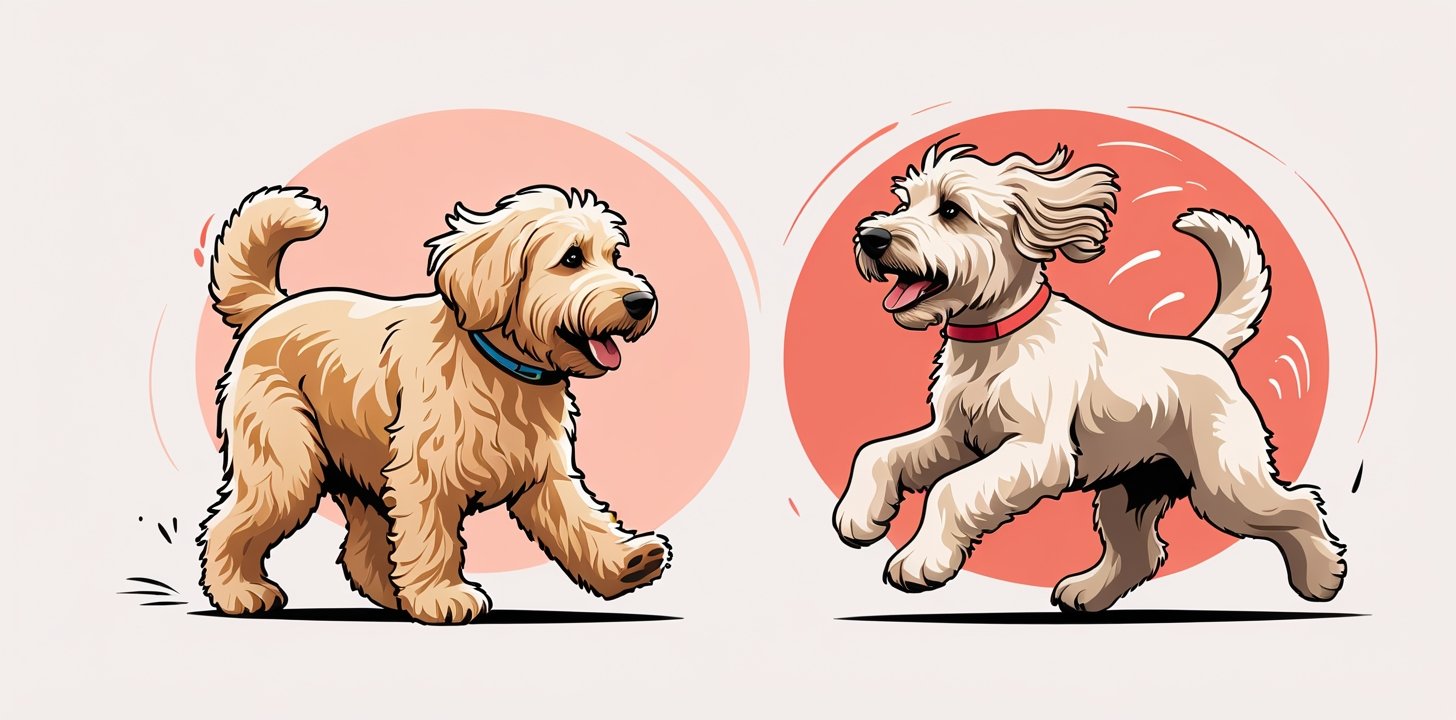
If your idea of cardio is walking to the fridge, the Goldendoodle is your co-pilot. If you run 5Ks for fun, the Labradoodle will happily log the miles. Winner: Labradoodle for pure, uncut pep.
Worth knowing: In colder climates like Canada and the northern US, both breeds handle outdoor activity well year-round. In hotter regions like Australia and the southern US, high-energy Labradoodles especially need exercise scheduled during cooler morning or evening hours.
Round 3: Grooming Grind — Fleece or Felony?
Both are certified high-maintenance: Goldendoodles need brushing 2-3 times per week and professional grooming every 6-8 weeks at roughly $100 per session. Labradoodles have more coat variety, which sounds like a perk until you realize “more variety” includes coats that mat faster if you skip a brushing session.

Annual grooming runs $500-1,200 for both. Neglect either one and you’re not dealing with a dog, you’re dealing with a sentient throw rug. Winner: Tie — both are fleece factories.
Warning: Grooming costs for both breeds run $500-1,200 per year. That’s before the emergency detangling appointment you’ll need after one rainy hike. Budget accordingly or learn to wield a slicker brush like a professional.
Round 4: Trainability and Smarts — Brainiac Brawl
Both breeds inherit Poodle intelligence, which means they learn fast and get bored faster. Goldendoodles are famously eager to please with low stubbornness, making them genuinely easy to train from day one. Labradoodles score high on trainability but carry a streak of Lab-side independence that occasionally turns “sit” into a negotiation.

Goldendoodles goof less during lessons. Winner: Goldendoodle — biddable bliss for first-timers.
Tip: Both breeds are highly trainable, but Goldendoodles are the slightly smoother ride for first-time dog owners. Pair early obedience training with puzzle toys and you’ll have a doodle genius on your hands. Early socialization is crucial for both breeds regardless of which you choose.
Round 5: Family Fit — Kiddo and Critter Champs?
Goldendoodles are gentle, playful, and famously patient with children, though their size and energy still warrant supervision around toddlers. Labradoodles are equally loving but bring more physical intensity to the party, which is wonderful for older kids and slightly chaotic for the under-three crowd.

Both breeds excel as therapy animals and are widely used in therapeutic settings across the US and UK. Goldendoodles edge this one out on sheer calm. Winner: Goldendoodle for family fluff.
Worth knowing: Labradoodle creator Wally Conron has publicly expressed regret about the breed’s creation, citing the explosion of puppy mills and irresponsible breeding that followed. This is a real concern for both doodle breeds. Always verify breeder health testing before purchasing.
Round 6: Health Hurdles — Vet Bill Vortex
Both breeds inherit health risks from their parent lines. Goldendoodles face hip and elbow dysplasia, progressive retinal atrophy (PRA), patellar luxation, and a notably higher cancer risk compared to many breeds. Labradoodles share the dysplasia and PRA concerns, plus elevated rates of epilepsy and Addison’s disease, with hip dysplasia affecting up to 50% of some lines.

Routine annual vet costs run $400-800 for both, with treatments ranging from $1,500-8,500 depending on the condition. The Orthopedic Foundation for Animals (OFA) and Canine Health Information Center (CHIC) both recommend hip, elbow, eye, and cardiac screenings for parent dogs before breeding. Winner: Labradoodle by a whisker, thanks to a slightly longer average lifespan of 12-15 years versus the Goldendoodle’s 10-15.
Warning: Screen breeding parents for PRA, hip dysplasia, and cardiac conditions through OFA and CHIC-certified testing. Treatments for hip dysplasia alone can run $1,500-6,000. Genetics are the single biggest factor in doodle health outcomes.
Round 7: Cost of Ownership — Wallet Workout
Purchase price runs $1,500-3,500 for both breeds, with wool-coated Labradoodles and multigenerational lines sometimes pushing higher. Monthly food costs $30-65, grooming runs $500-1,200 annually, and pet insurance averages $300-800 per year. First-year totals land at $2,000-7,000 for either breed, with ongoing annual costs around $1,500-3,000.

Grooming dominates both budgets. There is no financial winner here, only varying degrees of commitment. Winner: Tie.
Note on generations: F1 doodles (first-generation crosses) have the most genetic variability. F1B crosses (doodle bred back to a Poodle) tend to have curlier, lower-shedding coats. Multigenerational doodles offer the most predictable traits but require the most careful breeding oversight to maintain health.
The Scorecard: Doodle Duel Results
| Round | Winner |
|---|---|
| Size and Build | Tie |
| Energy Levels | Labradoodle |
| Grooming | Tie |
| Trainability | Goldendoodle |
| Family Fit | Goldendoodle |
| Health | Labradoodle |
| Cost | Tie |
Goldendoodle takes 2. Labradoodle takes 2. Three ties. This is the fluffiest photo finish in canine history.
The Real Winner
There is no knockout here. Both are exceptional family dogs, both are therapy superstars, and both will absolutely steal your spot on the couch within 48 hours of arriving home.
Choose a Goldendoodle if you want moderate energy, a goofier personality, slightly easier first-time training, and a dog that leans toward cuddles over chaos.
Choose a Labradoodle if you live an active lifestyle, want a highly sociable dog with serious stamina, and are ready to match their energy every single day.
Both breeds are popular across the US, Canada, Australia, and the UK, with availability varying by region and breeder. In warmer climates, coat type matters more for comfort. In colder regions, both breeds handle outdoor activity well year-round. Wherever you are, test your allergies before committing, commit to professional grooming, and verify health testing on both parents before purchasing from any breeder.
The real champ is whichever doodle fits your actual life, not your fantasy version of it.
Key Takeaway: Both Goldendoodles and Labradoodles excel as therapy dogs and family companions. Goldendoodles offer a slightly calmer entry point for first-time owners. Labradoodles reward active households with boundless loyalty and energy. Neither is a low-maintenance choice, and that’s exactly what makes them worth it.
Frequently Asked Questions
Which is better for first-time dog owners?
Goldendoodles get the edge here. Their eagerness to please and lower stubbornness make training more straightforward from the start. Labradoodles are also trainable but bring more intensity that benefits from experienced handling. Both require consistent early socialization and obedience work.
Do Goldendoodles or Labradoodles shed less?
Both are low-shedding by design, but neither is guaranteed shed-free. Shedding varies by generation and coat type. F1B crosses (backcrossed to a Poodle) tend to shed the least. Some Labradoodle lines with straighter coats shed more than expected.
Which breed is more hypoallergenic?
Neither breed is truly hypoallergenic, a fact the American Kennel Club is clear about for all dogs. Labradoodles were originally bred specifically for an allergic owner, giving them a slight edge in origin intent. F1B generations of both breeds offer the best odds for allergy sufferers. Always spend time with the specific dog before committing.
Are Goldendoodles more affectionate than Labradoodles?
Both breeds are highly affectionate and people-oriented. Goldendoodles are often described as goofier and more overtly cuddly. Labradoodles are equally devoted but channel more of that love into activity and play. Think snuggler versus adventure buddy, though plenty of individuals blur that line entirely.
Which doodle lives longer?
Labradoodles have a slight edge with an average lifespan of 12-15 years versus the Goldendoodle’s 10-15 years. Smaller sizes of both breeds tend to outlive their standard counterparts. Diet, exercise, and responsible breeding practices are the biggest factors in longevity for either breed.
Do Labradoodles or Goldendoodles have more energy?
Labradoodles consistently run higher on energy, needing 60-120+ minutes of structured daily activity. Goldendoodles are moderate, typically satisfied with 30-120 minutes of walks and play. If your lifestyle involves regular running, hiking, or active outdoor time, the Labradoodle is your match.
Which is better for families with children?
Both are excellent family dogs with proper socialization. Goldendoodles tend to be gentler and calmer around young children. Labradoodles are wonderful with older kids who can match their energy, but their exuberance warrants supervision around toddlers. Either breed benefits from early training and consistent boundaries.
What about Goldendoodle vs Labradoodle size differences?
Goldendoodles range from 15-75 lbs depending on whether the Poodle parent was miniature, medium, or standard. Labradoodles range from 15-90 lbs with similar size tiers. On average, standard Labradoodles run slightly larger. Both breeds offer miniature versions that adapt well to smaller living spaces when properly exercised.