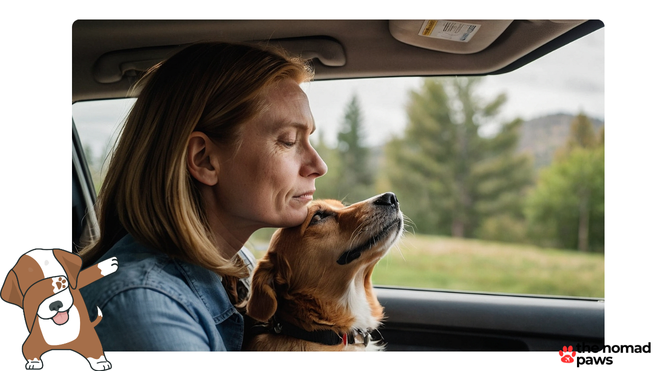

If your dog buries their head in your lap, chest, or arms multiple times a day, you’re probably wondering if it’s normal, sweet, or something to worry about.
You’re not imagining things, and you’re not alone in noticing this behavior. Here’s the good news: in most cases, this is healthy bonding behavior rooted in deep attachment science.
But there’s an important distinction you need to understand between normal comfort-seeking head burying and a neurological emergency called head pressing. Knowing the difference could save your dog’s life.
The Science Behind Head Burying Behavior
When your dog gently nuzzles their head into you, something remarkable happens in both your brains. Physical contact triggers the release of oxytocin (often called the “bonding hormone”) in both you and your dog. This neurochemical reward creates a self-reinforcing loop: the behavior feels good, so your dog repeats it, which strengthens your attachment bond even further.
This isn’t speculation. Research published in Science by Nagasawa and colleagues (2015) demonstrated that mutual gazing and physical contact between dogs and humans activate the same oxytocin pathways that bond human mothers to their infants.
Your dog isn’t manipulating you or being problematically needy. They’re engaging in a behavior that evolution shaped over thousands of years of cohabitation with humans.
Head burying also taps into ancestral canine instinct. In the wild, young canines bury their heads in their mother’s fur for warmth, safety, and scent bonding.
Domestic dogs retain this instinctual coping mechanism well into adulthood. When your dog presses their head against you during a thunderstorm or after you’ve been gone all day, they’re using you as what attachment researchers call a “secure base,” a safe haven for managing stress and uncertainty.
The behavior also triggers dopamine (the reward neurotransmitter) and serotonin (which regulates mood and anxiety). This triple neurochemical hit makes head burying one of the most self-reinforcing behaviors in a dog’s repertoire. Understanding this helps explain why some dogs do it constantly: it genuinely feels that good to them.
Why Some Dogs Do This More Than Others
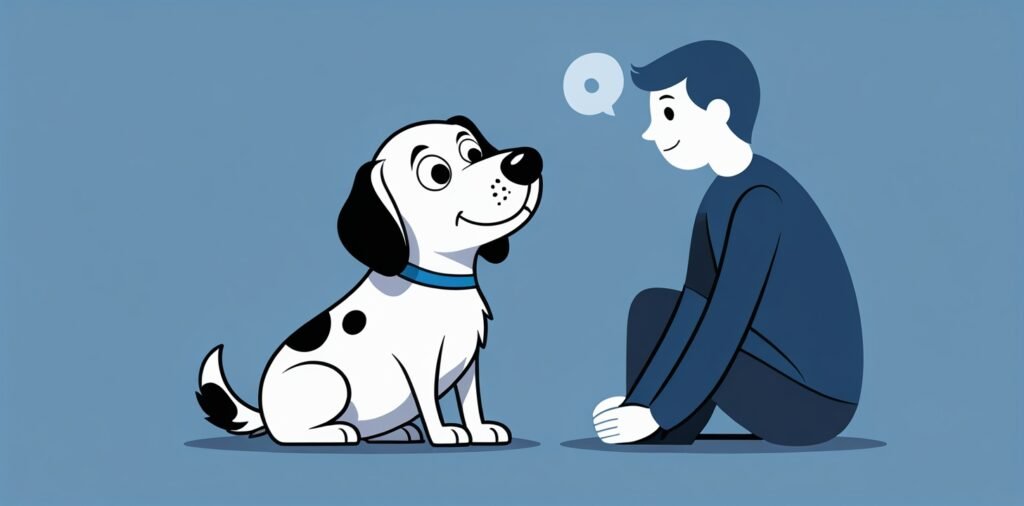
Breed genetics play a surprisingly large role. Research on canine behavioral heritability shows that attachment and attention-seeking behaviors have among the highest genetic components of all dog behaviors. This doesn’t mean every Cavalier King Charles Spaniel will bury their head in you, but it does mean the trait runs strong in breeds selectively bred for companionship.
Companion breeds like Cavaliers, Poodles, and Bichon Frises were intentionally bred over centuries to bond intensely with humans. Gun dogs and retrievers, bred to work closely with handlers, also show elevated attachment-seeking behaviors compared to more independent terrier or herding lineages.
That said, recent genomics research challenges old stereotypes. Individual variation within breeds often exceeds variation between breeds. A mixed-breed dog with unknown ancestry might show just as much head burying as a purebred companion dog.
Normal vs Concerning: Key Signs to Recognize
This is the most important section of this article. Most head burying is completely normal. Some head burying is a medical emergency. You need to know the difference immediately.
Healthy Comfort-Seeking Behaviors
Normal head burying looks like this: your dog approaches you with soft, relaxed body language. Their ears aren’t pinned back. Their tail isn’t tucked under their body. They gently press their head into your lap, chest, or the crook of your arm and hold the position for 10 to 60 seconds. They might sigh contentedly or close their eyes. Their body stays loose and relaxed.
You can redirect them easily. If you stand up or offer them a toy, they respond. The behavior happens in context: during cuddle time on the couch, after you come home from work, during a thunderstorm when they’re seeking reassurance. It doesn’t consume their day or interfere with normal activities like eating, playing, or sleeping.
Some normal variations include:
- Burrowing under blankets or pillows while maintaining soft, relaxed posture
- Pushing their snout gently under your arm repeatedly until you lift it and let them snuggle in
- Leaning their full head weight against your hand or leg while making eye contact
- Restless repositioning for 20 to 30 seconds until they achieve the “perfect” head contact angle, then settling
- Soft vocalizations like sighs, gentle groans, or quiet “talking” sounds during the contact
If your dog’s head burying looks like this, you’re witnessing healthy attachment behavior. No intervention needed beyond managing it if it becomes excessive.
Red Flag Warning Signs
Now we need to talk about head pressing, and this is where things get serious. Head pressing is not the same behavior as head burying. It’s a neurological symptom that requires immediate veterinary attention.
Head pressing looks like this: your dog stands facing a wall, door, or piece of furniture and presses their head against it with sustained, rigid force. They might hold this position for minutes at a time. Their body is stiff, not relaxed. They seem compulsive about it. You can call their name, offer treats, or try to redirect them, and they either don’t respond or immediately return to pressing their head against the surface.
Head pressing is often accompanied by other neurological signs:
- Lethargy or unusual drowsiness
- Vomiting or loss of appetite
- Disorientation or confusion (walking into walls, getting stuck in corners)
- Circling repeatedly in one direction
- Seizures or tremors
- Changes in vision (bumping into objects, dilated or unresponsive pupils)
- Behavioral changes like sudden aggression or withdrawal
Head pressing can indicate life-threatening conditions including hepatic encephalopathy (liver disease causing toxin buildup in the brain), brain tumors, encephalitis, stroke, toxin exposure (lead, certain molds, chemicals), or severe metabolic imbalances. These conditions require emergency diagnostic workup including bloodwork, neurological examination, and often CT or MRI imaging.
YMYL Medical Disclaimer: If your dog shows rigid, compulsive head pressing against walls or objects, especially if accompanied by vomiting, lethargy, disorientation, or seizures, this is a veterinary emergency. Do not wait. Contact your veterinarian or emergency animal hospital immediately. Head pressing is not a behavioral issue you can train away; it’s a symptom of potentially fatal neurological dysfunction.
The key distinction: burying is soft, responsive, goal-directed contact with you. Pressing is rigid, compulsive, irrational pushing against inanimate objects with no social goal. If you’re not sure which you’re seeing, err on the side of caution and call your vet.
Common Triggers for Head Burying
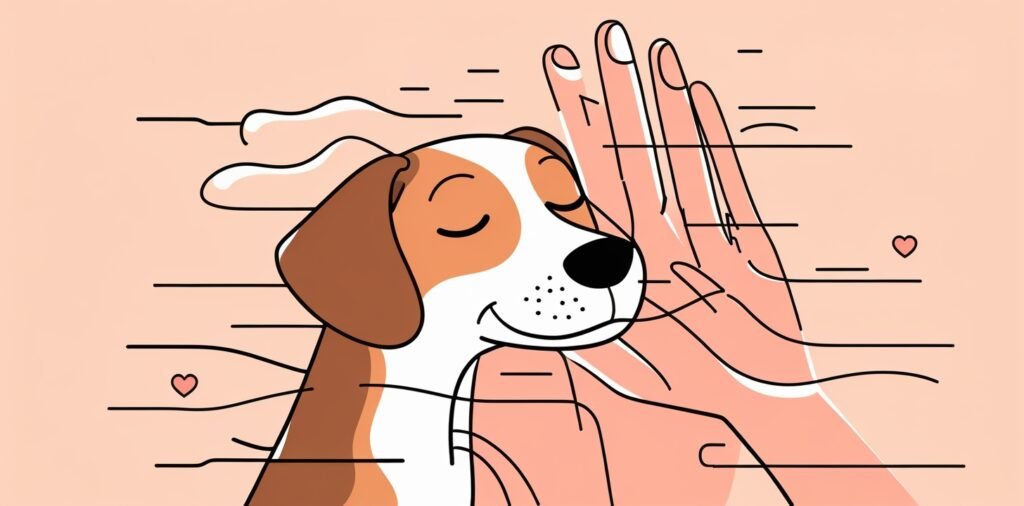
Understanding what triggers head burying helps you distinguish between normal bonding, anxiety-driven comfort-seeking, and attention-seeking behavior that needs gentle management.
Bonding and attachment is the most common trigger. Your dog has learned that physical contact with you releases those feel-good neurochemicals. This typically happens during calm moments: evening relaxation on the couch, quiet mornings before the household wakes up, or reunion moments after you’ve been separated. Duration is usually brief (30 to 90 seconds) and your dog settles afterward.
Environmental stress is the second major trigger. Loud noises like thunderstorms, fireworks, vacuum cleaners, or construction sounds send many dogs seeking the safety of their owner’s body. The doorbell ringing, car alarms, or visitor arrivals can trigger the same response. Your dog’s body language during stress-triggered head burying looks different: ears pinned back, tail tucked, visible whites of the eyes (called “whale eye”), sometimes panting or trembling.
Separation anxiety often manifests as increased head burying before you leave. If your dog follows you from room to room and intensifies head burying when you pick up your keys or put on shoes, they’re trying to prevent the separation. This version needs professional intervention, not just management.
Overstimulation can paradoxically trigger head burying. After intense play sessions, when multiple guests visit, or during high-energy activities, some dogs bury their heads as a reset mechanism. Think of it like a toddler who gets overwhelmed at a birthday party and needs to hide their face in a parent’s shoulder. The dog is seeking sensory regulation.
Attention-seeking is the version that most often needs training intervention. If your dog has learned that burying their head in you reliably earns eye contact, verbal attention, petting, or treats, they’ll increase the frequency. This version often escalates: head burying becomes head burying plus pawing, plus jumping, plus vocalizing. The dog’s body language is tense, not relaxed. Eyes are wide and focused on you. They’re persistent and difficult to redirect.
Travel and Nomadic Lifestyle Stress
If you live a nomadic lifestyle or travel frequently with your dog, expect head burying to increase significantly during transitions.
Unfamiliar environments, absence of routine, vehicle motion, new smells, and unpredictable schedules all trigger proximity-seeking behavior. Dogs traveling full-time often show two to three times their baseline head burying frequency during the first 24 to 48 hours in a new location.
This isn’t pathological. It’s a normal stress response. Your dog is using you as their one constant in an ever-changing environment. The behavior typically stabilizes within two to three days once you establish a routine in the new space. If it doesn’t, or if it’s interfering with your dog’s ability to settle and rest, you’ll need the travel-specific training protocol outlined later in this article.
What NOT to Do: Debunking Harmful Advice
Before we get to what works, let’s address what doesn’t and why some of the advice you’ll find online is not just ineffective but actively harmful.
Myth: “Your dog is trying to dominate you. You need to assert yourself as pack leader.”
This advice still circulates in some training circles, and it’s completely wrong. Head burying demonstrates vulnerability and trust, not dominance. The entire foundation of dominance theory in dog training has been rejected by the American Veterinary Society of Animal Behavior (AVSAB) in their 2008 position statement on humane dog training.
The original “alpha wolf” studies that spawned dominance theory were conducted on captive wolves in artificial pack structures. Subsequent research by L. David Mech on wild wolf packs showed that pack leadership is based on parental relationships and cooperative behavior, not aggressive dominance. Applying this flawed model to domestic dogs, who evolved alongside humans for 15,000 to 30,000 years, makes even less sense.
Trainers who use dominance theory often recommend confrontational techniques: alpha rolls (forcing the dog onto their back), scruff shakes, or physically blocking them. A 2009 study by Herron and colleagues published in Applied Animal Behaviour Science found that these confrontational techniques frequently elicited aggressive responses in dogs. These methods damage trust and potentially trigger fear-based aggression.
Head burying is attachment behavior rooted in oxytocin bonding. The science is clear on this.
Myth: “You should never interrupt or redirect head burying because it damages your bond.”
This is the opposite extreme, and it’s also problematic. Normal comfort-seeking head burying doesn’t need intervention. But excessive attention-seeking versions, where your dog is burying their head in you 10, 15, 20 times a day and escalating to jumping, pawing, and vocalizing, do need gentle management.
Allowing unmanaged escalation can lead to compulsive patterns. Dogs whose attention-seeking behavior never receives clear boundaries often become increasingly frustrated and anxious. The behavior intensifies because it’s inconsistently reinforced: sometimes it works (you give attention), sometimes it doesn’t (you’re busy), and that unpredictability creates what behaviorists call a “variable reinforcement schedule,” the most powerful type for strengthening behavior.
Teaching your dog when proximity-seeking is appropriate and when they need to self-soothe doesn’t damage your bond. Secure attachment actually requires some degree of independence. Dogs with anxious attachment styles, those who can’t tolerate any separation or lack of constant contact, benefit from structure and predictable responses.
The correct approach: allow and even encourage normal comfort-seeking head burying during appropriate times (cuddle sessions, post-separation reunions, stressful events). Gently redirect excessive attention-seeking versions using positive reinforcement. This clarifies expectations without punishment.
Myth: “If your dog buries their head, something is medically wrong.”
This myth causes unnecessary panic and expensive vet visits for normal behavior. The vast majority of head burying is healthy bonding behavior. Research on attachment confirms that head burying correlates with secure oxytocin-mediated bonding, not illness.
The confusion arises from conflating head burying with head pressing. As covered earlier, these are completely different behaviors with different implications. A soft, responsive head nuzzle into your lap while your dog maintains normal eating, playing, and sleeping patterns is not a medical concern. A rigid, compulsive head press against a wall accompanied by lethargy, vomiting, or disorientation is an emergency.
If your dog is otherwise healthy, eating well, playing normally, and responding to you, their head burying is almost certainly normal attachment behavior.
Step-by-Step Training Protocol
This protocol is designed for dogs showing excessive attention-seeking head burying: multiple times per day with escalating intensity, jumping, pawing, or vocalizing alongside the behavior.
If your dog’s head burying is limited to calm bonding moments and doesn’t interfere with daily function, you don’t need this protocol. Just enjoy the snuggles.
Timeline expectation: Full behavior modification typically takes 8 to 12 weeks of consistent work. You’ll see initial improvement around weeks 3 to 4, significant reduction by weeks 5 to 6, and stabilization by weeks 7 to 8.
Dogs with high genetic predisposition to attachment-seeking may plateau at 50% reduction rather than complete elimination, and that’s normal and acceptable. The goal isn’t to eliminate bonding behavior; it’s to manage excessive attention-seeking while preserving healthy attachment.
Phase 1: Baseline and Environmental Setup (Weeks 1 to 2)
You cannot modify a behavior you haven’t measured. Start by understanding exactly what you’re working with.
- Document your baseline. For seven consecutive days, track every head burying episode. Note the time, duration (in seconds), what you were doing immediately before, and how you responded. Use your phone’s notes app or a simple tally sheet. This data tells you if you’re actually seeing improvement later.
- Identify your triggers. Review your tracking data. Does head burying cluster when you’re on your laptop? During meal prep? When you’re on the phone? Identifying patterns lets you manage the environment proactively.
- Establish exercise minimums. Before any training can work, your dog needs adequate physical outlet. Minimum 30 to 45 minutes of aerobic exercise daily: fetch, running, swimming, or vigorous play. Research shows that adequate exercise reduces attention-seeking behavior by 40 to 50%. This isn’t optional.
- Set up enrichment protocols. Provide three to four enrichment activities daily on a schedule: puzzle toys, sniff mats, lick mats, frozen Kongs. The key is scheduled, not reactive. Don’t hand your dog a puzzle toy when they’re head burying (that’s rewarding the behavior). Provide it during calm moments.
- Create environmental boundaries. If your dog can see you working at your desk, they’ll seek interaction. Set up a baby gate or closed door during “working hours.” Use consistent visual cues: closed door means unavailable, open living space means available for interaction. Dogs learn these patterns quickly.
Success markers for Phase 1: You have seven days of baseline data. Your dog is getting daily exercise. Enrichment toys are in rotation. You’ve identified the top three contexts where head burying happens most.
Phase 2: Attention Reallocation (Weeks 3 to 4)
Now you’re teaching your dog that head burying no longer earns attention, but calm behavior does. This is where the actual behavior change begins.
- Implement differential reinforcement. When your dog buries their head in you, provide zero response. No eye contact. No talking. No touching. No pushing them away (that’s interaction). Turn your body slightly away. Stay boring. Wait 30 full seconds after the head burying stops before you engage with your dog in any way. This breaks the reinforcement cycle.
- Heavily reward calm proximity. When your dog is near you but NOT burying their head (lying down next to your feet, sitting calmly beside you, leaning against your leg without pushing), immediately deliver a high-value treat plus soft verbal praise. Say “Good settle” in a calm tone. You’re teaching them that calm presence earns rewards, not demanding contact.
- Teach a redirect cue. Choose a specific cue like “Go to your mat” or “Find your toy.” Practice this 5 to 10 times daily during low-stress moments. Say the cue, lure your dog to their mat or toy with a treat, reward heavily when they comply. Practice for 3 to 5 minutes per session for 7 to 10 days. Build this as a strong, reliable behavior before you use it during head burying episodes.
- Use interrupt-and-redirect. When head burying starts, use a neutral-toned “uh-uh” (not harsh, just informational), then immediately give your redirect cue. When your dog complies (goes to mat, picks up toy), reward with three to five high-value treats in rapid succession. You’re making the alternative behavior extremely rewarding.
- Remove access if needed. If your dog persists in head burying after two redirect attempts, calmly stand up and walk to another room for 30 to 60 seconds. No drama. No scolding. Just removal of access to you. Return and try again. This teaches that persistence doesn’t work.
Success markers for Phase 2: Head burying frequency drops 30 to 40% from baseline. Your dog begins offering calm behaviors (lying down near you, settling on their mat) without prompting. You can successfully redirect head burying with your cue at least 60% of the time.
Expected challenge: Around week 3, you may see an “extinction burst,” where head burying temporarily increases in frequency and intensity. This is your dog trying harder because the old strategy isn’t working. This is normal and expected. Do not give in. Continue the protocol. The burst typically lasts 3 to 5 days, then behavior drops significantly.
Phase 3: Building Independence Skills (Weeks 5 to 6)
Now you’re teaching your dog that being calm and independent is rewarding in itself. This builds confidence and reduces dependency on constant owner proximity.
- Practice structured alone time. Set up 5 to 10 minute sessions where your dog is in an adjacent room with the door open (you’re visible but not interactive). Provide a puzzle toy or chew. Practice 2 sessions daily for 5 to 7 days. Gradually increase to closed-door sessions. If your dog scratches or vocalizes at the door, you’ve progressed too fast. Go back to shorter duration.
- Teach “settle” as a formal cue. During naturally calm moments, mark the behavior with a clicker or verbal “yes,” then reward. You’re capturing and naming the behavior. Practice 3 to 5 sessions of 5 minutes daily for 7 to 10 days until your dog understands that “settle” means “lie down calmly on your mat and stay there.” Build duration gradually: 2 minutes, then 5, then 10.
- Increase duration systematically. Week 5 goal: 5 minutes of calm settlement on mat while you’re in the room but not interacting. Week 6 goal: 10 to 15 minutes. If head burying resurges, you’ve increased difficulty too quickly. Drop back to the previous duration for 3 to 5 more days.
- Introduce variable reinforcement. Instead of rewarding every calm settle, start rewarding randomly: sometimes after 2 minutes, sometimes after 7 minutes, sometimes after 12 minutes. This actually strengthens the behavior because your dog learns that persistence pays off unpredictably. This mirrors how natural reinforcement works in the real world.
- Normalize calm owner proximity. Practice being in the same room with your dog while you read, work on your laptop, or do other activities that don’t involve them. Periodically reward calm behavior without making a big deal of it. Just drop a treat beside them while they’re settled. You’re teaching that your presence doesn’t always mean interaction.
Success markers for Phase 3: Your dog can settle independently for 10 to 15 minutes without seeking attention. Head burying frequency is down 50 to 70% from baseline. Your dog proactively seeks out their mat, toys, or resting spot instead of constantly following you.
Teaching Alternative Comfort Behaviors
Some dogs bury their heads because they genuinely need comfort during stressful moments, not just attention. Give them alternative outlets that serve the same emotional function.
Teach “touch” as a structured affection cue. Hold your hand out, palm facing your dog. Say “touch.” When your dog bumps your hand with their nose, mark with “yes” and reward. Practice 3 sessions of 5 minutes daily for 7 to 10 days until reliable. Now you have an on-demand way to provide brief, structured affection when your dog seeks it. This satisfies the need for contact without allowing the behavior to become excessive.
Create a “safe space” routine. Designate a specific bed, crate, or corner as your dog’s safe space. During stressful events (thunderstorms, fireworks, visitors), direct your dog there, provide a high-value chew or puzzle toy, and stay nearby but calm. You’re teaching them that the space itself provides security, not just contact with you.
Use calming protocols during stress. When you know a stressful event is coming (you’re leaving for work, guests are arriving), do a brief calming routine: 5 minutes of slow, rhythmic petting along your dog’s sides, soft verbal reassurance, then redirect to a puzzle toy or chew. This provides the comfort they’re seeking in a structured, time-limited way.
Managing Attention-Seeking Head Burying
If your dog’s head burying is primarily attention-seeking (tense body, wide eyes, paired with pawing or vocalizing), you need clear boundaries paired with alternative ways to earn attention.
Establish “available” vs “unavailable” signals. When you’re available for interaction, sit in a specific chair or area. When you’re unavailable (working, cooking, on the phone), use a visual cue like closing a door, putting on headphones, or sitting at your desk. Dogs learn these contextual cues quickly. Reward your dog heavily for respecting the “unavailable” signal by settling independently.
Schedule interaction time. Set specific times for play, training, or cuddle sessions: maybe 15 minutes after breakfast, 20 minutes in the evening. Use a timer. During these sessions, engage fully. Outside these times, redirect attention-seeking. This teaches your dog that attention is predictable and abundant, just not on-demand 24/7.
Reward alternative attention-seeking. If your dog brings you a toy instead of burying their head, reward that immediately. If they sit calmly and make eye contact instead of jumping and head-butting, reward that. You’re shaping the behavior toward more appropriate forms of interaction.
Special Considerations for Traveling Dogs
If you live a nomadic lifestyle or travel frequently with your dog, head burying often intensifies during transitions.
This is normal. Your dog is experiencing repeated disruption to their routine, unfamiliar environments, and loss of familiar scent markers. You are their one constant. Expect head burying to spike 30 to 50% above baseline during the first 48 hours in any new location.
The key is maintaining as much consistency as possible across changing environments.
Pack a portable enrichment kit. Bring the same puzzle toys, sniff mats, and chews to every location. Set them up in the same configuration: bed in the corner, water bowl to the left, toys in a specific basket. This sensory consistency helps your dog settle faster. Research on travel anxiety shows that familiar object placement reduces stress behaviors significantly.
Establish an arrival routine. Before entering any new space (hotel room, Airbnb, campsite), do a 10-minute decompression walk. Let your dog sniff extensively. This “sniffari” allows them to gather information about the new environment and release stress. Only after this walk should you bring them inside and set up their space.
Maintain training consistency across caregivers. If you’re traveling with a partner or family, everyone must use the same redirect cues, differential reinforcement protocols, and reward timing. Inconsistency across handlers resets training progress. Have a brief conversation before each trip: “When the dog head buries, we both ignore for 30 seconds, then redirect to mat, then reward.”
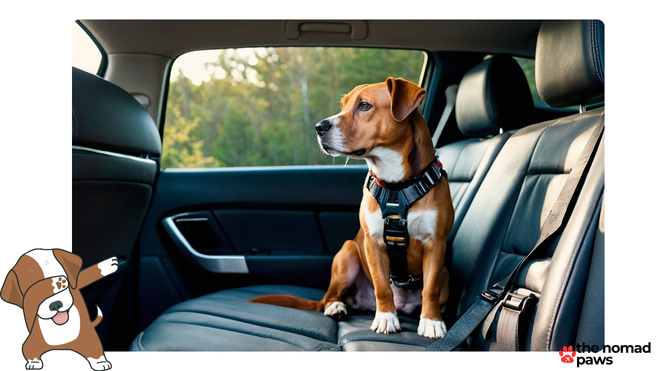
Manage vehicle anxiety separately. If your dog’s head burying intensifies specifically during car rides, you’re dealing with travel anxiety that needs its own protocol. Start with stationary car sessions: sit in the parked car with your dog, provide high-value treats, then exit. Practice 5 to 10 minutes daily for 7 days. Week 2: engine on, no movement. Week 3: drive to the end of the driveway and back. Week 4: around the block. Week 5: short purposeful trips. Week 6: longer trips. This systematic desensitization typically takes 6 to 8 weeks but significantly reduces travel-related stress behaviors.
Increase enrichment frequency during travel. What works at home (three puzzle toys daily) may need to double during travel (six puzzle toys daily). Your dog has fewer familiar outlets for stress, so provide more structured ones. This isn’t spoiling them; it’s meeting increased environmental demand.
Use calming aids appropriately. Adaptil (dog-appeasing pheromone) diffusers or collars can help during travel transitions. These synthetic pheromones mimic the calming scent nursing mother dogs produce. They don’t sedate your dog; they just take the edge off environmental stress. Plug in a diffuser in each new space 2 to 3 hours before your dog arrives if possible.
Accept temporary regression. Even a well-trained dog will show increased head burying during major transitions. If your dog has been stable at 1 to 2 head buries per day and suddenly spikes to 5 to 6 during a cross-country move, that’s expected. Maintain your training protocol, increase enrichment, and expect stabilization within 3 to 5 days. Don’t panic and don’t abandon the training structure you’ve built.
When to Seek Professional Help
Most head burying can be managed with the protocol outlined above. But some situations genuinely require professional intervention. Here’s when to call for help and what type of professional you need.
Immediate veterinary emergency (within hours):
- Rigid head pressing against walls, doors, or furniture that doesn’t respond to redirection
- Head pressing accompanied by vomiting, lethargy, disorientation, or seizures
- Sudden onset of compulsive head behavior in a dog with no prior history
- Head pressing with visible neurological signs: loss of coordination, circling, behavioral changes, vision problems
Contact your veterinarian or emergency animal hospital immediately. Expect diagnostic workup including complete blood count, chemistry panel, neurological examination, and possibly CT or MRI imaging. Cost range: $500 to $3,000+ depending on diagnostics needed.
Veterinary behaviorist consultation (within 2 to 4 weeks):
- Head burying occurring 15+ times daily for more than two weeks despite training intervention
- Compulsive pattern developing: head burying interfering with eating, sleeping, or normal daily function
- Concurrent severe anxiety signs: destructive behavior, self-harm, inability to settle, constant pacing
- Head burying accompanied by aggression, resource guarding, or other concerning behavioral changes
A Diplomate of the American College of Veterinary Behaviorists (DACVB) is a veterinarian with specialized training in animal behavior. They can prescribe behavioral medication if needed and develop comprehensive treatment plans. Initial consultation cost: $400 to $800. Find one through the American College of Veterinary Behaviorists directory.
Alternatively, a Certified Applied Animal Behaviorist (CAAB) holds a graduate degree in animal behavior and can develop detailed behavior modification plans. They cannot prescribe medication but work closely with your veterinarian if medication is warranted. Cost: $300 to $600 for initial consultation.
Certified dog trainer consultation (within 1 to 2 weeks):
- Head burying is primarily attention-seeking and occurring 8+ times daily
- Training protocol from this article isn’t producing 30% reduction by week 4
- You need help implementing the protocol or troubleshooting specific challenges
- Travel-related head burying is interfering with your nomadic lifestyle
Look for a CPDT-KA (Certified Professional Dog Trainer, Knowledge Assessed) credential. This certification requires 300+ hours of training experience, passing a comprehensive exam, and continuing education. Verify they use positive reinforcement methods. Ask directly: “Do you use aversive tools like prong collars, shock collars, or alpha rolls?” The answer should be an unequivocal no.
Cost: $100 to $200 per session, typically 3 to 6 sessions needed. Many trainers offer virtual consultations, which work well for behavior issues like this. Find certified trainers through the Certification Council for Professional Dog Trainers directory.
Separation anxiety specialist (within 1 week if severe):
- Head burying intensifies dramatically before you leave and is accompanied by destructive behavior, house soiling, or escape attempts when you’re gone
- Your dog cannot tolerate being alone for even 5 to 10 minutes without panic
- Head burying is part of a broader separation anxiety pattern
Separation anxiety requires specialized systematic desensitization protocols. Look for trainers certified through the Separation Anxiety Certification Program (SACP) or Malena DeMartini’s program. These specialists work almost exclusively on separation issues and typically offer virtual training. Cost: $400 to $1,200 for complete protocol implementation over 8 to 12 weeks.
What to expect from professional help: A qualified professional will take a detailed behavioral history, observe your dog directly (in person or via video), rule out medical causes, develop a customized behavior modification plan, and provide ongoing support as you implement it. They should never recommend punishment, dominance-based techniques, or aversive tools. If they do, find a different professional.