
Short answer: Yes, your dog can land in Hawaii and go home with you the same day. It needs a microchip, two rabies shots, a passing FAVN blood test, a 30-day wait, papers received at least 10 days ahead, and a health certificate and tick treatment from the last 14 days.
Plan on at least four months for a grown dog and ten for a puppy, budget $185 in state fees, and fly Alaska or Hawaiian, because Delta and United don’t carry pets there.
Picture the moment: you step off a long flight into that warm, flower-scented Honolulu air, and an hour later your dog is in the car with you instead of in a kennel for four months. That’s what Hawaii’s rules make possible, if you get the order of things right.
Hawaii is the only rabies-free state in the country and has guarded that since 1912, so its rules are stricter than anywhere else in the US. They’re also very precise, and the dates are where it’s easiest to slip.

I rebuilt this guide in October 2026 from the state’s own checklists, forms and rules, so here is the whole process in order, with the fees, the airlines that actually fly pets there and the traps worth knowing about.
| What | The rule in 2026 |
|---|---|
| Microchip | In before the FAVN blood draw, US or ISO type |
| Rabies shots | At least two in its life, more than 30 days apart |
| Blood test | FAVN only, 0.5 IU/ml or higher, at an approved lab |
| Waiting period | 30 days, counted from the day after the lab receives the blood |
| Papers | Received more than 10 days before arrival (30 for neighbor islands) |
| Health certificate | Within 14 days of arrival, with tick treatment |
| State fee | $185 same-day release in Honolulu |
| Airlines | Alaska Airlines and Hawaiian from the mainland |
| Lead time | At least 4 months (10 for a newborn puppy) |
From the Hawaii Department of Agriculture & Biosecurity’s animal quarantine pages, checklists and form AQS-279, checked 21 October 2026.
Five ways your dog can enter Hawaii
Hawaii’s 5 Day Or Less program has been running since June 30, 2003, and it covers every dog and cat, whatever its age or the reason it’s coming. Inside it there are a few routes, and the one you aim for decides your deadlines.
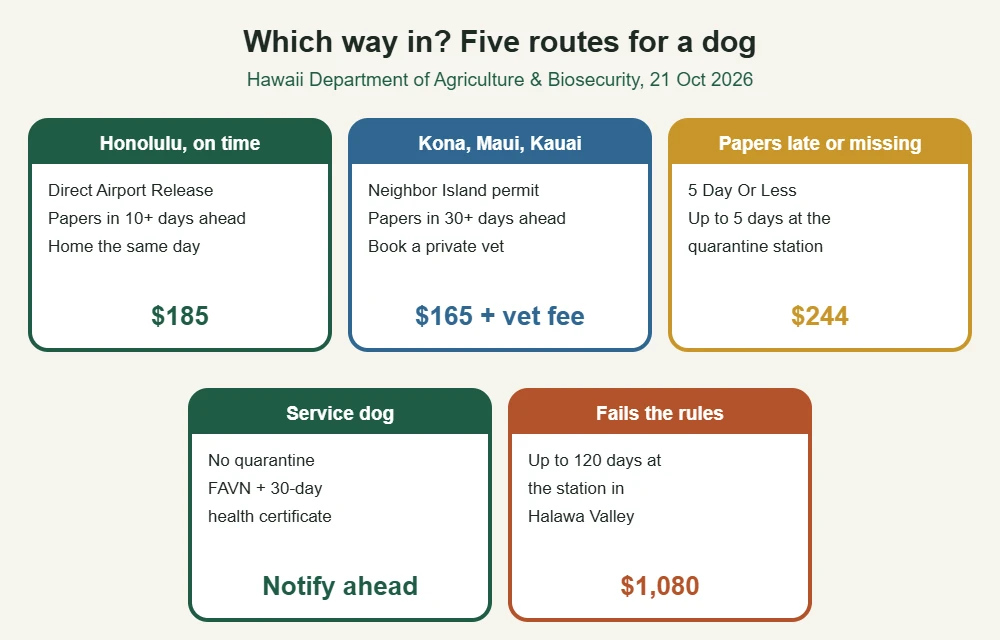
The best outcome is Direct Airport Release: your dog is inspected at Honolulu airport and leaves with you, usually within an hour. If your papers are late or something needs a closer look, the dog can spend up to five days at the quarantine station instead.
Flying straight into Kona, Kahului or Lihue works too, with a Neighbor Island Inspection Permit and earlier deadlines. A dog that can’t meet the rules faces up to 120 days of quarantine, which is the outcome all of this is designed to avoid.
The countdown, step by step
The state says it takes at least four months to qualify a grown dog that has already had one rabies shot, and at least 10 months for a newborn puppy. With lab delays in 2026, I’d give yourself more.
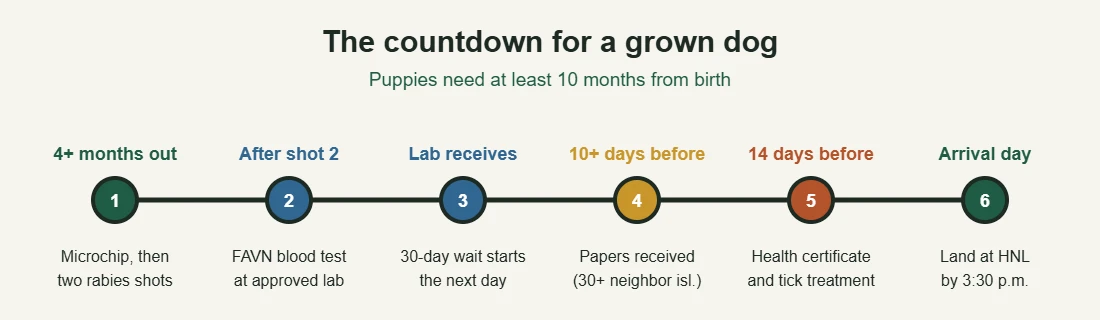
1. Microchip first
Your dog needs a working microchip before, or at the same visit as, the blood draw for the rabies test. Hawaii accepts both US and ISO type chips, so you don’t need a special 134.2 kHz chip, but it does have to scan.
A dog that can’t be identified by its chip on arrival doesn’t qualify for release at the airport, so ask your vet to scan it at every visit.
2. Two rabies shots
Your dog needs at least two rabies vaccinations in its life, given more than 30 days apart. Puppies can’t get their first shot before three months of age.
The most recent shot has to be more than 30 days before you land and still within its licensed booster interval: 12 months for a one-year vaccine, 36 months for a three-year one.
Each certificate needs the vaccine name, lot or serial number, booster interval, vaccination date and lot expiry date. If you only have paperwork for the latest shot, your dog won’t qualify until it has had another booster.
3. The FAVN blood test
This is the step that sets your timeline. Hawaii only accepts the FAVN rabies antibody test, and the result must be 0.5 IU/ml or higher.
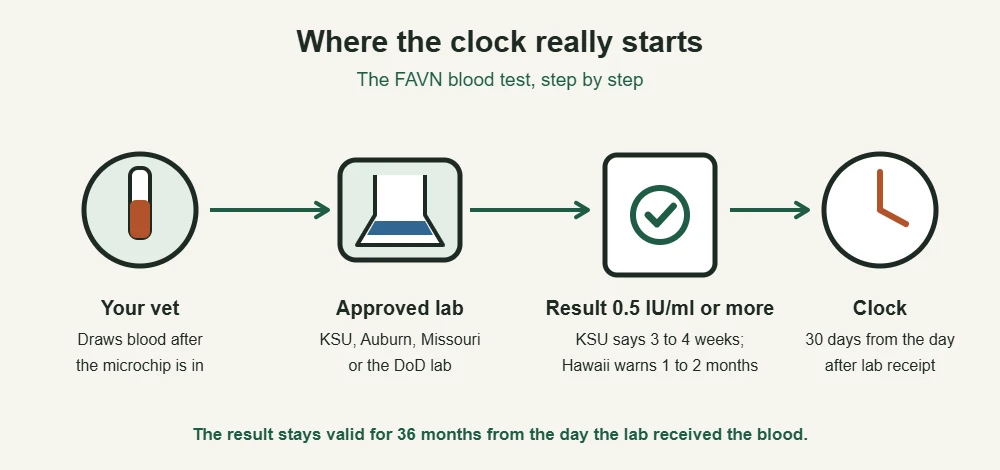
Only four labs count: Kansas State, Auburn, the University of Missouri and the DoD lab, which is only open to DoD beneficiaries. The RFFIT test and KSU’s Micro Screen test are not accepted.
At Kansas State the FAVN test cost $86.00 plus a $7.50 accession fee when I checked in October 2026. Your vet’s fee for the blood draw and the shipping come on top.
KSU quotes three to four weeks for results with no rush option, while Hawaii warns that results can take one to two months right now. Ask KSU to list HAWAII as the destination, because it sends the official result straight to the state.
Two traps catch people. Sending the sample through an intermediate lab such as Antech or Idexx can delay the date the approved lab receives it, and drawing blood at the same visit as a rabies shot can make the test fail.
4. The 30-day wait
After a passing test, your dog must wait at least 30 days before arriving. The count starts the day after the approved lab received the blood, and the result stays valid for 36 months from that receipt date.
Arrive early and your dog stays at the quarantine station until the 30 days are up, at $14.30 a day on top of the $244 program fee, with no exceptions.
5. Send the papers
Fill in the Dog & Cat Import Form AQS-279, one per pet, and send it with your documents so they are received more than 10 days before you land in Honolulu. It doesn’t need to be notarized.
Since March 2, 2026 you can also apply online through the Hawai‘i Pet Owner Portal (HIPOP), paying by Visa or Mastercard. Mailed applications are still accepted, with cashier’s checks or money orders payable to the Department of Agriculture & Biosecurity.
One detail on names: the department was renamed in July 2025, so older checklists still say Department of Agriculture. A pet transport company can help, but it can’t be listed as your dog’s owner.
6. Health certificate and tick treatment
Within 14 days of arrival your dog needs an original health certificate in English, and a long-acting tick treatment whose product name and date go on that certificate.
Hawaii’s rule says the certificate is issued by a veterinarian. Some airlines want it done within 10 days, so check yours and aim for the tighter window.
Revolution doesn’t count. Hawaii keeps a list of accepted active ingredients, last updated October 12, 2026, which includes fipronil and oral products such as fluralaner, afoxolaner, sarolaner and lotilaner. Our NexGard comparison explains one of them.
Since New World Screwworm was found in the US on June 3, 2026, the health certificate also needs a statement that your dog was inspected and found free of it. Ticks found on arrival rule out release at the airport.
Arrival day in Honolulu
No permit is needed to fly a dog into Honolulu.
Book a flight that lands by 3:30 p.m., because inspections run from 8:30 a.m. to 4:30 p.m. every day.
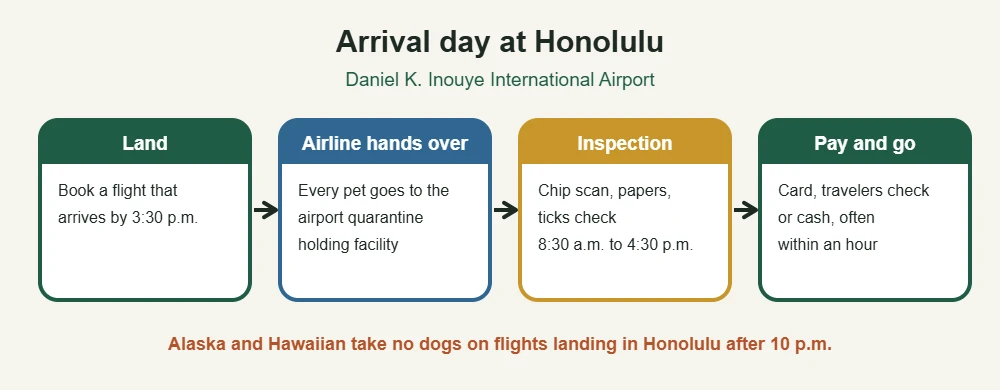
When you land, the airline takes every pet, including cabin pets, to the Airport Animal Quarantine Holding Facility. There the inspector scans the chip, checks the papers and looks for ticks, and most dogs are released within an hour.
You can pay at the airport by Visa, Mastercard, travelers check or cash. If you have a connecting flight, allow at least four to five hours, and remember your dog stays in its crate on airport property.
A dog held overnight has to be collected by 10 a.m. the next morning, or there’s an extra $59. Coming from abroad, your dog also has to clear US Customs first and meet the CDC rules for dogs entering the US.
Flying straight to a neighbor island
To land with your dog in Kona, Kahului or Lihue you need a Neighbor Island Inspection Permit, and the permit has to be for the first Hawaii airport you land at.
Your papers and a passing FAVN must be in 30 days or more before you arrive, and you must arrange an approved private vet at that airport, who charges their own fee on top of the $165 permit. Print the permit, because you need it to board.
If your flight changes, it’s up to you to tell the inspector named on the permit. A dog that is refused entry on a neighbor island goes to Honolulu or back out of the state, at your expense.
What it all costs
The state fees are simple once you know which route you’re on, and they haven’t changed in 2026.
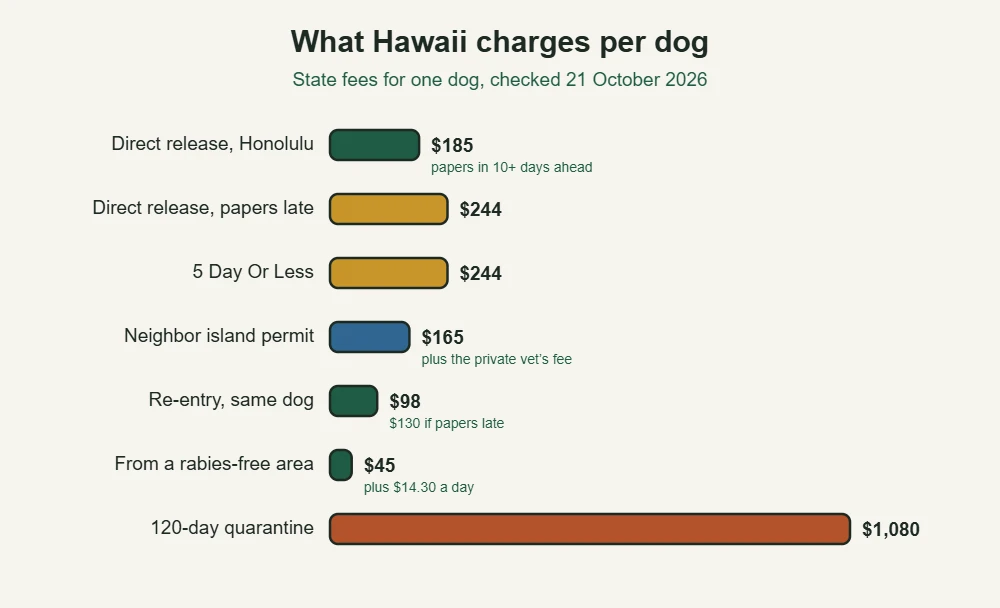
Direct Airport Release in Honolulu is $185 when your papers arrive more than 10 days ahead, and $244 when they don’t. The 5 Day Or Less program is also $244, and the neighbor island permit is $165 plus the vet.
Coming back with the same dog can be cheaper: the re-entry fee is $98, as long as you don’t redo the FAVN test or the rabies shot used to qualify. A dog that stays past its release date pays $17.80 a day.
Add the FAVN test, your vet visits, the tick treatment and the airline fee to work out your own total. Our guide to what it costs to ship a dog covers pet shippers.
Which airlines fly dogs to Hawaii
This is where many plans fall apart, because most big US airlines don’t carry pets to Hawaii at all.
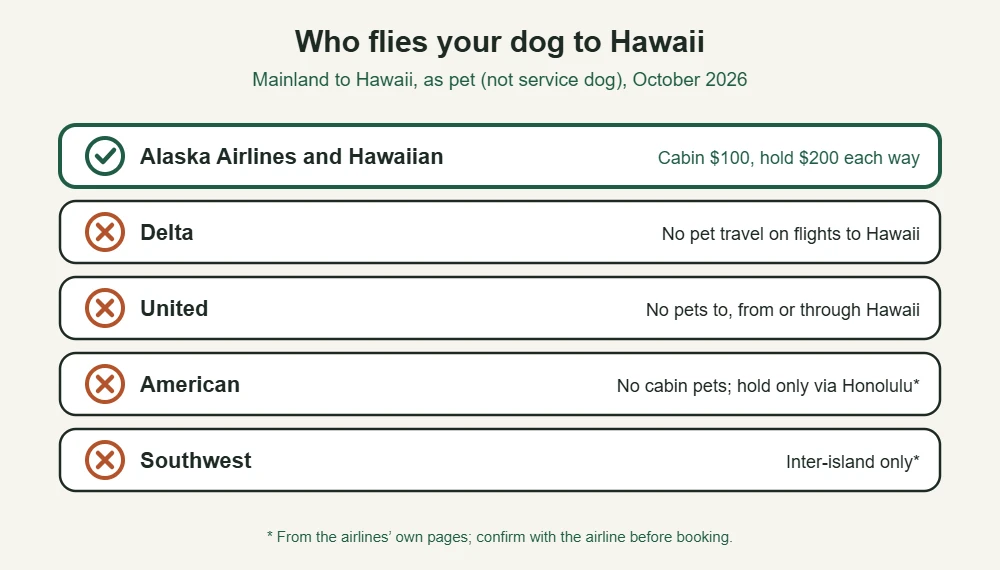
Alaska Airlines and Hawaiian now share one pet policy. A cabin pet costs $100 each way ($35 within Hawaii), and a pet in the baggage compartment costs $200 each way ($60 within Hawaii).
Only dogs, cats and rabbits can fly in the cabin to Hawaii, in a soft-sided carrier of up to 17 x 11 x 9.5 inches, and there’s no room for carriers in Business Class on their A330 and 787 aircraft.
Snub-nosed dogs and cats can’t fly in their baggage compartment, crates over 28 inches aren’t allowed on flights within Hawaii, and no dogs fly on flights landing in Honolulu after 10 p.m.
Delta doesn’t carry pets on flights to Hawaii, and United doesn’t carry them to, from or even through Hawaii. American and Southwest also bar pets in the cabin between the mainland and Hawaii, although Southwest does take pets between the islands.
For the airline side in more detail, see our guides to Alaska Airlines and Hawaiian Airlines.
Service dogs and emotional support dogs
Trained guide and service dogs can enter Hawaii without quarantine. They need a passing FAVN, a health certificate from within 30 days rather than 14, and the tick treatment.
Tell the state before you land: its web page asks for at least 24 hours’ notice, while the written rules offer an inspection inside the Honolulu terminal with at least seven days’ notice, so a week ahead is the safer plan.
Emotional support, comfort and companionship don’t count as service dog tasks, and dogs in training don’t qualify either, so they follow the normal pet rules. Since January 1, 2019, passing off a pet as a service animal breaks state law.
Coming from a rabies-free place
Dogs coming from the British Isles, Australia, Guam or New Zealand can use a separate, simpler route if they meet its residence and transport rules, such as flying on the same aircraft all the way to Honolulu. The exempt checklist lists a $45 fee.
Puppies, and dogs that can’t come
Because of the waiting periods, a newborn puppy will be about six months old by the time it qualifies. A puppy that can’t meet every requirement is quarantined for 120 days.
Some animals can’t come at all: wolf hybrids, wolf crosses and dingoes are banned under Hawaii’s plant quarantine law, and so are cat hybrids such as Bengals and Savannahs.
Questions people ask
Can my dog skip quarantine in Hawaii?
Yes, if you meet every requirement on time. A dog with a microchip, two rabies shots, a passing FAVN test, the 30-day wait, a recent health certificate and tick treatment can be released at the airport the day it lands.
How long does it take to get a dog ready for Hawaii?
At least four months for an adult dog that has already had one rabies shot, and at least 10 months for a newborn puppy, according to the state. With today’s lab delays, start earlier than that if you can.
How much does it cost to bring a dog to Hawaii?
The state fee is $185 for Direct Airport Release in Honolulu when your papers arrive more than 10 days ahead, or $244 if they’re late. A neighbor island permit is $165 plus a private vet’s fee, and 120-day quarantine is $1,080.
Which airlines fly dogs to Hawaii?
From the mainland, Alaska Airlines and Hawaiian, which now share one pet policy, take pets in the cabin for $100 and in the hold for $200 each way. Delta and United don’t carry pets to Hawaii.
Does Hawaii accept any rabies blood test?
No. Hawaii only accepts the FAVN test, done at Kansas State, Auburn, the University of Missouri or the DoD lab for DoD beneficiaries. RFFIT and the KSU Micro Screen test are not accepted.
Can I fly straight to Maui or Kona with my dog?
Yes, with a Neighbor Island Inspection Permit. Your papers and a passing FAVN have to be in at least 30 days before you land, and you must book an approved private vet at the arrival airport.
Do service dogs need to quarantine in Hawaii?
No, if they qualify. A trained service dog with a passing FAVN, a health certificate from within 30 days and tick treatment can enter without quarantine, and you notify the state before you land.
Are emotional support dogs treated as service dogs in Hawaii?
No. Hawaii says emotional support and companionship aren’t service dog tasks, so an emotional support dog follows the same rules as any pet.
I rewrote this guide in October 2026 and corrected several mistakes in the old version, including the form number (it’s AQS-279), an ISO-only microchip rule, a 30-day gap between the rabies shot and the blood draw that Hawaii doesn’t require, vaccines it doesn’t ask for and the old two-to-four-week lab estimate.
If you have questions about your own dog, the Animal Quarantine Station prefers email and also answers the phone on (808) 483-7151.
Sources
Hawaii Department of Agriculture & Biosecurity. Animal quarantine information (rules, fees, arrival, airports).
Hawaii Department of Agriculture & Biosecurity. Checklist 1: Direct Airport Release in Honolulu (step-by-step requirements).
Hawaii Department of Agriculture & Biosecurity. Checklist 2: neighbor island release (NIIP and 30-day deadline).
Hawaii Department of Agriculture & Biosecurity. Form AQS-279 (fees).
Hawaii Department of Agriculture & Biosecurity. Acceptable tick treatments (tick products).
Hawaii Department of Agriculture & Biosecurity. Guide and service dogs entering Hawaii (service dog route).
State of Hawaii. Hawaii Administrative Rules, chapter 4-29 (health certificate and service dog rules).
Kansas State Veterinary Diagnostic Laboratory. FAVN test (turnaround and reporting to Hawaii).
Alaska Airlines. Pets traveling to Hawaii (airline rules and fees).
The Nomad Paws is in memory of Woody, a great traveler and, most of all, the best, kindest and wisest friend I have ever had.
This guide is built from the Hawaii Department of Agriculture & Biosecurity’s own checklists, forms and rules, the labs and the airlines named above, all read on 21 October 2026.
Hawaii’s process rewards people who double-check, so confirm the details with the Animal Quarantine Station and your vet before you book, and treat this as a careful guide rather than veterinary or legal advice. Here is how I make my guides.