
French Bulldogs can fly on planes, but their brachycephalic (flat-faced) anatomy creates serious restrictions.
Most major US airlines ban French Bulldogs from cargo holds year-round due to breathing risks, but cabin travel remains an option if your dog weighs under 20 pounds and fits in an 18″L x 11″W x 11″H carrier.
This guide provides the exact airline policies, health certificate deadlines, and cost breakdowns you need to book safely.
Can French Bulldogs Fly in Airplane Cabins?

Yes. Delta, United, American Airlines, and Alaska Airlines allow French Bulldogs in cabins if the dog and carrier together fit under the seat in front of you.
The standard maximum carrier dimensions are 18″L x 11″W x 11″H for soft-sided carriers. Your French Bulldog must remain inside the carrier for the entire flight except during TSA screening.

Cabin fees range from $95 to $150 each way depending on the airline. Delta charges $125 per flight segment (delta.com/pet-travel),
United charges $150 each way (united.com/traveling-with-pets), American Airlines charges $125 to $150 (aa.com/pets), and Alaska Airlines charges $105 for the first pet (alaskaair.com/pets). These fees are non-refundable and must be paid at the airport ticket counter, not during online booking.
Pro Tip: Airlines limit cabin pets to 1-2 per flight. Call to reserve your pet’s spot immediately after booking your ticket. Waiting until check-in risks being denied boarding if the pet quota is full.
Are French Bulldogs Allowed to Fly in Cargo?
No, not on major US carriers. Delta, United, American Airlines, and Alaska Airlines ban French Bulldogs from cargo holds due to brachycephalic obstructive airway syndrome.
The breed’s compressed airways make them vulnerable to heat stress and breathing failure during the temperature fluctuations and stress of cargo transport. DOT incident reports show brachycephalic breeds have 10 times higher mortality rates in cargo compared to other breeds.
Even airlines that theoretically allow cargo transport impose temperature embargoes when ground temperatures exceed 85°F (29°C), which eliminates summer travel in most US regions. If your French Bulldog exceeds cabin size limits (typically dogs over 20-25 pounds), consider ground transport services like PetRelocation (starting at $1,000) instead of air cargo.
8-Week Preparation Timeline
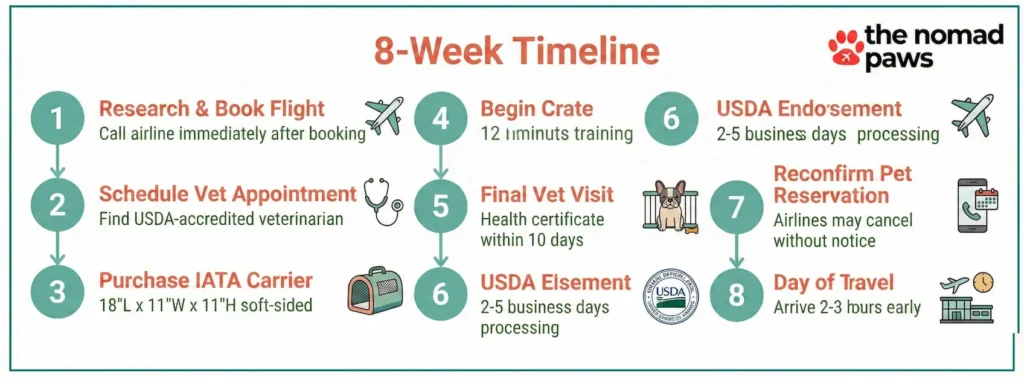
Pet travel requires advance planning. Missing a single deadline can cost you $200+ in rebooking fees or force you to cancel entirely. Follow this timeline to avoid last-minute disasters.
8 Weeks Before Departure
Research airline policies and book your flight. Call the airline directly after purchasing your ticket to reserve a pet spot. Delta: 800-221-1212, United: 800-864-8331, American: 800-433-7300, Alaska: 800-252-7522. Do not rely on online booking systems, they don’t reserve pet space. Confirm the pet fee amount and payment method during this call.
6 Weeks Before Departure
Schedule a vet appointment with a USDA-accredited veterinarian. If traveling internationally, your dog needs a rabies vaccination at least 21 to 30 days before departure depending on the destination country. Find accredited vets at aphis.usda.gov/accreditation. Expect to pay $100 to $250 for the health certificate appointment, $20 to $50 for rabies vaccination if needed, and $50 to $100 for microchipping if required for international travel.
4 Weeks Before Departure
Purchase an IATA-compliant travel carrier. For cabin travel, buy a soft-sided carrier measuring 18″L x 11″W x 11″H or smaller. Popular options include the Sherpa Original Deluxe ($60) or similar TSA-approved carriers with leakproof bottoms and ventilation on at least three sides. Measure your French Bulldog first: the dog must be able to stand, turn around, and lie down comfortably inside.
2 Weeks Before Departure
Begin crate acclimation training. Place treats inside the carrier and let your dog explore it for 30 minutes daily. Gradually increase the time with the door closed. Feed meals inside the carrier. This reduces barking and stress during the actual flight. Do not skip this step, stressed dogs are more likely to be denied boarding.
1 Week Before Departure
Final vet visit for the health certificate. This is a hard deadline. Most airlines require a health certificate issued within 10 days of travel (verify with your specific airline). For international flights, the USDA must endorse this certificate through the VEHCS electronic system, which takes 2 to 5 business days. Submit your USDA endorsement request at least 10 business days before departure to account for processing delays. The health certificate costs $100 to $250, and USDA endorsement adds $38 to $150.
Reconfirm your pet reservation with the airline during this week. Airlines sometimes cancel pet reservations without notice due to aircraft changes.
24 Hours Before Departure
Complete online check-in and confirm pet arrangements. Call the airline one final time to verify your pet is listed on the flight manifest. Print your boarding pass and health certificate. Pack a collapsible water bowl, pee pads (20-pack costs $15), and any prescribed anxiety medication from your vet.
Day of Travel
Arrive 2 to 3 hours early. Pet check-in happens at the ticket counter, not at self-service kiosks or bag drop. The agent will inspect your carrier, verify the health certificate, and collect the pet fee (cash or card, verify payment method in advance). TSA requires you to remove your dog from the carrier during screening, so bring a secure harness and leash.
Withhold food for 4 to 6 hours before the flight to reduce the risk of motion sickness. Offer small amounts of water up until boarding. Locate pet relief areas before security (available at major airports like LAX Terminal 2/4 and ATL Terminals 2/4).
Complete Cost Breakdown
Budget accurately to avoid surprises. Here’s what you’ll actually spend for a round-trip domestic flight with a French Bulldog in the cabin.
| Expense Category | Low End | Typical | High End |
|---|---|---|---|
| Airline cabin fees (round-trip) | $210 (Alaska) | $250 (Delta) | $300 (United) |
| Health certificate (vet visit) | $100 | $150 | $250 |
| Rabies vaccination (if needed) | $20 | $35 | $50 |
| Microchip (international only) | $50 | $75 | $100 |
| USDA endorsement (international) | $38 | $75 | $150 |
| IATA-compliant carrier | $50 | $100 | $200 |
| Accessories (bowl, pads, cooling mat) | $30 | $50 | $75 |
| Layover fees (if connection >4 hours) | $0 | $0 | $150 |
| TOTAL (domestic, direct flight) | $410 | $660 | $925 |
| TOTAL (international) | $498 | $810 | $1,275 |
Hidden costs to watch for: If your dog and carrier together exceed the airline’s weight limit at check-in (rare but possible), you may face a $100+ overweight fee or be denied boarding. If your flight is delayed beyond the 10-day health certificate validity window, you’ll need to pay for a new certificate ($150). Hotels charge $50 to $200 per night in pet fees if you need overnight accommodation.
Ways to save: Book direct flights to avoid United’s $150 layover fee for connections exceeding 4 hours. Reuse your carrier for future trips. Ask your vet about bundled packages that combine the health certificate and vaccinations for $50 off the total cost.
Airline Policy Comparison for French Bulldogs
| Airline | Cabin Fee (Each Way) | Carrier Size Limit | Cargo Allowed? | Notable Restrictions |
|---|---|---|---|---|
| Delta | $125 | 18″L x 11″W x 11″H | No (brachycephalic ban) | 1-2 pets per flight, reserve by phone |
| United | $150 (+$150 if layover >4hrs) | 18″L x 11″W x 11″H | No (brachycephalic ban) | Call 800-864-8331 to reserve |
| American | $125-$150 | 19″L x 13″W x 9″H | No (brachycephalic ban) | Slightly larger carrier allowed |
| Alaska | $105 (first pet) | 17″L x 11″W x 9.5″H | No (brachycephalic ban) | Lowest cabin fee, strict size limit |
Verify before booking: Airline policies change seasonally and without notice. Always call the airline directly to confirm current pet fees, carrier dimensions, and breed restrictions before purchasing your ticket. Policy pages: delta.com/pet-travel, united.com/traveling-with-pets, aa.com/pets, alaskaair.com/pets.
Health Certificate Requirements
The health certificate is the most common reason for denied boarding. Get this right or risk losing your entire trip.
Domestic US flights: No federal health certificate is required, but airlines demand a veterinary health certificate issued within 10 days of departure. Your vet must be licensed in the state where the examination occurs. The certificate must confirm your French Bulldog is healthy, free from contagious diseases, and fit to travel. Cost: $100 to $250.
International flights: You need a USDA APHIS Form 7001 health certificate issued by a USDA-accredited veterinarian, then endorsed by the USDA. Find accredited vets at aphis.usda.gov/accreditation. After your vet completes the certificate, submit it through the VEHCS electronic system (aphis.usda.gov/vehcs) for endorsement. USDA processing takes 2 to 5 business days, so submit at least 10 business days before departure. USDA endorsement costs $38 to $150 depending on the destination country.
Additional international requirements: The CDC requires rabies vaccination certification for dogs entering the US from high-risk rabies countries (cdc.gov/importation/dogs). The EU requires a microchip and rabies titer test at least 21 days before travel. The UK requires tapeworm treatment 1 to 5 days before entry. Check destination-specific requirements at aphis.usda.gov/pet-travel.
Pro Tip: If your flight is delayed beyond the 10-day validity window, you’ll need a new health certificate. Keep your vet’s contact information accessible and budget an extra $150 for emergency reissuance.
Breed-Specific Safety Considerations
French Bulldogs face higher risks during air travel than other breeds. Understanding these risks helps you make informed decisions.
Brachycephalic obstructive airway syndrome (BOAS): French Bulldogs have compressed airways, elongated soft palates, and narrow nostrils. Stress, heat, and altitude exacerbate breathing difficulties. Symptoms include labored breathing, blue gums, and collapse. DOT incident reports document 10 times higher mortality rates for brachycephalic breeds in cargo compared to other dogs.
Temperature restrictions: Airlines impose embargoes when ground temperatures exceed 85°F (29°C). This eliminates summer travel in most US regions from June through September. Even cabin travel carries risks if the aircraft sits on the tarmac in extreme heat before takeoff. Book early morning or late evening flights to avoid peak temperatures.
Weight and size limits: Most French Bulldogs weigh 16 to 28 pounds. If your dog exceeds 20 pounds, verify that the dog and carrier together fit under the seat. Airlines enforce the “fit under seat” rule strictly. Measure your specific aircraft’s under-seat dimensions (varies by plane model) by calling the airline.
Pre-travel vet consultation: Schedule a breathing assessment with your vet 2 to 4 weeks before travel. Discuss whether your individual dog is fit to fly. Some French Bulldogs with severe BOAS should not fly at all. Your vet may prescribe trazodone (5 to 10 mg per kg body weight) for anxiety, but avoid sedatives, which suppress breathing in brachycephalic breeds.
Alternatives for high-risk dogs: If your French Bulldog has severe breathing issues, consider ground transport services (PetRelocation starts at $1,000) or driving yourself. For distances under 500 miles, driving is often safer and less stressful than flying.
Booking Process Step-by-Step
Airlines don’t make pet booking easy. Follow these exact steps to secure your French Bulldog’s spot.
Step 1: Book your own ticket first through the airline’s website or app. Do not book through third-party sites like Expedia, they cannot reserve pet space.
Step 2: Immediately call the airline to add your pet to the reservation. Delta: 800-221-1212, United: 800-864-8331, American: 800-433-7300, Alaska: 800-252-7522. Have your confirmation number ready. The agent will ask for your dog’s breed, weight, and carrier dimensions.
Step 3: Confirm the pet fee amount and payment method. Most airlines require payment at the airport ticket counter on the day of travel, not during the phone reservation.
Step 4: Request email confirmation of your pet reservation. If the airline doesn’t send one automatically, ask the agent to note your reservation in your booking record.
Step 5: Call again 1 week before departure to reconfirm. Airlines sometimes cancel pet reservations due to aircraft changes without notifying passengers.
Step 6: Arrive at the airport 2 to 3 hours early. Go directly to the ticket counter (not self-service kiosks). The agent will inspect your carrier, verify your health certificate, and collect the pet fee.
Pro Tip: Book direct flights whenever possible. Connections add stress for your dog and risk. United charges an additional $150 fee for layovers exceeding 4 hours, and finding pet relief areas in connecting airports is difficult.
What to Pack for Your French Bulldog
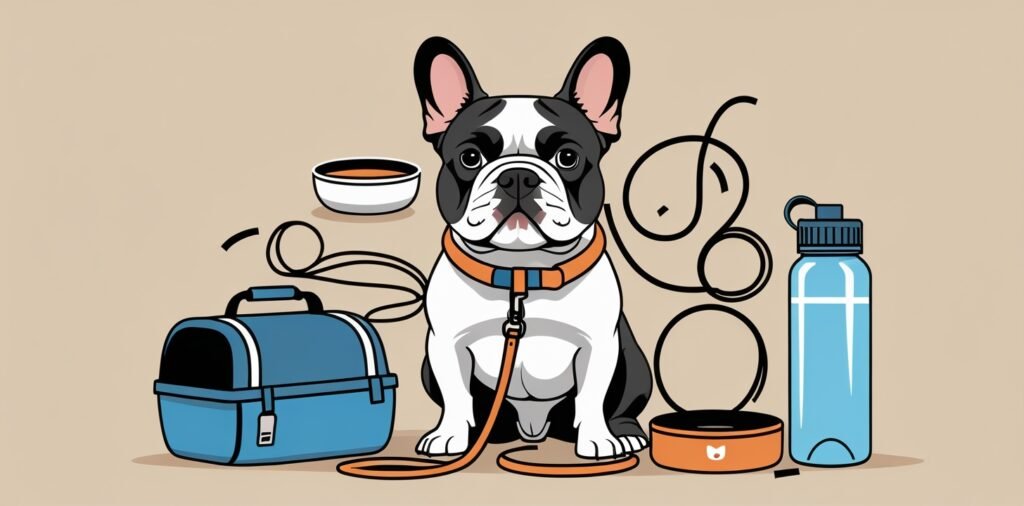
Bring only TSA-approved items. Security will confiscate anything questionable.
Required items: IATA-compliant soft-sided carrier (18″L x 11″W x 11″H or smaller, $50 to $150), printed health certificate, rabies vaccination certificate, leash and harness for TSA screening, collapsible water bowl ($10), pee pads (20-pack, $15).
Recommended items: Cooling mat ($20) to regulate temperature, small bag of treats for positive reinforcement, prescription anxiety medication if prescribed by your vet, extra leash in case the primary one breaks.
Do not pack: Squeaky toys (TSA may confiscate), loose food (spills create messes and attract pests), sedatives without a vet prescription (illegal and dangerous for brachycephalic breeds), retractable leashes (difficult to control during screening).
Feeding and hydration: Withhold food for 4 to 6 hours before departure to reduce motion sickness risk. Offer small amounts of water up until boarding. Freeze water in the collapsible bowl the night before, it will melt during the flight and provide cool hydration without spilling during takeoff.
Airport and In-Flight Procedures
Knowing what to expect reduces stress for both you and your dog.
Check-in: Go to the ticket counter, not self-service kiosks or bag drop. The agent will verify your health certificate (must be dated within 10 days), inspect the carrier for compliance, and collect the pet fee. Payment methods vary by airline, confirm in advance whether they accept cash or card.
TSA screening: You must remove your French Bulldog from the carrier and carry the dog through the metal detector while the carrier goes through the X-ray machine. Bring a secure harness and leash. If your dog is anxious, request a private screening room (available at all major airports).
Boarding: Airlines typically board passengers with pets last to minimize time in the cabin before takeoff. Your dog must remain in the carrier under the seat for the entire flight except during TSA screening. Flight attendants will verify the carrier is stowed properly before takeoff.
In-flight: Monitor your French Bulldog for signs of distress: labored breathing, excessive panting, blue gums, or lethargy. If you notice any of these symptoms, alert a flight attendant immediately and request oxygen if available. Keep the cabin air vent above your seat open and directed away from the carrier to maintain airflow.
Layovers: If you have a connecting flight, locate pet relief areas immediately after deplaning. Major airports like LAX (Terminal 2/4) and ATL (Terminals 2/4) have designated relief areas, but smaller hubs may not. Budget extra time, relief areas are often located outside security, requiring you to re-screen.
Common Mistakes That Cause Denied Boarding
Learn from others’ expensive errors. These scenarios happen frequently and are entirely preventable.
Mistake 1: Carrier too large. Airlines enforce the “must fit under the seat” rule strictly. If your carrier exceeds 18″L x 11″W x 11″H, you’ll be denied boarding and lose your $200+ ticket. Measure your carrier before leaving home and test-fit it under a chair.
Mistake 2: Expired health certificate. The 10-day validity window is firm. If your vet dated the certificate 11 days before your flight, you’ll be denied boarding. Schedule your final vet appointment carefully and keep your vet’s contact information accessible for emergency reissuance ($150).
Mistake 3: No pet reservation. Booking your ticket online does not reserve pet space. You must call the airline separately. Showing up at the airport without a confirmed pet reservation risks denial if the flight’s pet quota is full. Airlines limit cabin pets to 1 to 2 per flight.
Mistake 4: Summer travel without checking embargoes. Temperature embargoes above 85°F (29°C) ground temperatures cancel flights for brachycephalic breeds with little notice. Check the weather forecast for your departure city 48 hours before travel and have a backup plan.
Mistake 5: Insufficient crate acclimation. Dogs that bark, whine, or show extreme distress during boarding may be denied travel at the gate agent’s discretion. Start acclimation training at least 2 weeks before departure, 30 minutes daily with treats and positive reinforcement.
Mistake 6: International travel without USDA endorsement. Domestic health certificates are not valid for international flights. You need USDA endorsement through the VEHCS system, which takes 2 to 5 business days. Submitting your request the day before departure guarantees denial.
Destination-Specific Restrictions
Some destinations impose additional restrictions on French Bulldogs beyond airline policies.
Hawaii: Requires a 5-day-or-less program with rabies vaccination, microchip, rabies titer test, and pre-arrival paperwork. French Bulldogs qualify but must meet all requirements to avoid the standard 120-day quarantine in Hawaii. Details at hdoa.hawaii.gov/ai/aqs/aqs-info.
United Kingdom: Requires microchip, rabies vaccination, tapeworm treatment 1 to 5 days before entry, and an Animal Health Certificate. Brachycephalic breeds face additional scrutiny. Details at gov.uk/bring-pet-to-great-britain.
European Union: Requires microchip, rabies vaccination at least 21 days before travel, and an EU Pet Passport or health certificate. Some EU countries restrict brachycephalic imports during summer months. Check country-specific rules at aphis.usda.gov/pet-travel.
Canada: Requires rabies vaccination certificate for dogs over 3 months old. No additional restrictions for French Bulldogs. Details at inspection.canada.ca/animal-health/terrestrial-animals/imports/pets.
Verify before booking: Destination requirements change frequently. Check aphis.usda.gov/pet-travel and the destination country’s official agriculture or customs website 8 weeks before departure.
Emergency Contacts and Resources
Save these numbers before you travel. You won’t have time to search during an emergency.
Airport veterinary services: LAX (24-hour vet): 310-646-5262, SFO (emergency vet): 650-877-0900, ATL (animal relief): 404-530-6600. Not all airports have on-site vets, call ahead to confirm availability.
ASPCA Animal Poison Control: 888-426-4435 (consultation fee applies). Use if your dog ingests something toxic during travel.
Airline customer service: Delta: 800-221-1212, United: 800-864-8331, American: 800-433-7300, Alaska: 800-252-7522. Call if your flight is delayed beyond your health certificate’s validity window or if you need to rebook due to temperature embargoes.
USDA APHIS: 301-851-3300 (Monday to Friday, 8am to 4:30pm ET). Call for questions about health certificate endorsement or international travel requirements.
Ground transport alternatives: PetRelocation (petrelocation.com, starts at $1,000), Royal Paws Pet Transportation (royalpawspettransport.com), CitizenShipper (citizenshipper.com, crowdsourced drivers). Use these if your French Bulldog is denied air travel or if you prefer ground transport.
Frequently Asked Questions
Can French Bulldogs fly in airplane cabins?
Yes. Most airlines allow French Bulldogs in cabins if they meet size requirements and fit under the seat in an approved carrier. Delta, United, American Airlines, and Alaska Airlines permit French Bulldogs in soft-sided carriers measuring 18″L x 11″W x 11″H or smaller. The dog must remain in the carrier for the entire flight except during TSA screening. Cabin fees range from $95 to $150 each way.
Are French Bulldogs allowed to fly in cargo?
No, not on major US airlines. Delta, United, American Airlines, and Alaska Airlines ban French Bulldogs from cargo holds year-round due to brachycephalic breathing concerns. The breed’s compressed airways make them vulnerable to heat stress and respiratory failure during cargo transport. Temperature embargoes during warm weather (above 85°F ground temperature) create additional restrictions. If your French Bulldog exceeds cabin size limits, consider ground transport services instead.
What airlines allow French Bulldogs to fly?
Delta, United, American Airlines, and Alaska Airlines allow French Bulldogs in cabins. Cargo policies ban the breed on all major US carriers due to brachycephalic risks. Cabin travel requires the dog and carrier to fit under the seat (maximum 18″L x 11″W x 11″H). Reserve pet space by calling the airline immediately after booking your ticket: Delta 800-221-1212, United 800-864-8331, American 800-433-7300, Alaska 800-252-7522. Airlines limit cabin pets to 1 to 2 per flight, so early reservation is critical.
How much does it cost to fly with a French Bulldog?
Cabin pet fees range from $95 to $150 each way. Delta charges $125 per flight segment, United charges $150 each way (plus $150 for layovers exceeding 4 hours), American Airlines charges $125 to $150, and Alaska Airlines charges $105 for the first pet. Total costs including health certificates, carrier, and accessories range from $410 to $925 for domestic round-trip travel and $498 to $1,275 for international trips. Budget an additional $150 for emergency health certificate reissuance if your flight is delayed.
What health documents does a French Bulldog need to fly?
Most airlines require a health certificate issued within 10 days of travel, current rabies vaccination proof, and sometimes a microchip for international destinations. Domestic US flights require a veterinary health certificate ($100 to $250) from a state-licensed vet. International flights require a USDA APHIS Form 7001 health certificate from a USDA-accredited veterinarian (find at aphis.usda.gov/accreditation), plus USDA endorsement through the VEHCS system (2 to 5 business days processing, costs $38 to $150). The CDC requires rabies vaccination certification for dogs entering the US from high-risk countries (cdc.gov/importation/dogs).