
Short answer: flying can give a dog the same blocked, painful ear we sometimes get, mostly as the plane comes down, but nobody has actually measured it in dogs on passenger flights, so how often it happens is unknown.
The flight risks that are well documented for dogs are breathing and heat, especially in flat-faced breeds, and sedation, so the best things you can do are keep your dog in the cabin if it fits, help it swallow on the way down and talk to your vet before you fly.
Most of us know the feeling of a plane starting its descent, when one ear goes dull and then pops, or doesn’t, until somewhere around the baggage carousel.
It’s natural to wonder what your dog is going through in its carrier under the seat, with ears that hear far more than yours and no way to tell you that something hurts.
The honest answer is a mix of solid physics and surprisingly thin dog research, and a few popular claims about dog ears on planes turn out to have no source at all. So here’s what we actually know, from the FAA, veterinary schools and the few studies of dogs in flight, and what’s worth doing about it.

What happens to ears on a plane
Airliners aren’t pressurised to sea level. US rules for passenger jets require a cabin pressure altitude of no more than 8,000 feet in normal flight, under 14 CFR 25.841, so the air around you, and your dog, thins out as the plane climbs.
The middle ear is a small pocket of air behind the eardrum, and it connects to the back of the nose through the auditory tube, also called the Eustachian tube. When the outside pressure changes, that pocket has to catch up.
The FAA’s guide for pilots explains that on the way up, the expanding air in the middle ear pushes the tube open on its own, which is why the climb is usually easy. On the way down, the tube has to be opened by swallowing, yawning or moving the jaw, and if it isn’t, the eardrum gets pushed inward and the ear blocks.
In people, a blocked ear can cause severe pain and hearing loss that lasts hours or even days. Dogs have the same basic parts, so the same thing can happen to them in principle.
The hold isn’t a different world either. Pet compartments on most aircraft are kept at the same temperature and pressure as the cabin, according to a 2019 JAVMA News report.
How a dog’s ear is built
A lot of articles say a dog’s Eustachian tube is “more horizontal” than ours and harder to clear. I couldn’t find a single study that says so, and the mix-up seems to come from a different part of the ear.
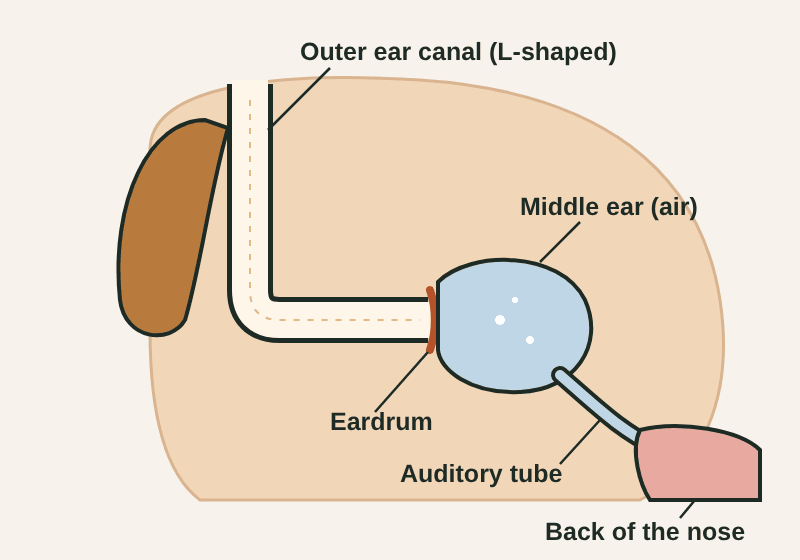
It’s the outer ear canal that has the famous L shape. In a review of canine ear anatomy, it runs down vertically for about an inch and then turns into a horizontal section that leads to the eardrum, and the Merck Veterinary Manual notes that it’s much longer than a human ear canal.
That shape matters for ear infections, because it traps moisture and debris, but it sits on the outside of the eardrum and has nothing to do with pressure. The auditory tube is described in the same review as a short canal from the back of the nose to the middle ear.
A 2024 study of 17 breeds found that the middle ear scales with the size of the skull, so a St Bernard’s is far bigger than a Chihuahua’s, but its shape stays very similar across breeds.
Dogs do hear much more than we do, roughly 67 to 45,000 Hz against our 64 to 23,000 Hz, according to Louisiana State University’s vet school. That makes noise a fair concern, but it doesn’t change how their ears handle pressure.
What the research says, and doesn’t
I searched for studies of ear pain or ear injury in dogs on commercial flights and found none, which means every claim about how often dogs’ ears hurt on planes, or how rare damage is, is a guess.
The closest thing is a 2002 Canadian study that flew 24 beagles between Montreal and Toronto in the belly hold of a Boeing 757, on flights that averaged 48 minutes. It measured stress rather than ears, and the biggest jumps in heart rate came during loading and unloading, not take-off or landing.
The dogs were inactive about three-quarters of the time, except during take-off, and their stress hormone rose most after the drive to the airport. The hold stayed between 7.0 and 18.8°C with the door closed, and the researchers measured temperature, humidity and pressure, but not noise.
So what the evidence points to is that handling and travel around the flight may matter as much as the flight itself, which is a useful thing to know when you plan the day.
Dogs more at risk
Flat-faced breeds
Brachycephalic dogs, the Pugs, French Bulldogs and their short-nosed cousins, often have fluid in the middle ear without any signs. In a German study of 55 dogs having airway surgery, 32% had it, including 53% of French Bulldogs and 25% of Pugs, and a Cambridge study found smaller, thicker-walled middle ears in these breeds.
Researchers suspect the auditory tube plays a part, but it hasn’t been proven, and a Vienna study found the fluid wasn’t linked to how narrow the back of the nose was. Nobody has studied what that fluid means in flight.
The bigger danger for these dogs is their breathing. The AVMA says short-nosed breeds account for about half of 122 dog deaths linked to airline travel in five years of US records, mostly because of their airways and their vulnerability to heat and poor air.
That’s why airlines treat them differently. American Airlines won’t take brachycephalic dogs as checked pets, Delta’s shipping page says snub-nosed dogs aren’t permitted, and United now carries pets only in the cabin. Our guides to flying with pugs and French bulldogs go through each airline.
Ear infections, colds and allergies
The FAA advises people not to fly with a cold or a nasal allergy, because swelling near the tube makes an ear block more likely. There’s no flight data for dogs, but a dog with an active ear infection or a stuffy nose is worth a vet check before the trip, and the vet may suggest waiting until it’s cleared.
A condition called primary secretory otitis media, a mucus-filled middle ear, mainly affects Cavalier King Charles Spaniels and small brachycephalic breeds, according to Merck, so owners of those breeds have one more reason to ask.
Noise and ear muffs
Cabin noise is loudest during take-off and landing, up to about 105 dB(A) in studies reviewed in a 2022 paper on wide-body aircraft, and drops during the cruise. Nobody seems to have published measurements of noise in the hold.
Dog ear muffs are passive, like ear defenders, and they do nothing for pressure. The best-known pair, Mutt Muffs, is sold with a seller’s estimate of 21 to 24 dB of reduction with a good seal, but it was out of stock on Amazon when I checked in October 2026.
Many dogs simply won’t wear them. If you want to try, start at home weeks before the trip with short sessions and treats, and only fly with them if your dog is relaxed wearing them.
Why vets say no to sedation
Giving a dog something to knock it out for the flight seems kind, but the AVMA strongly recommends against tranquilizing pets for air travel, and its travel FAQ warns that sedatives can raise the risk of heart and breathing problems.
Cornell’s vet school says dogs should never be tranquilized for flights, although anti-anxiety medication may sometimes be prescribed, which is a different thing from sedation.
Airlines agree. American Airlines won’t accept sedated or tranquilized pets, and Delta doesn’t permit sedation, including any medication that causes it, which can catch vet-prescribed anti-anxiety drugs too. United’s current pet page doesn’t mention sedation at all, so ask before you fly.
In the 2002 beagle study, a sedative made no measurable difference to the dogs’ stress, although the authors put that partly down to flight delays after it was given.
You’ll often hear of trazodone or gabapentin for travel anxiety. Neither has an FDA approval for animals, so vets prescribe them extra-label, which is legal under FDA rules, and the one approved calming gel, Sileo, is licensed for noise aversion rather than flying and isn’t for dogs with serious heart or breathing disease.
If your dog is a nervous traveler, the right move is a conversation with your vet weeks before the trip, a trial run at home of anything they prescribe, and a check that your airline will accept it. Our guide to keeping a dog calm on a flight has the non-drug side.
What helps on the day
None of these tips has been tested on dogs’ ears, and most come from how ears work in people, but they’re low-risk and some help with stress as well.
- Keep your dog in the cabin if it fits. You can see it, offer water and comfort it on the descent. United charges $150 each way and allows a soft carrier of up to 18 x 11 x 11 inches, the size Delta recommends too, and the medium Sherpa Original Deluxe (17 x 11 x 10.5 inches, for pets up to 16 lb) fits that on paper.
- Fly direct if you can. One climb and one descent instead of two, and one round of loading and unloading, which the beagle study found to be the most stressful part.
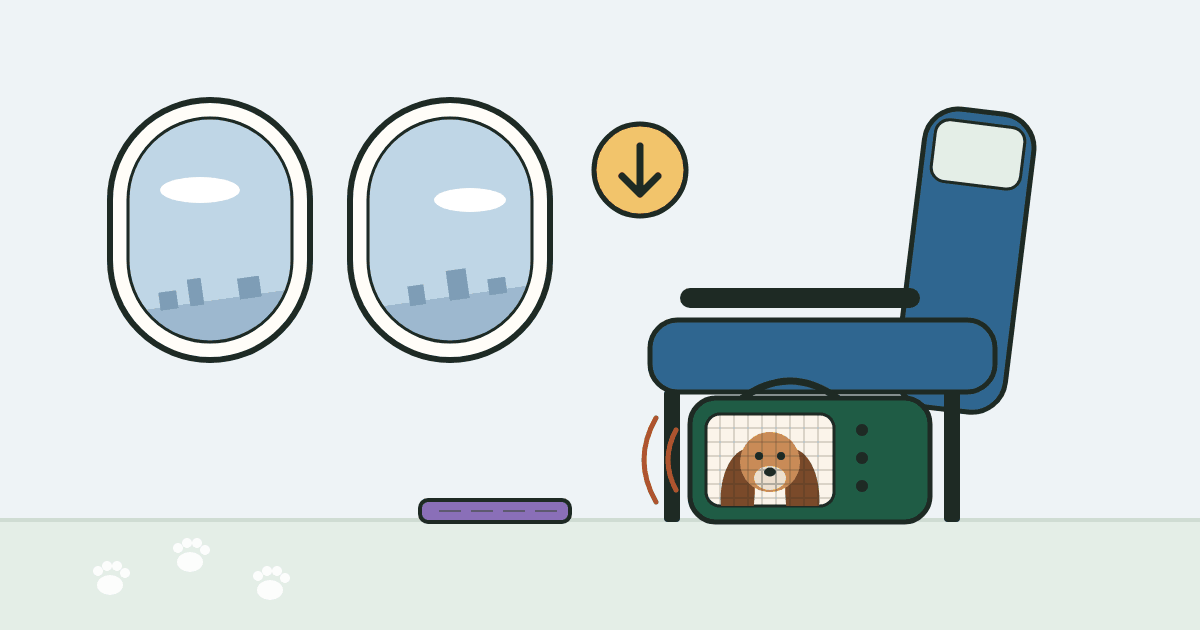
- Get your dog swallowing on the way down. A flat lick mat with a thin smear of wet food, or a small chew, gives it something to work on as the plane descends. Check your airline’s rules on food in the cabin, and keep this for dogs flying with you, since nobody can watch a dog in the hold.
- Offer small sips of water, which also gets your dog swallowing.
- Go easy on the meal. For dogs prone to motion sickness, Cornell suggests not feeding for 4 to 6 hours before travel.
- Leave the ears alone unless your vet says otherwise. Cleaning the outer canal can’t reach the auditory tube, and Cornell warns that over-the-counter ear products can cause more inflammation. Ear drops sold for flying have no evidence behind them, and none should go in without a vet checking the eardrum.
The lick mat is a seller’s product and the carrier sizes are the seller’s own, so measure the carrier you get against your airline’s limit. Our guide for flying with a dog for the first time covers the rest of the day.
Signs to watch after the flight
Ear trouble in dogs usually shows up as head shaking, scratching at an ear or rubbing it along the floor, according to Merck, and a little of that right after landing isn’t unusual.
The FAA tells people to see a doctor if an ear block doesn’t clear soon after landing, and that’s a sensible rule for dogs too: if the shaking and scratching don’t settle, book a vet visit.
See a vet urgently
Cornell says a persistent head tilt or a drunken, wobbly walk can mean the middle or inner ear is involved and may need an emergency visit. Crying when your dog scratches an ear is another sign that it needs looking at soon.
How risky is flying for dogs?
Larger US airlines have to report every animal that dies, is injured or goes missing in their care. In 2025 the total was 3 deaths, 5 injuries and 1 loss among 117,861 animals, or 0.76 incidents for every 10,000, according to the Department of Transportation.
| Airline | Deaths | Injuries | Losses | Animals carried | Per 10,000 |
|---|---|---|---|---|---|
| Alaska Airlines | 2 | 1 | 0 | 64,217 | 0.47 |
| Hawaiian Airlines | 0 | 1 | 0 | 10,924 | 0.92 |
| American Airlines | 0 | 2 | 1 | 20,133 | 1.49 |
| Delta | 0 | 1 | 0 | 2,896 | 3.45 |
| United | 1 | 0 | 0 | 301 | 33.22 |
| All reporting airlines | 3 | 5 | 1 | 117,861 | 0.76 |
From the DOT’s February 2026 Air Travel Consumer Report, full year 2025. The rules cover airlines flying aircraft with 60 or more seats.
United’s rate looks alarming, but it comes from one death among just 301 animals, since United no longer checks pets. Our American Airlines and Delta guides cover each airline’s rules in full.
Questions people ask
Does flying hurt a dog’s ears?
It can, in the same way it can hurt ours, because a dog’s middle ear is an air-filled space connected to the back of the nose. But no study has measured ear pain in dogs on airliners, so we don’t know how often it happens or how much it bothers them.
Is take-off or landing worse for a dog’s ears?
Landing, if dogs work like people. The FAA explains that on the way up, expanding air in the middle ear pushes its way out on its own, while on the way down the tube has to be opened, by swallowing or yawning, to let air back in.
Should I give my dog something to chew or lick on a plane?
For a dog in the cabin, something to lick or chew during the descent is a low-risk way to get it swallowing, which opens the tube to the middle ear in people. Keep it small, check your airline’s rules on food, and save it for dogs flying in the cabin with you.
Can I sedate my dog for a flight?
The AVMA strongly recommends against tranquilizing pets for air travel, and American Airlines and Delta won’t accept sedated pets. If your dog is very anxious, talk to your vet weeks ahead about a plan, and check the airline’s rules before using any medication.
Do dogs need ear muffs on a plane?
Not for pressure, since muffs don’t help the middle ear equalize. They can cut noise, which peaks at take-off and landing, but many dogs won’t keep them on, so practise at home well before the trip.
Are flat-faced dogs more at risk when flying?
Yes, though mostly not because of their ears. The AVMA says short-nosed breeds made up about half of 122 airline-related dog deaths in US records, mainly from breathing and heat problems. They also have fluid in the middle ear more often, which is worth a vet check before flying.
How do I know if my dog’s ears hurt after a flight?
Head shaking, scratching or rubbing an ear are the usual signs of ear trouble. If they don’t settle soon after landing, see your vet, and treat a head tilt, a wobbly walk or loss of balance as urgent.
References
Federal Aviation Administration. Aeronautical Information Manual, chapter 8, section 1: Fitness for flight (ear block).
US Code of Federal Regulations. 14 CFR 25.841, Pressurized cabins.
Cole LK (2009). Anatomy and physiology of the canine ear. Veterinary Dermatology.
Mason MJ, Lewis MA (2024). Structure and scaling of the middle ear in domestic dog breeds. Journal of Anatomy.
Bergeron R, et al. (2002). Physiology and behavior of dogs during air transport. Canadian Journal of Veterinary Research.
Schuenemann R, et al. (2022). Prevalence and characterization of middle ear effusion in 55 brachycephalic dogs. Tierarztliche Praxis Ausgabe K.
Salguero R, et al. (2016). Comparison between computed tomographic characteristics of the middle ear in nonbrachycephalic and brachycephalic dogs with obstructive airway syndrome. Veterinary Radiology and Ultrasound.
Milne E, et al. (2020). Cytological and microbiological characteristics of middle ear effusions in brachycephalic dogs. Journal of Veterinary Internal Medicine.
Krainer D, Dupre G (2021). Influence of computed tomographic dimensions of the nasopharynx on middle ear effusion and inflammation in pugs and French bulldogs with brachycephalic airway syndrome. Veterinary Surgery.
Lee HP, et al. (2022). Assessment of in-cabin noise of wide-body aircrafts. Applied Acoustics.
American Veterinary Medical Association. Air travel and short-nosed dogs FAQ and Traveling with your pet FAQ.
Cornell University College of Veterinary Medicine. Traveling safely with your dog and Itchy ear problems.
US Department of Transportation. Air Travel Consumer Report, February 2026 (2025 animal incident reports).
We rewrote this guide in October 2026, correcting the ear anatomy in the old version and adding the sedation advice, the airline rules and the research behind each tip.
The Nomad Paws is in memory of Woody, a great traveler and, most of all, the best, kindest and wisest friend I have ever had.
This guide is built from veterinary school, FAA, airline and government sources and the published studies listed above, read in October 2026. It isn’t veterinary advice, and nobody here tested the products on a dog, so treat the carrier and lick mat as starting points and your vet as the final word. Here is how I make my guides.
As an Amazon Associate I earn from qualifying purchases, which costs you nothing extra and helps keep these guides free.