
Somewhere online there is still a list promising that Southwest, JetBlue or Singapore Airlines will seat your emotional support dog at your feet for free, and it is years out of date.
Since January 11, 2021, US airlines have been free to treat an emotional support animal as a pet, and none of the big ones has kept the old free ride. The airlines that allow emotional support animals today are a short list of foreign carriers, and only a few of their routes touch the US.
Where things stand. No US airline carries emotional support animals as service animals anymore, so an ESA flies under the normal pet rules and fees. On flights to and from the US, Viva Aerobus and Aeromexico still carry emotional support dogs and cats free with a mental health letter.
Air Canada and Avianca accept emotional support dogs without ruling out US flights, so ask before you book. A dog that is task-trained for a psychiatric disability can fly as a service dog with the DOT form.

The 2021 rule, and why nothing has replaced it
The change came from the US Department of Transportation’s rule on traveling by air with service animals, published in the Federal Register on December 10, 2020 and in force from January 11, 2021.
It narrowed the definition of a service animal to a dog individually trained to do work or perform tasks for a person with a disability, psychiatric disabilities included. Emotional support animals, comfort animals and dogs still in training sit outside it.
The rule doesn’t ban emotional support animals. It says airlines don’t have to recognize them as service animals and may treat them as pets, which is why a handful of carriers abroad still choose to take them.
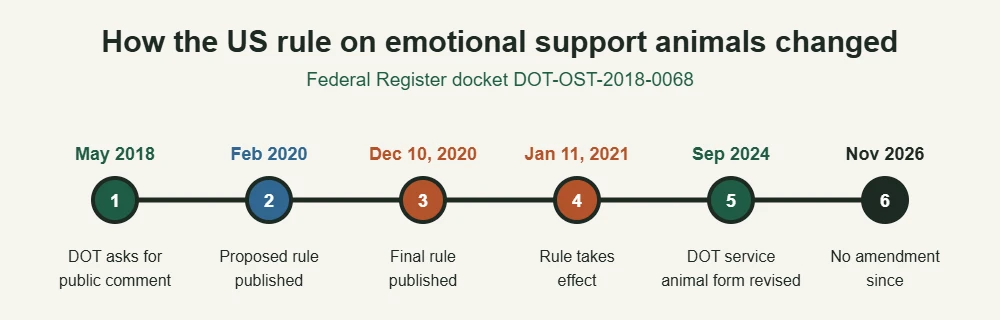
Nothing has replaced it. The rule’s docket in the Federal Register ends with paperwork notices about the DOT forms in 2024, and every 2025 and 2026 notice touching the same part of the regulations is about wheelchairs and accessible lavatories.
The DOT Service Animal Air Transportation Form was last revised in September 2024, and the DOT’s service animal page still lists emotional support animals among the animals that aren’t service animals.
How US airlines handle an emotional support animal now
Every US airline I checked sends an emotional support animal down the pet route. In practice that usually means a cat or small dog in a carrier under the seat, with the pet fee and the airline’s limit on pets per flight.
| Airline | What its pages say | Where that leaves an ESA |
|---|---|---|
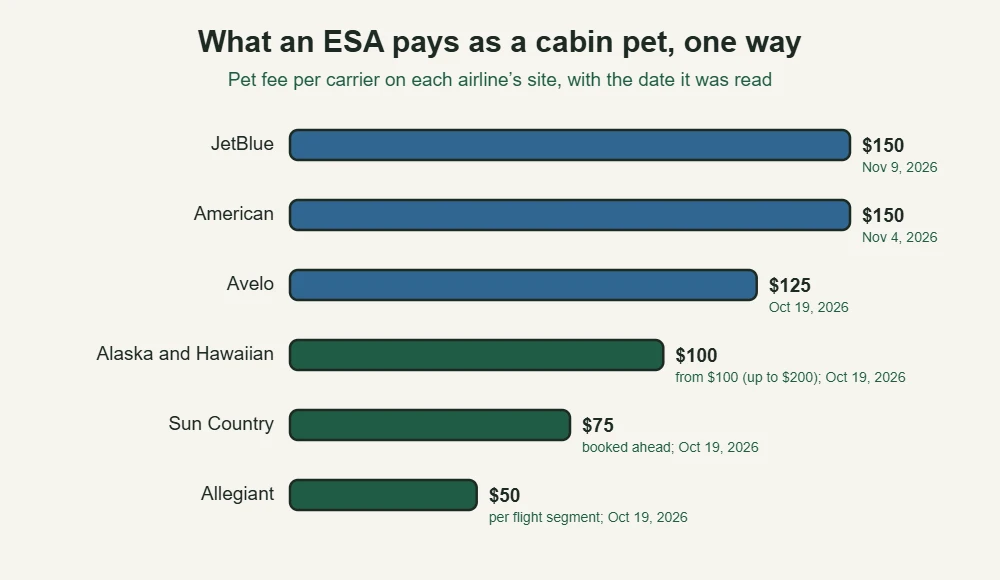
| American | ESAs may travel as pets, not as service animals | Cabin pet, $150 per kennel each way |
| Delta | ESAs are not recognized as service animals | Delta’s pet rules |
| United | ESA and therapy cats and dogs fly as pets | In a carrier at the airport and on board |
| Southwest | ESAs may qualify to travel as pets | Cabin pet program, dogs and cats |
| Alaska and Hawaiian | ESAs are no longer accepted as service animals | Pet, $100 to $200 each way |
| JetBlue | It no longer accepts emotional support animals | Small dog or cat, $150 each way |
| Frontier | Emotional support animals are not accepted | Domestic cabin pet only |
| Allegiant | Only trained dogs are service animals | Cabin pet, $50 per flight segment |
| Breeze | ESAs are not treated as service animals | Cabin pet up to 25 lb with the carrier |
| Avelo | Only trained dogs are service animals | Cabin pet, $125 each way |
| Sun Country | A service animal is a trained dog | Cabin pet, $75 each way booked ahead |
| Spirit | Took ESAs as paid pets until it stopped flying | No longer an option |
Fees as listed on each airline’s site between October 19 and November 9, 2026.
Two lines in that table deserve a closer look. Spirit, whose 2025 contract let emotional support animals ride as paid pets, has wound down, and its website no longer loads.
Frontier has stopped taking new pets on international flights, its family and pets page says, so on Frontier an emotional support animal can’t leave the country even as a pet.
A letter from a therapist doesn’t change any of this on a US airline. The pet fee and the carrier rules apply whatever the paperwork says.
Foreign airlines that still carry emotional support animals
Outside the US the old category survives where local rules still recognize it, mostly in Mexico and Latin America. Air Canada is the other notable holdout, and ANA keeps it for one country.
Viva Aerobus
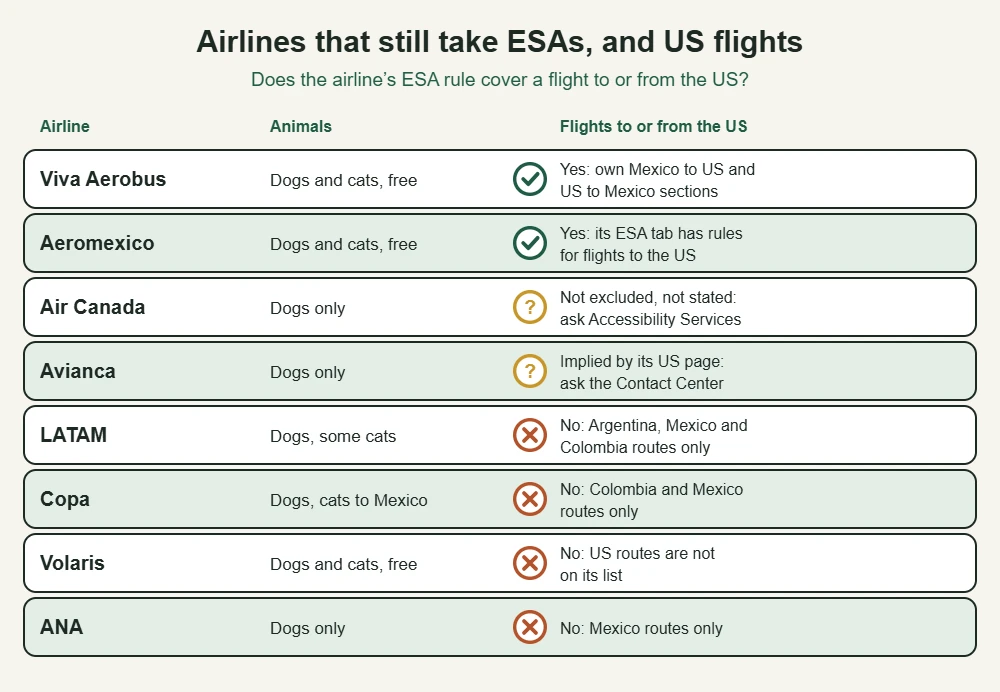
Viva is the clearest case. Its emotional support page says support dogs and cats fly completely free, and it has separate sections for flights from Mexico to the US and from the US to Mexico.
A dog rides without a carrier but needs a leash, a harness and an ID tag, while a cat stays in its carrier. Each passenger can bring one animal, and a flight takes up to six animals in the cabin.
You need a prescription on letterhead from a psychologist or psychiatrist, dated within a year of the flight, plus two signed copies of Viva’s liability letter.
A dog landing in the US also needs to be at least 6 months old, microchipped, cleared through the CDC import form and free of screwworm, with an emergency contact in Mexico or the US. Heading south, Senasica, Mexico’s animal health agency, inspects the animal.
Aeromexico
Aeromexico carries emotional support dogs and cats at no extra cost, and its service and emotional support animals page gives support animals their own section on flights to the US.
The animal can weigh up to 26 lb (12 kg) and measure 22 in long by 12 in tall. It must be at least 8 weeks old, and it rides on your lap or under the seat in front of you, without a carrier if it is properly trained.
The paperwork is the strict part. Only a psychiatrist’s certificate counts, on letterhead, under a year old, with license and specialty numbers, and Aeromexico turns down psychologists and vet certificates of emotional support training.
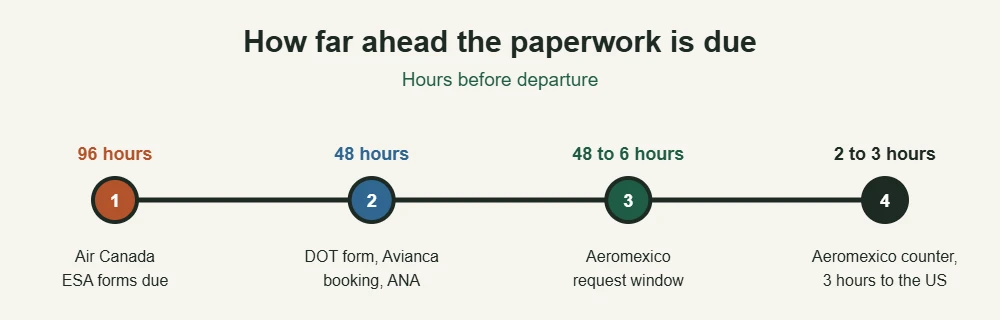
You request the service through Aeromexico’s form between 48 and 6 hours before departure, so a ticket bought inside that window can’t use it.
At the airport the animal goes to the counter at least 2 hours before departure, or 3 hours before a flight to the US, where staff check the dog and its papers.
For a US arrival the dog needs a rabies shot at least 28 days before it lands, on top of the CDC rules. Support animals can’t fly to London, and Iberia and Air Europa won’t take them on connecting flights.
Air Canada
Air Canada accepts emotional support dogs, and only dogs. The dog has to travel in an approved carrier under the seat for the whole trip, or in the pressurized baggage compartment if it won’t fit.
At least 96 hours before the flight you send a request form confirming the dog’s behavior, a form from a licensed medical or mental health professional who is treating you, a vet health form and the entry documents for your destination.
The emotional support section sets no route limit, while Air Canada gives service dogs separate rules for US flights. It doesn’t say a support dog can fly to the US, and its pet page lists no support-dog fee, so ask Accessibility Services before you book.
Avianca
Avianca’s help center says you can fly with one emotional support dog if you book it through the Contact Center up to 48 hours before departure. Cats aren’t accepted in this category.
In the cabin the dog travels in a flexible kennel up to 22 x 14 x 10 in (56 x 36 x 25 cm), and a dog over 10 kg (22 lb) goes in the hold at no extra charge. The minimum age is 4 months.
Avianca’s documents article waives the mental health letter on flights to and from the US, and its US page treats support dogs entering the country as a normal case. Neither page says plainly that support dogs fly on US routes, so confirm yours with the Contact Center.
LATAM, Copa, Volaris and ANA, away from the US
LATAM takes support dogs on international flights to and from Argentina, Mexico and Colombia and within Colombia. It excludes the US because, as it notes, the DOT doesn’t recognize the category.
LATAM’s downloadable form names only Colombia and Mexico for dogs, so check the route if you’re flying from Argentina. Copa carries support animals in the cabin only on flights to or from Colombia and Mexico.
Volaris carries support dogs and cats free inside Mexico and on its Latin American routes, and US flights are not on its list. Without the right documents the animal flies as a paid pet instead.
ANA takes emotional support dogs only on flights to or from Mexico. On its US routes the page covers psychiatric service dogs and alert dogs, with the DOT forms 48 hours ahead.
Airlines the old lists get wrong
Most of the outdated claims trace back to pages airlines never took down, or to a sentence lifted out of context.
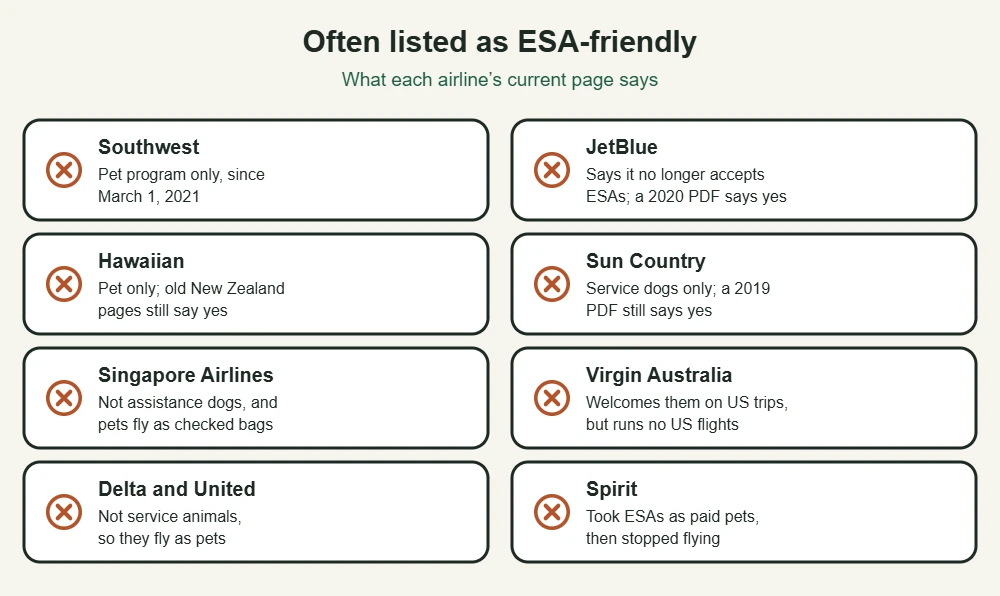
- Hawaiian’s older New Zealand pages still describe emotional support animals, while its current pages say they travel as pets.
- Sun Country has a 2019 PDF that mentions support animals in the cabin, but its help center now defines a service animal as a trained dog.
- JetBlue has an August 2020 contract of carriage that still turns up in search and accepts support animals at no charge. The current pets page says JetBlue no longer accepts them.
- Virgin Australia welcomes support dogs on US travel, yet it says it doesn’t fly to the US itself, so the partner airline’s rules apply.
- Singapore Airlines says emotional support dogs are not assistance dogs, and it carries pets only as checked baggage.
Elsewhere the answer is a plain no. Lufthansa, LOT, WestJet and Qantas don’t accept emotional support animals as assistance animals.
Japan Airlines, China Airlines, EVA Air and Iberia treat them as pets. Air France and KLM describe trained service dogs only and never mention support animals, so plan on their pet rules.
If your dog is trained for a psychiatric disability
A psychiatric service dog is a service dog, not an emotional support animal. The difference is training: the dog does specific tasks for your disability, where a support animal comforts you by being there.
A dog that qualifies flies free on US airlines, on your lap or in the floor space at your feet, and an airline can limit you to two. The airline can’t ask for other documents beyond the DOT forms, apart from the animal import rules of your destination.
If you booked more than 48 hours ahead, the rule lets the airline ask for the DOT Service Animal Air Transportation Form up to 48 hours before departure. For flights of 8 hours or more it can also ask for the relief attestation form.
The form is an attestation about training and behavior, and the gate is where it gets tested. United says it won’t consider a dog a trained service dog if it doesn’t behave appropriately in public.
For a dog that comforts you but isn’t task-trained, our guide on emotional support dogs covers the letter and what it does and doesn’t get you.
If your animal flies as a pet
For most people this is the real route. Book the pet as early as you book your seat, because most airlines cap the carriers per flight, and measure the carrier against the seat in front of you, not the bag’s label.
Our guide to airlines that allow pets in the cabin compares the international options, and our airline guides cover American, Delta, Southwest, JetBlue and Alaska in detail.
Border rules treat a support dog like any other dog. A dog entering the US needs the CDC paperwork, and United says a dog flying into Mexico needs a screwworm inspection certificate from a USDA-accredited vet, issued no more than 5 days before travel.
Our guide to the CDC rules for dogs entering the US works out which path your dog is on. For the cabin fee on a Mexico flight, Aeromexico lists $182 to $189 per segment on international routes, read on November 9, 2026.
Questions people ask about flying with an ESA
Can an emotional support cat still fly free anywhere?
Yes, on two Mexican airlines. Viva Aerobus carries a support cat in a carrier, and Aeromexico’s ESA page allows cats too, although one Aeromexico liability letter says dogs only, so get the cat confirmed. Air Canada and Avianca take dogs alone.
Will a letter from an online ESA service work for Aeromexico?
Only if a psychiatrist signs it. Aeromexico wants a letterhead certificate under a year old with the psychiatrist’s medical and specialty license numbers, and it turns down psychologists. Viva Aerobus is less strict and takes a psychologist or a psychiatrist.
Can my emotional support dog and my pet cat fly with me together?
Not on the two airlines most likely to take the dog. Aeromexico allows one animal in the cabin per traveler, counting support animals and service dogs, and Viva Aerobus also allows one animal per passenger.
What if Viva Aerobus turns down my papers at the airport?
Viva can move the animal to the hold and charge you for it. That is not an option for every dog: Viva keeps brachycephalic, or flat-faced, breeds such as pugs and boxers out of the hold, so check every document before you leave home.
Is an emotional support dog treated differently in Hawaii?
No. Alaska and Hawaiian fly it as a pet, and the state of Hawaii applies its pet entry rules to it, as our guide to bringing a dog to Hawaii explains.
Sources
Federal Register. Traveling by Air With Service Animals, final rule (the 2020 rule and its dates).
Federal Register. Docket DOT-OST-2018-0068 (no amendment since 2021).
eCFR. 14 CFR 382.3 (service animal definition).
eCFR. 14 CFR 382.75 (DOT forms and the 48-hour notice).
US DOT. Service animals (ESAs are not service animals).
United Airlines. Service animals (ESAs fly as pets, Mexico screwworm rule).
Southwest Airlines. Traveling with a service dog (ESAs as pets).
JetBlue. Traveling with pets (no ESAs, $150 pet fee).
Frontier. Service animals FAQ (ESAs not accepted).
Viva Aerobus. Animales de apoyo emocional (free ESAs, US route requirements).
Aeromexico. Service and emotional support animals (ESA rules, US flights, documents).
Air Canada. Service and emotional support dogs (ESA dogs and 96-hour forms).
Avianca. Can I fly with my emotional support dog? (ESA dog rules).
LATAM. Soporte emocional (ESA routes).
ANA. Customers with assistance dogs (Mexico ESA routes, US psychiatric service dogs).
The Nomad Paws is in memory of Woody, a great traveler and, most of all, the best, kindest and wisest friend I have ever had.
A note on sources. Everything here comes from the airlines’ service animal and pet pages, their help centers and contracts, and the Federal Register, read between October 19 and November 9, 2026. It is built from those pages, not a flight I took, and where two pages disagree I have said so.
Animal policies change with little warning, so get the airline to confirm your animal in writing before you buy a ticket that depends on it. None of this is medical or veterinary advice: whether your animal should fly at all is a question for your vet.