

Bringing a dog home from abroad used to come down to one familiar rabies certificate. Since August 1, 2024 the paperwork depends on where your dog has been and where it was vaccinated, and the rules apply just as much to a dog that lives in Ohio and spent a week in Cancún.
The good news is that most trips are simple. One question about the last six months tells you which of three paths you are on, and two of those paths have very little to do.
I worked through CDC’s own rules, its Dog Importation Navigator and the USDA screwworm pages in October 2026, so here is what each path asks for, six real trips worked through, and the 2025 and 2026 changes that catch owners out.
The short answer. Every dog entering or returning to the US must look healthy, be at least 6 months old, have a microchip and travel with a CDC Dog Import Form receipt. A dog that has been in one of CDC’s 111 high-risk countries in the last six months also needs a specific rabies form.

Dogs vaccinated abroad add a titer and a booking at a CDC-registered care facility, and anyone coming back from Mexico or Central America needs a USDA screwworm certificate too.
One question decides your path
Start with this: has your dog been in any country on CDC’s high-risk list for dog rabies in the six months before it arrives? The list has 111 countries and areas and was last updated on April 15, 2026.
Mexico, Canada and the UK are not on it. Brazil, Colombia, the Dominican Republic, India, the Philippines, Thailand, Turkey, the UAE, Ukraine, Vietnam and mainland China are.
If the answer is no, your dog follows the low-risk rules. If the answer is yes, what happens next depends on whether its rabies shot was given in the US or abroad.
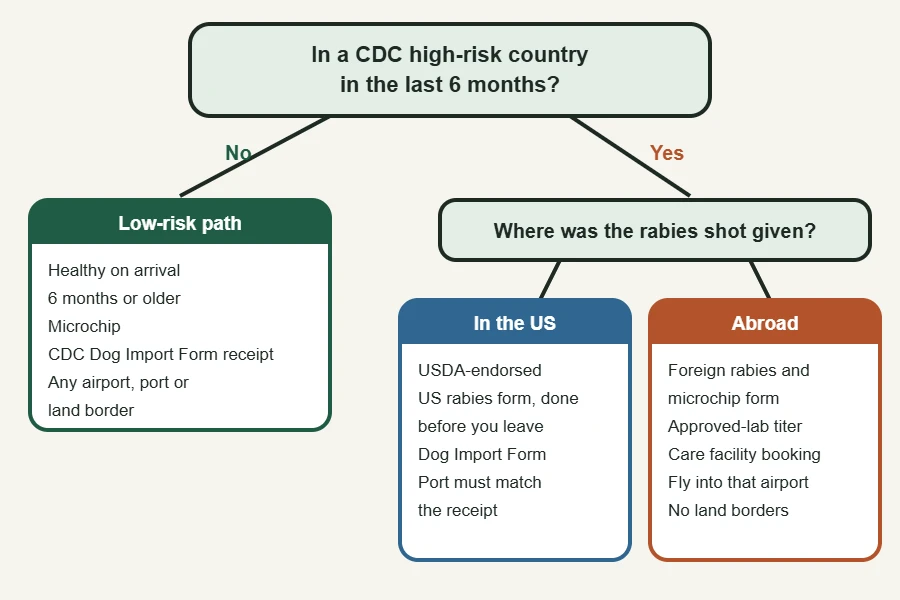
CDC’s free Dog Importation Navigator walks you through the same questions. It is informational only, so completing it doesn’t meet any requirement on its own.
What every dog needs, whatever the trip
- Age: at least 6 months old at the time of entry or return.
- Microchip: any brand, as long as a universal scanner can read it. The 2024 rule text asks for an ISO-compatible chip, so an ISO 11784/11785 chip is the safe choice.
- Health: the dog must appear healthy when it arrives.
- CDC Dog Import Form receipt: filled in online by the person bringing the dog. CDC doesn’t list a fee for it.
You can complete the form on the day you travel, although CDC suggests doing it a few days to six months ahead. Dogs under a year old need a photo taken within 15 days of arrival, and the receipt comes by email within about 15 minutes.
The form’s website was updated on February 5, 2026. CDC says the requirements didn’t change, and older receipts still work if they are accurate and unexpired.
Path one: no high-risk country in the last six months
This is the path for most holidays, including Mexico, Canada and the UK. Your dog needs the four basics above and nothing else for CDC, and it can arrive at any airport, seaport or land border crossing.
CDC still strongly recommends a rabies vaccination, and you will want one anyway for the country you are visiting.
The receipt from a low-risk country covers multiple entries for six months, as long as the country you leave from doesn’t change. That is handy for owners who cross into Canada or Mexico often.
Path two: a US-vaccinated dog coming home from a high-risk country
A normal rabies certificate is not enough here. CDC wants a form called the Certification of U.S.-issued Rabies Vaccination, filled in by a USDA-accredited vet and endorsed by USDA through its online VEHCS system.
The timing is what catches people: the form has to be completed before the dog leaves the US. Once endorsed, it stays valid for as long as the rabies vaccine on it, usually one or three years.
- The microchip must go in before the rabies shot, or the vaccine doesn’t count.
- The dog must have been at least 12 weeks old when vaccinated.
- USDA charges a fee for the endorsement. CDC’s page doesn’t state the amount, so ask your vet.
- Your dog can arrive at any airport, land border or seaport, as long as it matches the one on the Dog Import Form receipt.
If you are holding an older USDA-endorsed export health certificate instead, it only works if it was issued no later than July 31, 2025 and shows the dog’s age, microchip number and a valid US rabies vaccination. Anything issued after that date is not accepted for re-entry.
Path three: a dog vaccinated abroad coming from a high-risk country
This is the path for most international adoptions, and it is the one with real cost and planning. CDC asks for four things before the dog lands.
- A Certification of Foreign Rabies Vaccination and Microchip form, completed by your vet and endorsed by an official government vet in that country, no more than 30 days before travel.
- A rabies titer from a CDC-approved laboratory, with the blood drawn at least 30 days after the first valid vaccine and at least 28 days before entry.
- A confirmed reservation for an exam and revaccination at a CDC-registered animal care facility at the airport where the dog lands.
- A CDC Dog Import Form receipt that lists that same airport.
The facility list was updated on September 1, 2026 and covers nine facilities at eight airports: Atlanta, Dallas Fort Worth, Los Angeles (two), Miami, New York JFK, Philadelphia, Seattle and Washington Dulles. All costs there fall on you.
A valid titer stays good for the dog’s life, as long as its vaccinations never lapse and the lab stays approved. Without one, the dog faces a 28-day quarantine after revaccination.
These dogs can’t enter at a land border, can’t pass through another US airport first, and every document must be in English or come with a certified translation.
Layovers can quietly change your path
CDC counts a dog as having entered a country if it clears customs there. So a dog flying from Athens can end up on a high-risk path if it clears customs during a layover in Istanbul, because Turkey is on the list.
Dogs flying as checked or excess baggage sometimes have to clear customs on a long connection, so ask your airline before you book. CDC’s layovers page has the details.
Mexico, Central America and the screwworm certificate
The CDC rules are only half the story south of the border. USDA’s animal health service, APHIS, adds its own rule for New World screwworm, a parasite that can infest dogs and cats as well as livestock.
Dogs coming from a country that isn’t screwworm-free need a certificate showing they were inspected within five days before travel and found free of it, or treated in quarantine until free.
| Country | Screwworm | Foot-and-mouth disease |
|---|---|---|
| Mexico | Not free | Free |
| Guatemala, Belize, Honduras, El Salvador | Not free | Free |
| Nicaragua, Costa Rica, Panama | Not free | Free |
| Colombia | Not free | Not free |
| Brazil | Not free | Not free (Santa Catarina state is free) |
| Dominican Republic | Not free | Free |
| Jamaica | Not free | Free |
That table comes from APHIS’s country status list, last modified January 21, 2026, and it applies to US dogs coming home as well. For rabies, always use the CDC high-risk list rather than the APHIS rabies column.
Foot-and-mouth disease needs no paperwork. APHIS asks that dogs from affected countries are bathed on arrival and kept away from livestock for five days.
APHIS says the certificate should come from a full-time, salaried government vet of the country, and its dog page adds that in Mexico an authorized clinical vet may issue it.
Its February 2026 traveler guidance and a CBP reminder from June 26, 2026 don’t mention that exception, so check with APHIS if you rely on it.
This isn’t a paperwork formality. On June 8, 2026, USDA confirmed screwworm in a dog in Andrews County, Texas, that had recently been in Mexico, and CBP says it will strictly enforce the rule at the border.
Six trips, worked through
I ran these through CDC’s Navigator and checked the screwworm status for each country on APHIS’s list in October 2026.
| Your trip | CDC path | What the dog needs |
|---|---|---|
| US dog, road trip to Mexico and back | Low-risk | Healthy, 6 months+, microchip, Dog Import Form. Plus a USDA screwworm certificate, because Mexico is not screwworm-free |
| US dog flying home to Miami from Colombia | US-vaccinated, high-risk | USDA-endorsed US rabies form done before leaving, Dog Import Form. Colombia also needs the screwworm certificate |
| UK-vaccinated dog flying London to JFK | Low-risk | Healthy, 6 months+, microchip, Dog Import Form |
| Dog adopted in Thailand, landing at LAX | Foreign-vaccinated, high-risk | Foreign rabies and microchip form, approved-lab titer, booking at an LAX care facility, Dog Import Form. Thailand also needs the screwworm certificate |
| 4-month-old puppy from Canada | Low-risk, but too young | Not allowed until it is 6 months old |
| Dog from Greece that clears customs in Istanbul | High-risk (Turkey) | Treated as coming from a high-risk country, so a high-risk path applies |
Puppies, service dogs and cats
Puppies under 6 months can’t enter, full stop. The Navigator doesn’t even ask about age on the low-risk path, but CDC’s age rule applies to every dog.
Service dogs follow exactly the same rules as other dogs. CDC uses the airline definition of a service animal, so emotional support dogs don’t count as service dogs.
Cats are much simpler. CDC doesn’t require proof of rabies vaccination for them, only that they look healthy, although it recommends the vaccine and some states, Hawaii among them, add rules of their own.
If something goes wrong at the border
A dog that doesn’t meet the rules is denied entry and sent back to the country it left from, at your expense. Airlines must return it within 72 hours, and it can’t carry on to the next flight on your ticket.
That is why the details matter more than they used to: the wrong airport on the receipt or a form signed after you left can end a trip at the gate.
Before you leave: a checklist
- Check the CDC high-risk list against every country your dog will visit or clear customs in.
- Confirm the microchip reads on a universal scanner and was implanted before the rabies shot.
- If you will visit a high-risk country, get the USDA-endorsed US rabies form before departure.
- Heading to Mexico or Central America? Book a vet abroad for the screwworm certificate within five days of your return.
- Fill in the CDC Dog Import Form and check the arrival port and date on the receipt.
- Read your airline’s pet rules too, since they sit on top of all of this.
For the airline side, my airline pet policies guide covers the major US carriers, and the Mexico country guide covers the trip down.
Frequently asked questions
What does my dog need to enter the US?
Every dog must look healthy, be at least 6 months old, have a microchip that a universal scanner can read and travel with a CDC Dog Import Form receipt. Dogs that were in a CDC high-risk country in the last six months also need a rabies certification form.
Do these rules apply to US dogs coming home?
Yes. The CDC and USDA requirements apply to every dog entering the country, including dogs that live in the US and are returning from a trip.
Does my dog need a rabies certificate to return from Mexico?
Not for CDC, as long as the dog hasn’t been in a high-risk country in the last six months, because Mexico is not on the list. USDA does require a screwworm health certificate issued within five days of travel, since Mexico is not screwworm-free.
How much does the CDC Dog Import Form cost?
CDC’s instructions don’t list a fee for the form. You fill it in online, ideally a few days to six months before travel, and the receipt arrives by email within about 15 minutes.
Can a puppy under 6 months enter the US?
No. CDC requires dogs to be at least 6 months old at the time of entry or return, wherever they come from.
Can my dog use an export health certificate to come home?
Only if USDA endorsed it no later than July 31, 2025 and it lists the required rabies and microchip details. For anything newer, use the Certification of U.S.-issued Rabies Vaccination form instead.
Does a layover change the rules?
It can. If your dog clears customs during a layover in a high-risk country, CDC treats it as having been in that country, so the high-risk rules apply even if the trip started somewhere low-risk.
Do cats need a rabies certificate to enter the US?
Not for CDC. Cats must look healthy on arrival, and CDC recommends rabies vaccination, but some states such as Hawaii have their own rules.
References
Federal Register. Importation of Dogs and Cats, final rule, 89 FR 41726 (effective date, ISO-compatible microchip, 2007 rabies elimination).
CDC. Bringing a Dog into the United States (overall requirements).
CDC. Dog Importation Navigator (question flow and results for each path).
CDC. High-Risk Countries for Dog Rabies (the country list, updated April 15, 2026).
CDC. Dogs from Dog Rabies-free or Low-risk Countries (age, microchip, form timing).
CDC. U.S.-vaccinated Dogs Returning from High-risk Countries (the US form).
CDC. Foreign-vaccinated Dogs from High-risk Countries (foreign form, titer, facility).
CDC. Dog Importation: information for veterinarians (export certificates after July 31, 2025).
CDC. CDC Dog Import Form instructions (photo, receipt, February 2026 update).
CDC. CDC-registered Animal Care Facilities (facility list, updated September 1, 2026).
CDC. Layovers (clearing customs counts as entering).
CDC. Frequently Asked Questions on Dog Importations (denied entry, land borders).
CDC. Dog importation: information for airlines (72-hour return).
CDC. Bringing an Animal into the United States (cats).
USDA APHIS. Bringing dogs into the United States (screwworm certificate, Mexico exception, FMD).
USDA APHIS. Dog Imports: Check Country Disease Status (screwworm status by country).
USDA APHIS. New World screwworm guidance for travelers with cats and dogs (February 2026 guidance).
USDA APHIS. USDA confirms two additional cases of New World screwworm (June 2026 case in a dog in Texas).
U.S. Customs and Border Protection. Reminder for travelers with dogs crossing the U.S.-Mexico border (June 26, 2026 enforcement reminder).
The Nomad Paws is in memory of Woody, a great traveler and, most of all, the best, kindest and wisest friend I have ever had.
This is a research comparison, not a hands-on test. Everything here comes from CDC, USDA APHIS and CBP pages and from CDC’s Dog Importation Navigator, all read in October 2026. These rules have changed several times since 2024, so check CDC and APHIS again in the weeks before you travel.
As an Amazon Associate I earn from qualifying purchases, which costs you nothing extra and keeps these guides free to read. This page is general information, not legal or veterinary advice, and your vet and the agencies themselves have the final word on your dog’s paperwork.