
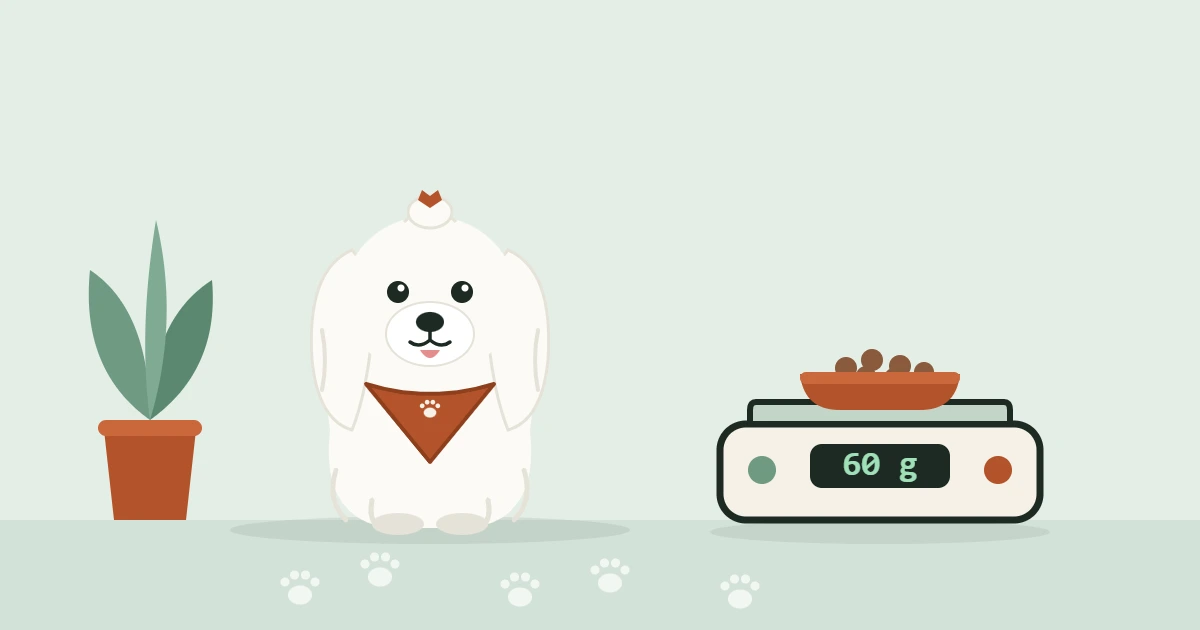
A Maltese weighs about as much as a bag of sugar from the grocery store.
It does not know this. It will stand its ground against a Great Dane, supervise every meal you cook, and look at you over the edge of the sofa as if dinner was promised an hour ago.
The breed has been a lapdog for a very long time. Its whole job, for centuries, has been to sit close to people and be adored, which it still does beautifully.
Here is the catch. On a dog this small, every mistake in the bowl is a big mistake.
A cup of the richest food on this page holds about 2.3 days of calories for a 5 pound Maltese. One ordinary 30 kcal biscuit is close to a sixth of its whole day.
So this page shrinks the maths to Maltese size. Five small-breed dry foods, every figure the brands print, and how much of each one your dog actually needs, in fractions of a cup.

Then the things that matter most for a toy dog: teeth that crowd a small jaw, puppies that cannot skip a meal, and a liver quirk that is far more common in Maltese than in most breeds.
The short answer. A grown Maltese needs only about 153 to 266 kcal a day, and a cup of these foods holds 298 to 452. Hill’s Perfect Weight Small & Mini has the lightest scoop, and Purina Pro Plan Small Breed the richest.
Pick the food your vet is happy with, weigh it in grams, and let the scale, not the cup, decide the portion.
At a glance
The smallest dog in the room
The breed standard says a Maltese should weigh under 7 pounds, with 4 to 6 pounds preferred.
At that size, half a pound is close to a tenth of the whole dog. That is the same as a 70 pound Labrador putting on 7 pounds, and on a Maltese it can hide under all that white coat.
Weigh your dog on a kitchen or baby scale every few weeks, and feel for the ribs under the hair rather than trusting your eyes.
How many calories a Maltese needs
The American Animal Hospital Association gives a simple formula. Resting energy is 70 times body weight in kilograms to the power 0.75, and a neutered adult needs 1.4 to 1.6 times that.
For a dog this small the formula is only a starting point, and your vet will adjust it after checking body condition. Here is what it gives.
| Dog | Weight | Resting kcal | Daily kcal (neutered) | Cups of the lightest food | Cups of the richest food |
|---|---|---|---|---|---|
| Maltese at the small end of the preferred range | 4 lb | 109 | 153 to 175 | 0.55 | 0.36 |
| Maltese in the middle | 5 lb | 129 | 181 to 207 | 0.65 | 0.43 |
| Maltese at the top of the preferred range | 6 lb | 148 | 208 to 237 | 0.75 | 0.49 |
| Maltese at the limit of the standard | 7 lb | 167 | 233 to 266 | 0.84 | 0.55 |
The last two columns assume the middle of the range, 1.5 times resting energy. A 5 lb Maltese needs about 0.65 cup of Hill’s Perfect Weight, or 0.43 cup of Pro Plan Small Breed. That gap is about three and a half tablespoons, and it adds up every single day.
The cup trap
A cup of Hill’s Perfect Weight Small & Mini holds 298 kcal. A cup of Purina Pro Plan Small Breed holds 452, about 52% more.
At these portions a measuring cup is too blunt a tool. Weigh the food in grams, and use the feeding guide for the food you are actually pouring.
The treat maths
Take a 5 lb Maltese on about 190 kcal a day. A 30 kcal biscuit is about 16% of that day, and two of them are close to a third.
Break treats into tiny pieces, count them as part of the day, and weigh everything. A simple digital kitchen scale that reads in single grams does the job.
Small mouth, crowded teeth
Teeth are the big health story for toy dogs. In a Royal Veterinary College study of 22,333 dogs seen by UK vets, periodontal disease was the most common diagnosis of the year, affecting about one dog in eight.
Size mattered. Dogs under 10 kg had about three times the risk of dogs weighing 30 to 40 kg, and every Maltese is far under that line.
No dry food replaces brushing. A kibble shaped for a small mouth makes eating easier, but the habit that protects a Maltese’s teeth is a toothbrush and regular dental checks with your vet.
Puppies cannot skip meals
The American Maltese Association warns that toy puppies can suffer low blood sugar, usually from weaning to about three or four months old. Missing a meal or being a picky eater are among the triggers it lists.
Signs include listlessness, trembling, staggering and pale gums. The association recommends frequent small meals through the day, and a vet visit if episodes keep happening.
Most puppies outgrow it. Very tiny adults can stay prone to it, which is one more reason not to aim for the smallest Maltese possible.
The liver quirk
Maltese are known for two liver conditions. A liver shunt is a blood vessel that carries blood around the liver instead of through it, and it can need surgery, diet and medication.
Microvascular dysplasia is far more common in the breed. The American Maltese Association says virtually all Maltese with it never show symptoms and live long, healthy lives.
A vet can tell the two apart with blood tests. Only a dog with symptoms needs a special diet, and that diet should come from your vet, not from a pet store shelf.
Fat and protein per 1000 calories
Percentages on a bag depend on water and on how many calories the food holds. Grams per 1000 kcal puts every food on the same footing.
Hill’s prints dry-matter averages, so I calculated its figures by allowing 5 to 12% water. The others print minimums, so their real fat and protein are higher than shown.
The five foods in numbers
| Food | kcal per cup | g fat per 1000 kcal | g protein per 1000 kcal | AAFCO basis |
|---|---|---|---|---|
| Hill’s Perfect Weight Small & Mini | 298 | about 32 (calculated) | about 83 (calculated) | Feeding tests |
| Royal Canin Maltese | 317 | at least 41 | at least 57 | Formulated to meet |
| Hill’s Small & Mini | 357 | about 38 (calculated) | about 62 (calculated) | Feeding tests |
| Royal Canin X-Small | 369 | at least 42 | at least 57 | Formulated to meet |
| Pro Plan Small Breed | 452 | at least 42 | at least 72 | Feeding tests |
I did not feed these to a dog, so there is no taste test here. I read each brand’s own page or label, copied the numbers as printed, and marked anything I worked out myself as calculated.
The foods one by one
Each card shows what is printed on the brand’s page or label. Hatched bars are my calculation, and solid bars on the fat and protein rows are label minimums.
Hill’s Science Diet Adult Perfect Weight Small & Mini, Chicken
Dry kibble · weight management
The lightest scoop in the group: 298 kcal per cup.
AAFCO feeding tests · 3189 kcal per kg
Full details
Hill’s prints dry-matter averages: 28.8% protein, 11.2% fat and 10.3% fibre. I turned those into per-1000-kcal figures by allowing 5 to 12% water, so treat them as calculated. Chicken, cracked pearled barley, brown rice and pea fiber come first. Its chart starts a 5 lb dog at 5/8 cup a day for weight management and 3/8 cup for weight loss.
Royal Canin Maltese Adult
Dry kibble · breed formula
Made for the breed and moderate per cup, but formulated to meet rather than feeding-tested.
Grain-inclusive · 3861 kcal per kg
Full details
The only food here made for Maltese by name, with a kibble shaped for a small mouth. Royal Canin prints 22% protein minimum, 16% fat minimum, 3.3% fibre maximum and 10% moisture maximum, with brewers rice, corn, chicken by-product meal and chicken fat first. Its chart starts a 4.4 lb dog at 1/2 to 5/8 cup a day.
Hill’s Science Diet Adult Small & Mini, Chicken & Brown Rice
Dry kibble · everyday adult
A feeding-tested everyday food in the middle of the group.
AAFCO feeding tests · 3699 kcal per kg
Full details
Hill’s prints dry-matter averages of 25% protein, 15.3% fat and 1.5% fibre, so my per-1000-kcal figures are calculated, allowing 5 to 12% water. Chicken, brown rice, whole grain wheat and whole grain corn come first. Its chart starts a 5 lb dog at 5/8 cup a day.
Royal Canin X-Small Adult
Dry kibble · dogs up to 8 lb
Sized for dogs up to 8 lb, but a richer cup than the breed formula.
Grain-inclusive · 3840 kcal per kg
Full details
Royal Canin makes this for adult dogs up to 8 pounds, which covers every Maltese in the standard. It prints 22% protein minimum, 16% fat minimum, 3.5% fibre maximum and 10% moisture maximum, with brewers rice, corn, chicken by-product meal and chicken fat first. Same minimums as the Maltese formula, but about 16% more calories in each cup.
Purina Pro Plan Small Breed Adult, Chicken & Rice
Dry kibble · everyday adult
The richest cup here at 452 kcal, more than two days of food for a 5 lb Maltese.
AAFCO feeding tests · 4053 kcal per kg
Full details
Feeding-tested and high in protein, but dense. Purina’s label prints 29% protein minimum, 17% fat minimum and 400 ppm glucosamine, with chicken, rice, corn protein meal and poultry by-product meal first. Its chart lumps every dog from 3 to 12 lb into one row of 1/3 to 1 cup, so a Maltese owner has to do the maths, which is what this page is for.
What about grain-free?
The US FDA has investigated a possible link between certain diets, many of them grain-free, and a heart condition called dilated cardiomyopathy. A clear cause has not been established.
Every food on this page contains grain. If you are considering a grain-free food, talk to your vet first.
Questions to take to your vet
- What is my Maltese’s ideal weight, and what is their body condition score today?
- How many calories a day should we aim for, in grams of the food we use?
- How are my dog’s teeth, and how often should we schedule dental cleanings?
- Should we run a bile acids test, and does anything in the results change what my dog eats?
Frequently asked questions
What is the best food for a Maltese?
There is no single best food. For a dog this small the useful questions are how many calories sit in a cup, whether the recipe has been through AAFCO feeding tests, and whether the kibble suits a tiny mouth. This page compares five small-breed foods on those numbers.
How much should a Maltese eat a day?
Using the AAHA formula, a neutered adult Maltese between 4 and 7 pounds needs roughly 153 to 266 kcal a day. Depending on the food, that is somewhere between about a third of a cup and just under a full cup. Your vet will adjust it by checking body condition.
How many calories are in a cup of Maltese food?
Across the five foods here, a cup holds 298 to 452 kcal. For a 5 lb Maltese needing about 190 kcal a day, a cup of the richest food is more than two days of calories.
How much should a Maltese weigh?
The breed standard says under 7 pounds, with 4 to 6 pounds preferred.
Why do Maltese puppies need frequent meals?
The American Maltese Association says toy puppies can suffer low blood sugar, usually from weaning to about three or four months, and recommends frequent small meals. Missing a meal is one of the triggers it lists.
Is grain-free food safe for a Maltese?
The US FDA has investigated a possible link between certain diets, many of them grain-free, and a heart condition called dilated cardiomyopathy. A clear cause has not been established, so talk to your vet before choosing a grain-free food.
This is a research comparison, not a hands-on test. Figures come from each brand’s page or label, and may change when a recipe changes.
As an Amazon Associate I earn from qualifying purchases, which costs you nothing extra. This page is general information, not veterinary advice.
References
Canadian Kennel Club. Maltese breed standard (weight).
American Animal Hospital Association. 2021 Nutrition and Weight Management Guidelines, energy requirement formulas.
O’Neill DG, et al. (2021). Epidemiology of periodontal disease in dogs in the UK primary-care veterinary setting. Journal of Small Animal Practice. Summary: Royal Veterinary College.
American Maltese Association. Hypoglycemia and Liver shunt and microvascular dysplasia.
U.S. Food and Drug Administration. FDA investigation into potential link between certain diets and canine dilated cardiomyopathy.
Product figures: Hill’s Science Diet Adult Perfect Weight Small & Mini; Royal Canin Maltese Adult; Hill’s Science Diet Adult Small & Mini; Royal Canin X-Small Adult; Purina Pro Plan Small Breed Chicken & Rice label.