
Short answer: a few spoonfuls of plain, boneless, skinless turkey breast, plain sweet potato, green beans, plain pumpkin or corn cut off the cob are fine for most healthy dogs. Skip the skin, fat, gravy, ham and anything with onion or garlic, which rules out most stuffing.
Never share cooked bones, corn cobs, raw bread dough, grapes or raisins (so no fruitcake, mince pies or stollen), chocolate, macadamia nuts, alcohol or anything sweetened with xylitol. If your dog gets into any of these, call your vet, the ASPCA Animal Poison Control Center on (888) 426-4435 or the Pet Poison Helpline on (855) 764-7661.
Every holiday table has a member who never gets a chair. They sit just out of reach, chin on the floor, tracking every fork from plate to mouth.
And every year someone at that table says, “Oh, a little bit won’t hurt.” Sometimes they’re right.
A sliver of plain turkey is a lovely thing to share. But the same plate also holds onion-heavy stuffing, gravy made from drippings, a bowl of raisins in the fruitcake and, by Christmas, chocolate in every second stocking.

The numbers back up the worry. In a UK study of vet records, chocolate exposure in dogs was recorded nearly five times more often at Christmas than at other times of year.
So here is the holiday menu, dish by dish, from the FDA, the ASPCA, the AVMA, the Merck Veterinary Manual and the vet schools at Tufts, UC Davis, Cornell and Kansas State. What’s fine to share, what to keep on your side of the table, and what means picking up the phone.
Fine in small, plain amounts
Turkey breast with no skin or bones, plain sweet potato, plain green beans, plain pumpkin or squash, corn kernels cut off the cob, chopped apple.
Keep it off their plate
Turkey skin, fat and drippings, gravy, ham, buttery or creamy sides, pecan pie, white chocolate, anything salty or rich.
Call if they eat it
Onion or garlic dishes, cooked bones, corn cobs, raw dough, grapes and raisins, chocolate, macadamia nuts, alcohol, xylitol.
Who to call, any hour
Your vet, the ASPCA on (888) 426-4435 (a consultation fee may apply) or the Pet Poison Helpline on (855) 764-7661 ($99 per incident).
The holiday plate, dish by dish
| Dish | Can your dog have it? | Why |
|---|---|---|
| Roast turkey, white meat | Yes, a little | Plain, boneless, skinless and fully cooked only |
| Turkey skin, dark meat, drippings | No | Fatty, linked to pancreatitis |
| Turkey bones or carcass | Never | Choking, blockage and internal injury |
| Stuffing or dressing | No | Usually onion, garlic, butter and salt |
| Gravy | No | Fat, salt from stock cubes, often onion |
| Green bean casserole | No | Fried onion topping and creamy sauce |
| Plain green beans | Yes | About 22 kcal per half cup |
| Plain sweet potato | Yes, a little | Skip the butter, sugar and marshmallows |
| Corn on the cob | Never the cob | Cobs often need surgery to remove |
| Mashed potatoes | Better not | Usually butter, cream and salt |
| Bread rolls and raw dough | Never the dough | Raw yeast dough rises in the stomach |
| Ham | No | Salty and fatty |
| Pumpkin pie | Plain pumpkin instead | Spices, and some pies contain xylitol |
| Pecan pie | No | Fatty nuts, sugar and butter |
| Fruitcake, mince pies, stollen | Never | Raisins and currants |
| Chocolate and cocoa | Never | Theobromine and caffeine |
| Eggnog and mulled wine | Never | Alcohol |
| Sugar-free desserts and mints | Never | May contain xylitol |
The turkey: yes, with three conditions
The AVMA says plain, boneless, skinless turkey is generally safe for pets in small portions. The ASPCA adds that it must be fully cooked, since raw or undercooked turkey can carry salmonella.
White breast meat is the bit to share. Tufts’ nutrition team puts a level tablespoon of cooked turkey breast at about 12 calories and a quarter cup at about 50.
Everything else on the bird is a problem. The FDA warns against fatty scraps such as roast turkey skin, and Kansas State’s vets list gravy, dark meat, ham, butter and drippings as foods that can upset the gut and, in some cases, cause fatal pancreatitis.
Pancreatitis is the painful one to watch for in the days after a feast. The FDA lists vomiting, stomach pain, restlessness, shaking, diarrhea, fever and weakness as its most common signs.
The trash can is a big part of the risk. In one study of dogs with pancreatitis, getting into the trash came with about 13 times the odds of the disease, and table scraps in the week before with about twice the odds.
Bones and the carcass in the bin
Cooked turkey bones are a firm no. The FDA says bones can lodge in the throat, stomach or windpipe, and sharp pieces can cause severe internal injuries.
Signs of a bone stuck further down can take hours or days to show, as vomiting, diarrhea, low energy, loss of appetite or a sore belly.
Bones were the most common thing stuck in the esophagus in a study of 125 dogs at two veterinary teaching hospitals, at 44% of cases. Another study found that small dogs under 10 kg had more complications when a bone had to be removed.
So the carcass goes straight into a bin your dog can’t open, and the AVMA recommends a tightly secured one. Take it outside before dessert if you can.
Stuffing, gravy and the onion family
This is the part of the meal people underestimate. The ASPCA notes that onions and garlic turn up in a lot of Thanksgiving dishes, and both can be toxic to dogs.
The Merck Veterinary Manual explains that onion and garlic, raw, cooked, dried or powdered, can damage a dog’s red blood cells. Garlic is three to five times more toxic than onion.
The concentrated forms cause the most trouble: dried flakes, powders and onion soup mix. That makes the crispy fried onions on a green bean casserole, boxed stuffing mixes and seasoned gravy the dishes to guard.
The damage is slow. Merck says the red blood cells typically break down three to five days after the meal, so a dog can seem fine on Thanksgiving night and be weak, tired or breathing fast by the weekend.
Gravy has a second problem. The ASPCA warns that bouillon cubes used for stock and gravy are very high in sodium, which can cause stomach trouble and even seizures.
The sage in the stuffing, for what it’s worth, isn’t the issue. The ASPCA lists sage as non-toxic to dogs; it’s the onion, garlic, fat and salt around it.
The sides: where your dog can share
Vegetables are the friendliest part of the meal, as long as they’re plain. The ASPCA suggests mixing a few pieces of turkey, sweet potato and green beans into your dog’s usual dinner.
Kansas State’s vets suggest vegetables not cooked in butter, chopped apple, and plain pumpkin or sweet potato. Tufts agrees that pumpkin, corn and green beans make good treats, minus the butter, sauces, salt and seasoning.
Plain green beans are light, at about 22 calories per half cup boiled, according to UC Davis. A quarter cup of baked butternut squash is about 21.
Sweet potato is a good share when it’s plain. The holiday casserole, with butter, brown sugar and marshmallows, is a different dish. Our guide to sweet potato for dogs covers the details.
Corn is fine off the cob and dangerous on it. Tufts says dogs that get hold of a cob often swallow large pieces, which frequently cause a blockage that needs surgery.
Bread rolls and raw dough
Baked bread isn’t the main worry here. Raw yeast dough is.
Merck explains that yeast dough keeps rising in the warm stomach, stretching it, while the yeast makes alcohol. Early signs are retching that brings nothing up, a swollen belly and lethargy.
The ASPCA warns that the stomach can bloat and even twist, which is a life-threatening emergency. Merck adds that most deaths come from the alcohol, so a dog that ate rising dough needs a vet straight away.
Pies, puddings and anything sugar-free
Plain canned pumpkin, not pie filling, is the safe way to share the flavor. The AVMA says small pieces of pumpkin can be healthy but pumpkin pie can contain ingredients that are toxic to pets.
Tufts does say a small spoonful of apple or pumpkin pie filling is reasonable for a healthy dog. If you share, make sure the pie has no xylitol and only a whisper of spice.
Spice is a real if smaller concern. The ASPCA’s poison control team says large amounts of nutmeg can cause vomiting, agitation, a fast heart rate and even hallucinations, and a lot of cinnamon can irritate the throat and stomach.
Pecan pie is out. The ASPCA warns that almonds, pecans and walnuts are high in fats that can cause vomiting, diarrhea and potentially pancreatitis.
The one to watch hardest is xylitol, a sugar substitute that may appear on labels as birch sugar or wood sugar. The FDA says it’s used in some cakes, muffins and pies, often ones made for people with diabetes, and in sugar-free holiday mints.
In dogs, xylitol can crash blood sugar within 10 to 60 minutes, according to the FDA, and Merck notes that higher doses can cause liver failure. Some effects can be delayed for 12 to 24 hours, so treat any xylitol as a call-now event even if your dog seems fine.
Check peanut butter too, if you use it to hide pills or fill a holiday Kong. The FDA says to read the label for xylitol first.
Chocolate: the darker it is, the less it takes
Chocolate contains theobromine and caffeine, both of which are toxic to dogs. In 2025, chocolate was the fourth most common reason people called ASPCA Poison Control, at 13.6% of exposures, and dogs were the most common patients.
How dangerous it is depends on three things: the type of chocolate, how much, and the size of your dog. Darker chocolate packs far more into each ounce.
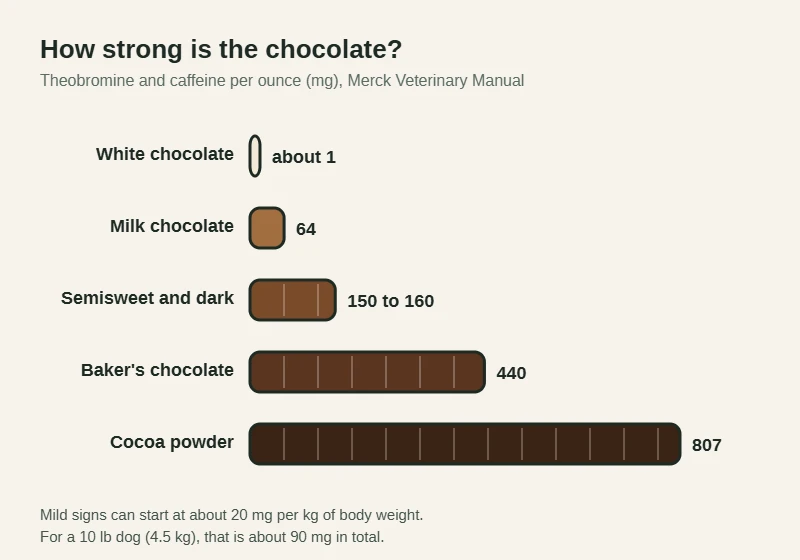
Merck says mild signs such as vomiting, diarrhea and thirst can start at about 20 mg per kg of body weight, heart effects at 40 to 50 mg/kg, and seizures at 60 mg/kg or more.
To show what that means, I ran one ounce of each type through the Merck vet manual’s chocolate toxicity calculator for three sizes of dog.
| One ounce of | 10 lb dog | 30 lb dog | 60 lb dog |
|---|---|---|---|
| Milk chocolate | 14.10 mg/kg, treatment usually not necessary | 4.70 mg/kg, no treatment necessary | 2.35 mg/kg, no treatment necessary |
| Semisweet chocolate | 35.25 mg/kg, emergency treatment advised | 11.76 mg/kg, treatment usually not necessary | 5.88 mg/kg, treatment usually not necessary |
| Baker’s chocolate | 96.91 mg/kg, emergency treatment advised | 32.33 mg/kg, emergency treatment advised | 16.17 mg/kg, emergency treatment advised |
| Cocoa powder | 177.75 mg/kg, emergency treatment advised, death possible | 59.29 mg/kg, emergency treatment advised | 29.65 mg/kg, emergency treatment advised |
Look at the bottom two rows. Even a 60 lb dog that eats one ounce of baker’s chocolate or cocoa powder gets an “emergency treatment advised” result, so any baking chocolate or cocoa means a phone call, whatever the size of the dog.
The FDA gives its own worked example: six ounces of semisweet chocolate chips hold 816 mg of theobromine, enough to cause severe signs in a 6 lb Chihuahua and possibly kill it without treatment.
Merck says signs usually show within 6 to 12 hours, and the FDA lists vomiting, diarrhea, restlessness, a racing heart, muscle spasms and, in bad cases, seizures. White chocolate has almost none of the toxic compounds, but Merck notes that the fat in any chocolate can trigger pancreatitis.
The holiday versions are the ones that get eaten. In that UK study, the festive culprits included Santa figurines, Advent calendars and chocolate tree decorations, so keep them higher than a dog can stretch.
Grapes, raisins, fruitcake and mince pies
Grapes, raisins, sultanas and Zante currants can cause sudden kidney failure in dogs. That puts fruitcake, mince pies, stollen, Christmas pudding and raisin-studded stuffing all on the never list.
Researchers now think the culprit is tartaric acid. A 2022 study by the ASPCA’s poison control team and Cornell linked it to kidney injury in dogs that ate cream of tartar or tamarinds, and Merck calls it one proposed cause, so it’s the leading explanation rather than settled fact.
There’s no safe number to go by. Merck gives a rough line of more than one grape or raisin per 10 lb of body weight as a possible risk, but the amount in each fruit varies, so any amount is worth a call.
Most dogs start vomiting or have diarrhea within 6 to 12 hours, and kidney failure can follow within one to three days. In an early ASPCA case series of 43 dogs, 53% survived.
True blackcurrants and redcurrants are a different plant and haven’t been linked to kidney damage, says Merck. The dried “currants” in a Christmas cake are usually the grape kind.
Macadamia nuts
Macadamias, in cookies or the cheese board, cause a strange but usually short-lived illness in dogs: weakness, wobbliness, vomiting and a high temperature.
The ASPCA says signs usually appear within 12 hours, with recovery expected within one to three days. Merck notes that dogs are the only species known to react this way. It’s rarely fatal, but call your vet if your dog has eaten them.
Eggnog, mulled wine and the leftover glass
The FDA uses an unattended glass of eggnog as its example of a holiday hazard, and for good reason. Alcohol is absorbed quickly, says the ASPCA, and can cause vomiting, poor coordination, breathing trouble, tremors and, in severe cases, coma and death.
Clear half-finished glasses off low tables before everyone moves to the sofa.
Ham, salt and salt-dough ornaments
Ham is both fatty and salty. The ASPCA says too much salt can cause vomiting, diarrhea, tremors, seizures and even death.
Homemade salt-dough ornaments are a surprise risk. The FDA, citing the Pet Poison Helpline, says a 10 lb pet can get sick on just half a teaspoon of salt, and one and a half teaspoons can be fatal.
Tufts also notes that salty holiday food is a particular concern for dogs with heart disease.
How much is a little?
Vet nutritionists use a simple rule: treats and extras should be no more than 10% of a dog’s daily calories. UC Davis gives the example of a dog eating 100 calories a day getting no more than 10 from extras.
Tufts puts a fairly active 25 lb dog at about 600 calories a day, so 60 calories of extras. That’s roughly a quarter cup of plain turkey breast, or a few spoonfuls of turkey with some green beans.
The ASPCA and Tufts both say the safest choice of all is to keep your dog’s meals the same over the holidays. Dogs with sensitive stomachs can easily get sick on foods they don’t usually eat.
If you’d like to make your dog a proper plate of their own, our page on homemade dog food is a good place to start, and our guide to which human foods dogs can eat covers the rest of the year.
Dogs that need extra care
Some breeds get pancreatitis more often. Merck says Miniature Schnauzers are dramatically overrepresented, with more cases also seen in Yorkshire Terriers, Cocker Spaniels, Dachshunds, Poodles and sled dogs.
Many Miniature Schnauzers carry high blood fats, and one study found those with severe levels were 4.5 times more likely to have test results consistent with pancreatitis. For these dogs, even turkey skin is worth refusing. See our guides for Miniature Schnauzers, Cocker Spaniels and Dachshunds.
If your dog has had pancreatitis before, ask your vet before sharing anything from the table. Our guide to food for dogs with pancreatitis explains why.
Small dogs need extra care too. The same square of chocolate is a much bigger dose for them, and in one study dogs under 10 kg had more complications from swallowed bones. Deep-chested breeds deserve extra caution with raw dough, which Merck says can trigger bloat and twisting of the stomach.
If your dog eats something it shouldn’t
Call first. Your own vet, the ASPCA Animal Poison Control Center on (888) 426-4435 or the Pet Poison Helpline on (855) 764-7661 can tell you if your dog needs to be seen.
Both lines run 24 hours a day, every day of the year. The Pet Poison Helpline charges $99 per incident, follow-up calls included, and the ASPCA says a consultation fee may apply.
The ASPCA says that in 50 to 75% of its cases, the pet can be safely managed at home when the exposure isn’t severe. In other words, a call can sometimes save you an emergency visit.
Don’t make your dog vomit unless a vet or the helpline tells you to. The Pet Poison Helpline is clear on that, and it also warns against home antidotes.
Have the packaging, or a photo of the recipe, to hand when you call, along with your dog’s weight and a rough idea of how much was eaten and when.
Holiday plants are worth a quick look while you’re at it. Poinsettia is mildly irritating and, in the ASPCA’s words, generally over-rated in toxicity, while mistletoe and holly can cause stomach upset and heart problems. And if you’re travelling for the holidays, here’s what US airlines restrict at Thanksgiving and Christmas.
Frequently asked questions
Can dogs eat turkey?
Yes, in small amounts, if it’s plain, fully cooked white meat with no skin, bones, gravy or seasoning. The AVMA says plain, boneless, skinless turkey is generally safe for pets in small portions.
Can dogs eat stuffing?
No. Most stuffing contains onion or garlic, which can damage a dog’s red blood cells, plus butter and salt. The concentrated forms in boxed stuffing mixes are especially risky.
Can dogs eat mashed potatoes or sweet potatoes?
Plain cooked sweet potato is fine in small amounts. Mashed potatoes and sweet potato casserole usually come with butter, cream, sugar or marshmallows, so keep those for the humans.
Can dogs eat pumpkin pie?
It’s better to share plain canned pumpkin. Pie can contain spices like nutmeg and, in sugar-free versions, xylitol, which is dangerous to dogs. If you share filling, keep it to a spoonful from a pie you know is xylitol-free.
Is a little chocolate OK for a big dog?
Milk chocolate in a small amount may not need treatment for a large dog, but baker’s chocolate and cocoa powder are far stronger. In the Merck vet manual’s calculator, one ounce of either gives a 60 lb dog an “emergency treatment advised” result, so call your vet or a poison line.
What should I do if my dog ate raisins or fruitcake?
Call your vet or a poison helpline straight away, even if your dog seems fine. Grapes and raisins can cause kidney failure, there is no known safe amount, and signs usually start within 6 to 12 hours.
Can dogs eat ham at Christmas?
It’s best not to. Ham is high in salt and fat, and Kansas State’s vets list it among the foods that can cause stomach upset and pancreatitis.
References
U.S. Food and Drug Administration. Keep your dogs and cats safe from holiday hazards, Paws off xylitol, Leave chocolate out of Rover’s celebrations and Take the “oh no” out of your holiday.
ASPCA. Animal Poison Control, Thanksgiving safety tips, People foods to avoid, Top 10 toxins of 2025, When pumpkin spice is not so nice and Holiday safety tips.
American Veterinary Medical Association. Thanksgiving pet safety. Pet Poison Helpline, homepage and fees.
Merck Veterinary Manual: chocolate, garlic and onion, grapes and raisins, xylitol, macadamia nuts, bread dough and pancreatitis; chocolate toxicity calculator.
Vet schools: Tufts Petfoodology, holiday foods to avoid and corn; UC Davis, treat guidelines for dogs; Cornell Riney Canine Health Center, holiday hazards; Kansas State University, Thanksgiving pet safety tips.
Noble et al. (2017), chocolate exposure at Christmas and Easter. Veterinary Record.
Lem et al. (2008), dietary factors and pancreatitis in dogs. Journal of the American Veterinary Medical Association.
Sterman et al. (2018), esophageal foreign bodies in 125 dogs. Journal of the American Veterinary Medical Association. Gianella et al. (2009), endoscopic foreign body removal. Journal of Small Animal Practice.
Wegenast et al. (2022), kidney injury after cream of tartar and tamarinds, PubMed. Eubig et al. (2005), 43 dogs after eating grapes or raisins, PubMed.
Xenoulis et al. (2010), triglycerides and pancreatitis in Miniature Schnauzers, PubMed.
The Nomad Paws is in memory of Woody, a great traveler and, most of all, the best, kindest and wisest friend I have ever had.
This guide is built from FDA, ASPCA, AVMA and vet school advice, the Merck Veterinary Manual and the published studies listed above, read in October 2026. It isn’t veterinary advice, and if your dog has eaten something worrying, the phone numbers above are the place to start. Here is how I make my guides.
Some guides on this site link to Amazon, and as an Amazon Associate I earn from qualifying purchases, which costs you nothing extra and helps keep these guides free.